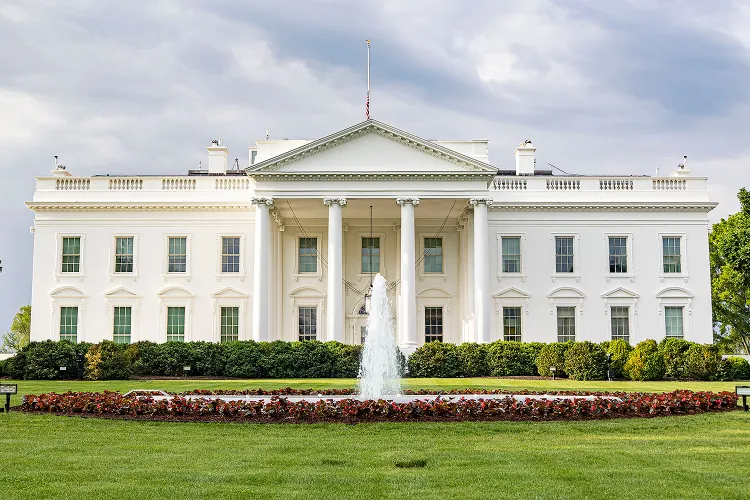

The White House complex is an architectural landmark. The original Executive Residence — photographed by thousands of visitors each day — can seem surprisingly understated for the home of the world’s most powerful leader: a clean, Neoclassical design conceived in the late 1700s.
From the North Lawn, the building still reads as a two-story façade. In reality, the structure contains multiple levels, including lower floors and upper residential areas that are largely concealed by the roofline and the site’s natural grade.
As the United States expanded its role on the world stage, the campus evolved with it. To address crowding and create more workspace within a heavily secured perimeter, the grounds were enlarged over time and key additions were made.
Those additions — most notably the West Wing (home to the Oval Office and much of the president’s staff) and the East Wing (used for the first lady’s staff and other support offices) — were designed to preserve the visual primacy of the standalone Executive Residence. Long colonnades connected the wings to the main building, with landscaping and sloped lawns helping keep those connectors subtle from street-level views.
:max_bytes(150000):strip_icc():focal(749x0:751x2):format(webp)/the-Northern-side-of-the-White-House-010926-1-adbb41a97c474bdd9f0de17bead273fd.jpg)
Over the years, the colonnades and adjacent spaces have taken on practical roles, including accommodating press operations and the briefing room on the west side, as well as family and support areas on the east side.
That long-standing balance is now facing a significant test.
During President Donald Trump’s first year back in office, he pushed for major changes to the existing White House footprint. After renovating the Oval Office and paving over the Rose Garden lawn, he launched plans for a 90,000-square-foot ballroom above the East Wing — a project whose public price estimates have risen from roughly $200 million to $400 million.
Although the project was initially framed as a build that would not disrupt the East Wing’s existing structure, the east side of the complex — including the East Colonnade and the Jacqueline Kennedy Garden — was demolished in October to clear the site.
At a National Capital Planning Commission meeting on Thursday, Jan. 8, Josh Fisher, director of the White House Office of Administration, said the administration concluded it would be more economical to raze the East Wing than to retrofit the historic structure, according to New York magazine.
Architect Shalom Baranes, who has recently taken over the project after Trump reportedly clashed with an earlier design team over the scope, presented the current plan for what the rebuilt East Wing would look like.
One of the most striking details: the new ballroom structure is expected to rise to the same height as the main residence. The Washington Post notes this would depart from long-standing norms that typically require additions to remain shorter than the primary building.
:max_bytes(150000):strip_icc():focal(749x0:751x2):format(webp)/Peter-Navarro-speaks-on-the-North-Lawn-of-the-White-House-010926-bfb3bcf894af41e2b3109f61975f9c94.jpg)
If the East Wing becomes taller, the East Colonnade would rise with it — potentially becoming visible from the street and changing the familiar silhouette that has long emphasized the central residence.
If the plans proceed as described, the Executive Residence may no longer appear as a distinct standalone structure framed by lower wings and greenery. Instead, the expanded massing could make the complex read as a more continuous, towering whole.
Baranes also told the commission his firm was “considering the idea” of adding an additional story to parts of the West Wing and West Colonnade to avoid a visibly uneven profile after the ballroom is completed.
“The reason to think about that is so that we would reinstate the symmetry around the central pavilion of the White House,” he said.
In August, Trump drew attention when he appeared atop the West Colonnade — above the press briefing room area — where a potential added story could be built. Asked by reporters what he was doing on the roof, he shouted down that he was “taking a little walk,” and suggested he was looking for “more ways to spend my money for the country.”
:max_bytes(150000):strip_icc():focal(719x284:721x286):format(webp)/white-house-east-wing-rubble-122925-107cd0ed573b4f3085a7d0851338a0ea.jpg)
Years before Trump moved into 1600 Pennsylvania Avenue, then-President Barack Obama joked that electing a high-profile real estate developer could lead to dramatic changes in the White House’s appearance.
:max_bytes(150000):strip_icc():focal(749x0:751x2):format(webp)/Donald-Trump-gestures-from-the-roof-of-the-West-Wing-of-the-White-House-010926-4f4717a44bde48cc8cde93244c92d42a.jpg)
During Obama’s remarks at the 2011 White House Correspondents’ Dinner, he said, “Say what you will about Mr. Trump, he certainly would bring some change to the White House,” referencing Trump’s longtime public flirtation with a presidential run.
:max_bytes(150000):strip_icc():focal(749x0:751x2):format(webp)/Shalom-Baranes-shows-elevation-drawings-for-a-new-400-million-White-House-ballroom-010926-3e2b701f947443e7be4de3f4e7936311.jpg)
Obama then pointed to an image shown on a screen — a parody rendering in which a tall tower loomed behind the original residence, emblazoned with “Trump” in large letters and “the White House” beneath it. The mock-up described the tower as a combined hotel, casino, and golf course, complete with a presidential suite.