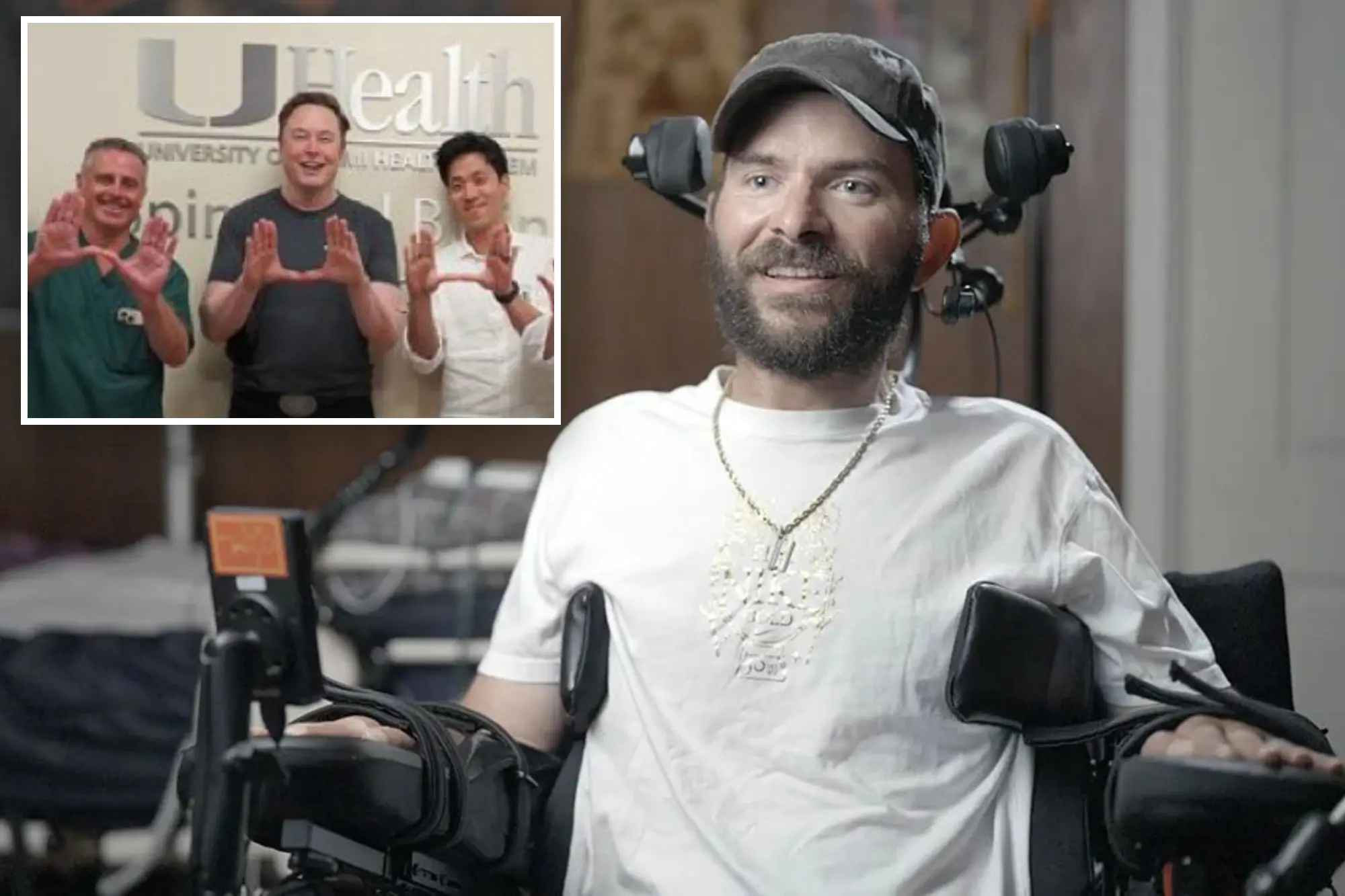

A fifth paralyzed patient has received a groundbreaking Neuralink brain implant, allowing him to control a smartphone and computer using only his thoughts.
The patient, RJ, a military veteran paralyzed in a motorcycle accident, underwent the implant procedure in April at the University of Miami. The chip, roughly the size of a coin, was surgically embedded in his brain as part of Neuralink’s PRIME clinical trial — a project aimed at giving greater independence to people with spinal cord injuries or ALS.
Since the surgery, RJ — also referred to as “P5” — has been able to operate digital devices with his mind, including his phone and television.
“My favorite thing so far? Turning on my TV by myself,” RJ told NBC 6 South Florida, describing the sense of independence the device has given him.
Neuralink, founded by Elon Musk, partnered with the Miami Project to Cure Paralysis to carry out the procedure. The surgery was led by Dr. Jonathan Jagid, who called the operation a success in its early stages.
“It’s already allowing patients to do things they otherwise couldn’t,” said Jagid.
RJ was discharged from the hospital just one day after the surgery.
“They’re giving me my spark back… my purpose,” he said. “Now, I can help reignite that drive in others going through what I did.”
Neuralink did not respond to a request for comment.
How It Works
The brain-computer interface (BCI) works by reading neural signals through tiny electrodes and converting them into digital commands. Because the chip is implanted directly into the brain, it can pick up signals with greater precision than non-invasive devices.
Neuralink’s PRIME trial — Precise Robotically Implanted Brain-Computer Interface — launched last year and has enrolled patients with severe mobility impairments.
RJ is the first Neuralink patient treated at the Miami hospital.
Future Ambitions
Neuralink has previously stated its long-term goal is to expand the implant’s capabilities, including restoring sight or speech.
“We’re hoping to implant our first device in someone who is completely blind later this year,” Musk said during a March event in Wisconsin.
“It’ll start with low-resolution vision, but over time could evolve into superhuman sight.”
Safety Questions
Despite the promising results, Neuralink has faced scrutiny from regulators and watchdog groups. A 2023 Reuters investigation revealed that the FDA had raised concerns about the implant’s safety, particularly related to:
- The lithium battery used in the device
- The risk of the ultra-thin wires migrating inside the brain
- Whether the device could be safely removed without harming brain tissue
Still, the FDA approved the company’s first human trial months after those concerns were raised.
As RJ and other participants continue testing the technology, Neuralink is positioning its implant as a potential game-changer in the field of neurotechnology — and a beacon of hope for thousands living with paralysis.