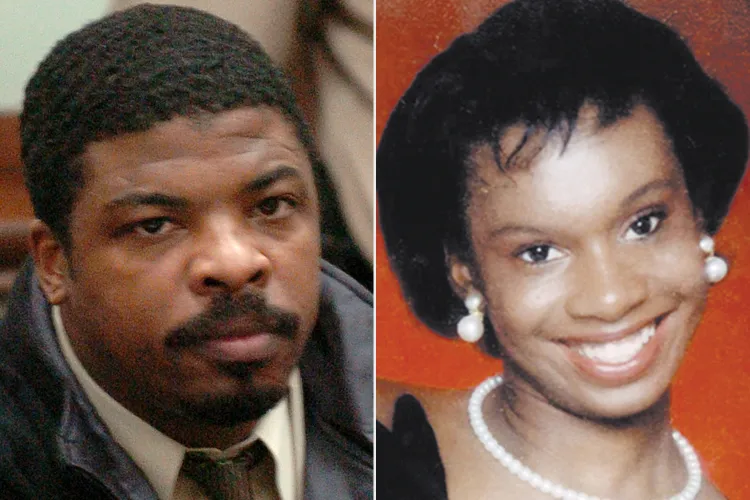

Twenty-five years after 18-year-old Jessica Currin was killed and burned behind a Kentucky school, the man convicted of her murder still says he didn’t do it. In a rare turn, Jessica’s father is now asking the courts to review the case before an important fall court date.
Jessica’s father, Joe Currin, told CNN he supports reopening the investigation. “We’ve always hoped the truth would come out. But when more people hide the truth than try to find it, it’s really hard,” he said.
The case is now covered in the latest season of the Bone Valley podcast. Hosted by Wrongful Conviction creator Maggie Freleng, Bone Valley, Season 3: Graves County takes a close look at the investigation that led to the conviction of Quincy Omar Cross, who is still in prison.
Jessica disappeared in late July 2000. Almost two weeks later, her burned and decomposed body was found behind Mayfield Middle School in Mayfield, Ky., according to CNN and court records. Investigators found a black, braided belt near her body, which became a key part of the state’s case.
Eight years later, in 2008, after the case had gone cold and then picked up again, a Hickman County jury convicted Cross of capital kidnapping, murder, first-degree rape and sodomy, tampering with physical evidence, and abuse of a corpse. He was sentenced to life without parole, according to Kentucky Supreme Court records.
“There’s no DNA, no forensics, no physical evidence linking him,” Freleng, who spent two years investigating Jessica’s case, told PEOPLE. “It’s built completely on hearsay, recanted testimony, and changing stories.”
According to CNN, Jessica spent the night of July 29, 2000, playing cards at a friend’s house with her 16-year-old cousin, Vinisha Stubblefield, before leaving to walk home.
:max_bytes(150000):strip_icc():focal(599x0:601x2):format(webp)/Jessica-Currin-091525-49dcfb9a6d6d407d9f7c9ffa5f896b75.jpg)
Stubblefield testified that she later rode in a car with Cross, Jeffrey Burton, and sisters Tamara and Victoria Caldwell. The group was reportedly high on pills, cocaine, and marijuana. She said the group offered Jessica a ride and took her to Burton’s house, where she claimed Cross hit Jessica and forced her into a back bedroom.
Stubblefield said she later saw Jessica unconscious on a bed as Cross put a belt around her neck. She claimed Burton assaulted Jessica while Cross encouraged others, including Stubblefield, to join in.
Victoria Caldwell also testified that Cross hit Jessica with a bat in the car and carried her into Burton’s house while she was unconscious. Caldwell said Jessica briefly woke up and mentioned her infant son before being struck with a metal tool and strangled with a black, braided belt.
Caldwell testified that the group wrapped Jessica’s body in a blanket, hid it in Burton’s garage, and later drove it to the middle school and set it on fire.
But Cross has always told a different story. On the Wrongful Conviction podcast, he said he was in Union City, Tenn., on July 29, driving around with friends and buying drugs before returning to Kentucky. He said he borrowed a car for cigarettes, got lost, ran out of gas, and was helped by Graves County Deputy Sheriff Mike Perkins, according to CNN.
Perks said he smelled gasoline on Cross and noticed he kept adjusting his pants because he wasn’t wearing a belt. Perkins allegedly found marijuana seeds and a gun in Cross’s car. Later, when Cross returned to Chris Drive, he was reportedly carrying “bags of powder and foil,” according to a Kentucky Innocence Project motion.
Cross was arrested on a drug charge on July 30 and said he first heard Jessica’s name after being jailed, according to CNN.
Before Cross was charged, the case had a complicated path. Police initially charged Jeremy Adams and Carlos Saxton in 2001, but those cases were dismissed in 2003 for procedural issues, according to Kentucky appellate decisions.
:max_bytes(150000):strip_icc():focal(749x0:751x2):format(webp)/joe-Currin-jean-currin-091525-af95427cf41a44abb0823b1791d352c1.jpg)
With the case cold, community members pushed authorities to make an arrest. WKMS reported that Mayfield homemaker Susan Galbreath and several teenagers gathered tips and files. BBC journalist Tom Mangold also shared leads. WKMS said their efforts helped lead to Cross’s 2008 conviction.
During the 2008 trial, the prosecution relied heavily on Caldwell and Stubblefield’s testimony. Caldwell also gave police a diary she said she wrote in 2000, which supported her statements. However, a Secret Service forensic chemist testified that the diary ink could not be matched to any commercially available 2000 formula.
Over time, both Caldwell and Stubblefield changed their accounts. “The two main eyewitnesses weren’t as reliable as the state claimed,” Freleng told PEOPLE. “They have since recanted significant parts, if not all, of their testimony.”
Jessica’s cause of death is still debated. The state medical examiner suggested possible strangulation with the belt but admitted during cross-examination that the signs weren’t clear because the body was burned and decomposed. Defense experts challenged the state’s conclusion. No DNA or lab evidence tied Cross to the belt or scene.
“The state… misled the jury by suggesting the black braided belt belonged to Quincy when there was no evidence linking it to him,” Freleng said.
“People were scared, angry, and wanted answers,” she added. “When someone offered a lead, the town wanted it to be true… Once a story formed, people had tunnel vision and were sometimes deceitful — that’s how wrongful convictions happen.”
:max_bytes(150000):strip_icc():focal(649x0:651x2):format(webp)/Maggie-Freleng-091525-489770e0ee9b46a496af16292a161a22.jpg)
After his conviction, Cross lost his direct appeal, and a 2014 post-conviction motion was denied without a hearing. He remains in Kentucky State Penitentiary. His lawyers, with the Kentucky Innocence Project, are asking a judge for a full evidentiary hearing.
“The October 23 date is to argue for a hearing,” Freleng told PEOPLE. “If the judge agrees, everything presented at the hearing will be included in the decision on whether Cross should get a new trial. Attorneys at KIP are hopeful.”
“This story has been mentally and emotionally tough,” Freleng said. “What keeps me going is the possibility of change… if an unfair system can be fixed, it’s worth it.”