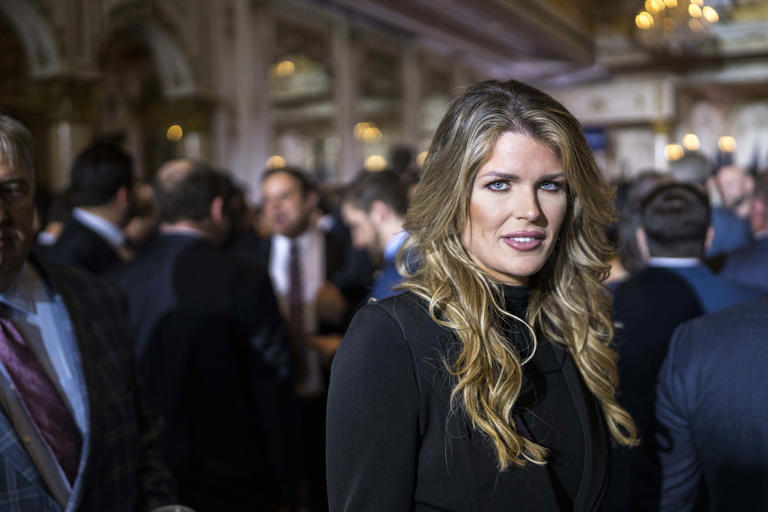

Lindsey Halligan, a Trump administration lawyer installed last year to lead the U.S. attorney’s office for the Eastern District of Virginia, left the Justice Department on Tuesday after two federal judges issued striking orders signaling they intended to replace her and warning of potential discipline for lawyers who continued to describe her as the district’s U.S. attorney in court filings.
The actions by Chief Judge M. Hannah Lauck and Judge David J. Novak — nominated by Presidents Barack Obama and Donald Trump, respectively — marked a sharp escalation in a months-long dispute that began after Halligan was disqualified from serving in the high-profile office.
Their orders also amplified a wider national clash between the executive and judicial branches over how the nation’s 93 U.S. attorneys can be placed into temporary roles without Senate confirmation. The conflict had already created significant hurdles for Halligan, who had no prosecutorial experience before taking the job, as she sought to carry out Trump’s direction to pursue criminal charges against two of his political adversaries: former FBI director James B. Comey and New York Attorney General Letitia James.
In a statement, Halligan accused the district’s federal judges of pressuring her to step aside after a court ruling found her appointment invalid. She said the push diverted “time and resources from public safety responsibilities.”
Abbe Lowell, an attorney for James who argued the case challenging Halligan’s appointment last year, called her departure “another failure in the Trump administration’s illegal attempts to install political loyalists as prosecutors,” describing it as a “fitting end to her brief and troubled tenure in office.”
It was unclear Tuesday night who would lead the office next. The Justice Department earlier this month dismissed first assistant U.S. attorney Robert K. McBride, who would ordinarily assume the role under federal law. A Justice Department spokesperson did not immediately respond to requests for comment.
Halligan is the third Trump-appointed U.S. attorney pick to step down amid a growing series of court rulings finding certain temporary appointments unlawful.
Alina Habba, a former Trump lawyer selected to run the U.S. attorney’s office in New Jersey, resigned last month following a months-long legal battle over whether she was lawfully serving. While the Justice Department continues to appeal the decision, Habba stepped down and moved into another Justice Department role.
Days later, Julianne Murray resigned as U.S. attorney in Delaware. Before her appointment, she served as the state’s Republican Party chairwoman.
Attorney General Pam Bondi praised Halligan in a statement Tuesday, saying her departure was the result of “deeply misguided” circumstances.
“While we will feel her absence keenly, we are confident that she will continue to serve her country in other ways,” Bondi said. “We are living in a time when a democratically elected President’s ability to staff key law enforcement positions faces serious obstacles.”
For weeks, several judges had suggested Halligan should resign and questioned her continued use of the U.S. attorney title after an out-of-district judge, Cameron McGowan Currie, ruled in late November that the Trump administration had used an unlawful method to install her.
On Tuesday, Lauck directed the clerk’s office to publish a job posting in local newspapers and invited applications by Feb. 10. “The position of United States Attorney for the Eastern District of Virginia is vacant,” read a public notice posted on the court’s website.
Lauck’s order signaled an active push to use a federal law that empowers district judges to appoint a U.S. attorney after an interim prosecutor has served for 120 days. Hours later, Novak followed with a warning that any lawyer who continued to represent Halligan as the district’s U.S. attorney could face disciplinary sanctions.
“No matter all of her machinations, Ms. Halligan has no legal basis to represent to this Court that she holds the position,” Novak wrote. “And any such representation going forward can only be described as a false statement made in direct defiance of valid court orders.”
The Trump administration has appealed Currie’s ruling but never sought a stay, meaning the decision disqualifying Halligan remained in effect. Still, Halligan continued to present herself as the U.S. attorney in court filings.
Earlier this month, Novak ordered Halligan to explain why she kept using the title, suggesting she might be making false or misleading statements. The Justice Department responded last week by arguing that Currie’s ruling was not binding and that Novak lacked authority to remove Halligan’s name from Justice Department filings.
Novak, in turn, said the rhetoric aimed at the court was beneath its dignity and more fitting for cable news. He described Halligan’s continued use of the title as an affront to the legal system.
“The Court cannot tolerate such obstinance, because doing so would undermine the very essence of the Rule of Law,” Novak wrote. “If the Court were to allow Ms. Halligan and the Department of Justice to pick and choose which orders that they will follow, the same would have to be true for other litigants and our system of justice would crumble.”
Halligan’s nomination for a full term remains pending in the Senate, though it was unclear Tuesday whether the White House would withdraw it. Even if it stays, the nomination appears unlikely to advance because it lacks support from Virginia’s two Democratic senators, Mark R. Warner and Tim Kaine, who have stressed that the Eastern District of Virginia manages complex cases involving national security, classified leaks, and international terrorism.
Currie’s ruling last fall concluded that Halligan was never lawfully appointed as interim U.S. attorney because the Trump administration had already appointed her predecessor, Erik S. Siebert, who served a full 120-day interim term from January to May 2025. District judges then unanimously extended Siebert at the Justice Department’s request, Novak wrote.
Siebert was pushed out in September after declining to seek charges against Comey and James. Career prosecutors had advised against both cases, citing insufficient evidence. Trump then named Halligan, who obtained indictments against Comey for allegedly making false statements to Congress and against James on a mortgage fraud accusation. Currie later threw out both indictments after finding Halligan’s appointment unlawful.
Halligan’s 120-day appointment ended Tuesday.
Justice Department lawyers argue the statute permits back-to-back interim appointments. But Currie and at least five other federal judges have rejected that view in challenges involving other Trump U.S. attorney picks, reasoning that if an attorney general could name successive interim appointees indefinitely, Senate confirmation would become largely optional.
Judges nationwide have been cautious about using their authority to install replacements. In New Jersey, federal judges named a veteran prosecutor to replace Habba last summer, only for the Justice Department to fire that pick within hours and pursue legal measures aimed at keeping Habba in place.
In Delaware, the chief judge began soliciting applications this fall to replace Murray, but Murray resigned in December before the dispute could reach a showdown. In Seattle, the chief federal judge issued an order last week seeking applications to potentially appoint a new acting U.S. attorney as the interim term there expires next month. In other districts, judges have declined to reappoint Trump’s interim picks without choosing replacements.