President Trump’s push to bring Greenland under U.S. control—paired with threatened tariffs on several European countries—has jolted the trans-Atlantic relationship and raised the risk of a costly trade fight. If retaliation escalates, the economic fallout wouldn’t stay in Brussels or Berlin. It could spread across the United States, from factory towns in the Southeast to tech hubs on the West Coast.
European officials meeting this week on the sidelines of the World Economic Forum in Davos are weighing how to respond. Options under discussion include tariffs on more than $100 billion of American goods and steps that could make it harder for U.S. multinationals to win European contracts. For Europe, already struggling with weak growth, a trade war would be deeply damaging.
Economists say a round of tit-for-tat tariffs likely wouldn’t by itself tip the U.S. into recession, but it could slow growth, strain a manufacturing sector that has already been soft, and push prices higher for consumers and businesses—at a time when the U.S. is still trying to bring inflation down to more comfortable levels.
Beyond the immediate hit, some analysts warn the bigger risk is structural: a prolonged rift could encourage Europe to reduce its reliance on the U.S. and deepen commercial ties elsewhere. That would weaken one of the world’s most important economic partnerships.
For American firms, the long-term danger is losing ground in Europe—lower sales, thinner profits, and more room for competitors, including China, said Mary Lovely, a senior fellow at the Peterson Institute for International Economics. “Once those new relationships get made, it’s very hard to change them,” she said.
A relationship deeper than goods trade
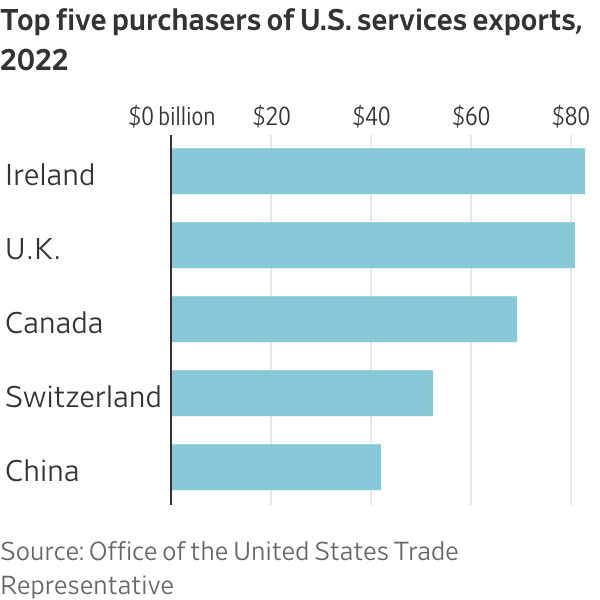
The U.S. and Europe remain tightly linked. The European Union is America’s biggest trading partner, and Europe is also the largest source of foreign direct investment in the U.S., with $3.6 trillion invested into the U.S. as of 2024. The ties run both ways: U.S. companies earn heavily in Europe, including from software, financial services, and energy exports.
“There are essentially no deeper relationships in trade,” said Philip A. Luck, director of the economics program at the Center for Strategic and International Studies. “If you look at the AI [and] data center build-out right now, that is being financed by the revenue generated from Europe and other places.”
And tariffs aren’t the only pressure point. Some analysts argue that heightened political risk could lead European investors to scale back purchases of U.S. stocks and bonds, potentially weakening the dollar, weighing on equities, and pushing U.S. borrowing costs higher. Higher rates, in turn, can suppress business investment and household spending.
Europe’s leverage—and its dilemma
Trump has used U.S. economic power to pressure both allies and rivals—and often extracted concessions. Europe, dependent on U.S. military support in the face of an aggressive Russia, has historically had strong incentives to avoid a rupture. That dynamic was evident last year, when the EU accepted a lopsided trade deal rather than risk jeopardizing U.S. backing for Ukraine’s war effort. But analysts caution it’s not guaranteed Europe will back down again.
On Saturday, Trump said he would impose 10% tariffs on Denmark, Norway, Sweden, France, Germany, the United Kingdom, the Netherlands and Finland starting Feb. 1. The tariffs would rise to 25% on June 1 if no deal to sell Greenland to the U.S. is reached by then, Trump wrote on social media. The threatened measures would hit high-profile European exports, including luxury and premium goods—from French perfumes, cheeses and wines to German automobiles.
Services and tech sit near the center of the fight
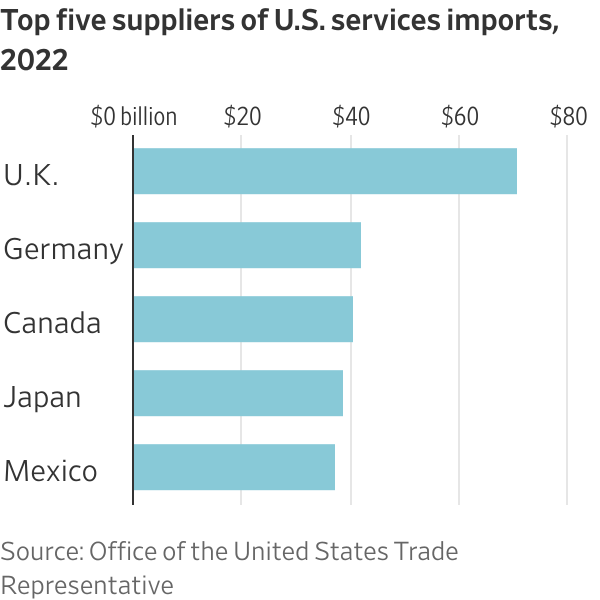
While U.S.-Europe goods trade has grown more slowly since the 2007–09 recession, U.S. services exports have expanded quickly—financial, legal, insurance, and increasingly digital services and cloud computing from major American firms such as Microsoft, Amazon, Google and IBM. The EU is the largest destination for U.S. services exports, which totaled $294.7 billion in 2024.
Sridhar Ramaswamy, CEO of U.S. cloud-software company Snowflake, said many successful tech companies draw substantial revenue from Western Europe. “Whether it is regulation or actual tariffs and taxation, I think this is very consequential,” Ramaswamy said from Davos.
Some EU leaders have suggested delaying ratification of last year’s trade deal that lowers tariffs on many U.S. exports. They are also weighing retaliatory levies. Economists say Europe’s response would likely be designed to maximize political impact—aiming at products that are visible and “symbolically significant for red states,” said Brad W. Setser, an economist at the Council on Foreign Relations. In previous disputes, the EU has targeted items like bourbon, Harley-Davidson motorcycles, and farm goods.
“Think high-end consumer goods that Europe likes but can do without,” Setser said.
When tariffs get high, trade can freeze
The economic stakes climb quickly as rates rise and retaliation broadens. Some economists argue that a 25% tariff layered on top of existing duties of 10% to 15% in some sectors could become high enough to shut down two-way trade in affected categories.
Even if Europe doesn’t retaliate, added tariffs would still likely weigh on the U.S. economy in the short term, because higher import costs tend to filter through to domestic prices.
A study from the Kiel Institute for the World Economy found that American companies and consumers paid 96% of tariff costs in 2024 and 2025, with foreign exporters absorbing just 4%. Tariffs so far haven’t produced the inflation spike many economists expected, and the U.S. economy grew at its strongest pace in two years—outperforming Europe. Still, vulnerabilities remain.
Manufacturing, in particular, could take a hit. Many U.S. factories rely on European machinery, turbines, and specialized components, and tariffs raise input costs. If Europe responds with levies on U.S. exports, American manufacturers selling into Europe could be squeezed from both directions. “It’s just another blow,” Lovely said.
A local flashpoint: South Carolina’s auto corridor
One region that could feel the strain is Spartanburg, S.C., home to a major BMW plant employing around 12,000 people and supporting tens of thousands more jobs across the state. The factory imports engines and parts from Europe and exports more than half of its vehicles, many to the EU. Retaliatory tariffs could pressure BMW to reduce U.S. output, said Stuart Pearson, head of automotive and mobility research at Oxcap Analytics.
At the same time, U.S. automakers are generally less dependent on Europe and could gain market share if tariffs make European imports less competitive, Pearson noted. Over time, higher trade barriers could also encourage more foreign manufacturers to build in the U.S.—a potential long-run boost to domestic production.
The “sell America” fear returns
European investors hold around $8 trillion of U.S. stocks and bonds—“almost twice as much as the rest of the world combined,” Deutsche Bank’s George Saravelos wrote in a report published Sunday.
“In an environment where the geoeconomic stability of the Western alliance is being disrupted existentially, it is not clear why Europeans would be as willing to play this part,” he added.
Wall Street has heard variations of this story before. Early last year, concerns about a potential “sell America” moment surfaced after signals that the Trump administration was wary about Europe’s defense—and later as tariff threats spread to broader global imports. Those fears ultimately faded: foreign demand for U.S. assets stayed strong, the S&P 500 posted its third straight year of double-digit gains, and U.S. Treasurys remained the world’s core safe haven.
Rich Nuzum, an executive at Franklin Templeton, said markets have become less reactive to tariff headlines. “There was a point in time when the market really cared about tariff announcements. That’s no longer the case,” he said. “The market believes that this will get worked through. It may be noisy, it may be disruptive, it may be scary, but that it will get worked through.”
The biggest escalation: Europe’s “Bazooka”
The sharpest turn would come if Europe used its anti-coercion instrument—often nicknamed “the Bazooka”—which could target U.S. services and investment. Under that scenario, the EU could raise taxes, intensify regulatory scrutiny, or otherwise constrain American companies operating in Europe.
That risk extends beyond tech. Pharmaceuticals could be hit because U.S. firms often route R&D through places like Ireland and manufacture active ingredients there, allowing profits to be booked in lower-tax jurisdictions. Big technology companies face similar exposure. Apple, for example, holds significant intellectual property and records a large share of global profits in Ireland, even though many devices are manufactured in China and sold worldwide.
“The businesses of the world’s most profitable companies have a significant European leg,” Setser said. If Europe moves against that, he added, it could mean lower global profits for U.S. companies, weaker stock market valuations—especially in tech—and less capacity to invest in areas such as artificial intelligence.