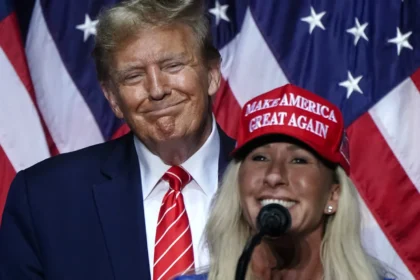
Heading into the Fourth of July weekend, President Donald Trump was riding high.
Aides described the stretch as one of the most successful of his presidency—possibly across both terms. The Supreme Court had just limited federal judges’ use of nationwide injunctions, clearing the way for Trump to revive long-stalled campaign promises, including plans to end birthright citizenship. At the same time, Congress passed a sweeping bill that bore his imprint—extending tax cuts, pouring billions into border enforcement, and slashing major welfare programs.
Abroad, the president had ordered a limited strike on Iran and secured a major NATO concession: members would increase defense spending to 5% of GDP. Wall Street rallied in response, with the S&P 500 hitting new highs. By July 4, Trump’s approval rating approached 50%—and among Republicans, his numbers soared past 80%. The fireworks over Washington, D.C., seemed to reflect a presidency firmly in control.
But within days, all of that changed—triggered not by Democrats or the media, but by Trump’s own supporters.
An Explosive Expectation
For months, Trump’s base had eagerly awaited the long-hyped “Epstein files.” Attorney General Pam Bondi had stoked the fire in February, publicly declaring the client list was on her desk. She even handed out labeled binders—The Epstein Files: Phase 1—to conservative influencers in a flashy White House photo op.
Then, nothing.
On July 7, following the holiday lull, the DOJ quietly released a terse, unsigned memo. It claimed no Epstein client list existed, no foul play was suspected in Epstein’s death, and that no additional records would be released. The department also dropped 11 hours of prison surveillance video—but there was a mysterious one-minute gap.
Instead of ending the conversation, the memo ignited a full-blown revolt.
Conservative figures from Laura Loomer to Tucker Carlson condemned the release as a “cover-up.” Dan Bongino, the deputy FBI director and former media firebrand, reportedly confronted Bondi in a closed-door meeting, threatening to resign. Trump’s effort to defend Bondi on Truth Social—calling Epstein “someone nobody cares about”—only poured fuel on the fire. It was the first time one of his posts was ratioed on his own platform.
Political Fallout
As pressure mounted, House Speaker Mike Johnson abruptly ended the legislative session and sent lawmakers home early. Public polling showed the damage was real: Quinnipiac found 63% of voters disapproved of Trump’s handling of the Epstein memo, and support among young male voters—once a critical demographic—collapsed. A CBS/YouGov poll found his approval among 18-to-29-year-olds dropped 27 points since February.
Even influential voices like Joe Rogan and Andrew Schulz, once aligned with Trump’s online ecosystem, began voicing their discontent. Social media saw a wave of red MAGA hats burned on video. Others posted memes mocking the now-infamous “Phase 1” binder with captions like: Where’s Phase 2?
As left-leaning commentator Thom Hartmann put it, the backlash wasn’t just political—it was psychological. “Many Trump supporters built their identities around the belief that he would expose hidden truths. When those expectations go unmet, it feels like betrayal.”
A Desperate Diversion
The Trump White House scrambled to change the subject. Communications staff even issued an official response to a satirical South Park episode mocking the president. In the span of two weeks, Trump accused Barack Obama of treason, demanded the Washington Commanders revert to their old team name, hinted at repurposing Alcatraz for federal prisoners, and released long-sealed assassination records.
Nothing stuck.
With no further Epstein revelations forthcoming—and key figures in Trump’s orbit either silent or lashing out—the backlash hasn’t let up. As one former administration official told Newsweek, “He’s used to weathering media storms. But this one is coming from inside the house.”
Whether the fury fades or deepens may depend on what happens next. But for now, the president finds himself in uncharted territory: under siege from his most loyal supporters, and unable—for once—to change the narrative.