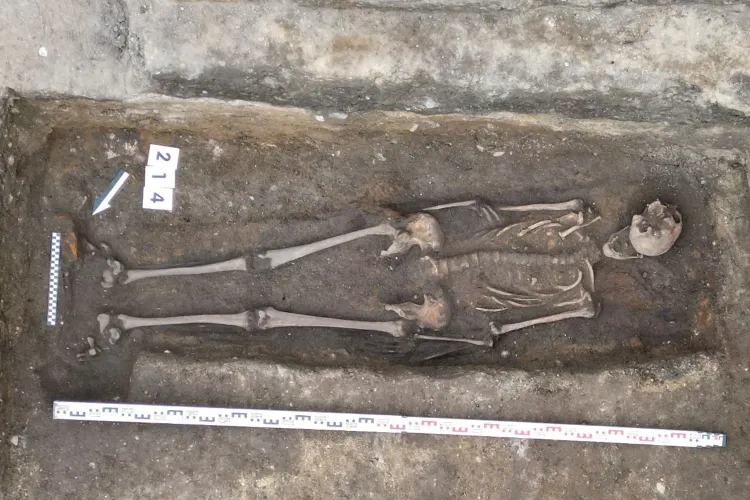

Archaeologists in northern Poland have uncovered what they believe to be the remains of a medieval knight—hidden for centuries beneath what was once a neighborhood ice cream parlor.
The tomb was discovered on July 8 beneath a street corner in Gdańsk, a historic city on the Baltic coast, according to a statement from Poland’s Provincial Council for the Protection of Monuments.
A translated report on the city’s official website dates the grave to the 13th or 14th century.
Based on the remains, archaeologists estimate the knight stood about 5 feet, 6 inches tall and was likely around 40 years old when he died.
The man is believed to have been a knight due to a hand-carved limestone tombstone marking the grave. The engraving depicts a figure holding a shield—an indication of military or noble status.
Popular Mechanics reported that while the carved shield once bore a coat of arms, it has been worn away over time, making it difficult for experts to identify whom the knight may have served.
In 1308, the Teutonic Knights seized control of Gdańsk, but researchers say the buried knight might have instead served under the Sobieslaw dynasty or possibly a German noble house.
The excavation is being carried out by ArcheoScan, a Polish archaeological company that began studying the site in 2023. The dig was made possible after a longtime ice cream shop that operated on the property for 60 years was sold to developers. Under Polish law, any development on historic land must be preceded by archaeological surveys—a process coordinated with Science in Poland.
Earlier surveys at the location revealed the remnants of a large wooden church, more than 200 burials, and six carved tombstones, according to the outlet.
“What we’re unearthing here is insane,” archaeologist Sylwia Kurzyńska told the Polish Associated Press, as cited by Science in Poland. She added that fragments of the knight’s chainmail boot and leggings had also survived.
The knight’s tombstone and skeletal remains have since been transferred to the Archaeological Museum in Gdańsk for further analysis, Smithsonian Magazine reported.
Researchers hope to uncover more about the knight’s identity and background and plan to release additional findings in the coming year.