
The Department of Homeland Security on Wednesday formally rolled out a new immigration enforcement operation in New Orleans, the latest Democrat-led city to see a surge of Border Patrol agents as part of President Trump’s mass deportation agenda.
DHS said the initiative is called “Catahoula Crunch,” confirming plans first reported by CBS News in mid-November. At that time, CBS News revealed that Border Patrol intended to send roughly 200 agents to New Orleans to run operations targeting people suspected of living in the U.S. without legal status. Internal agency documents also showed that officials requested armored vehicles for the effort.
Speaking with CBS News outside the U.S. Customs and Border Protection office in New Orleans on Wednesday, Border Patrol Commander Gregory Bovino said agents would remain in the city “until the mission is accomplished,” adding that they had arrested “a lot, and still counting.” Bovino said there are now “several hundred agents” stationed across the New Orleans area.
In a statement earlier Wednesday, DHS spokeswoman Tricia McLaughlin said New Orleans was chosen because of local rules that limit cooperation between city law enforcement and federal immigration authorities.
“‘Catahoula Crunch’ targets include violent criminals who were released after arrest for home invasion, armed robbery, grand theft auto, and rape,” McLaughlin said. “Under President Trump and Secretary [Kristi] Noem, we are restoring law and order for the American people.”
Catahoulas are Louisiana’s official state dog.
Two U.S. officials told CBS News that DHS has asked the Department of Defense for permission to use Naval Air Station Joint Reserve Base New Orleans as a staging site for immigration enforcement activities.
Coinciding with DHS’ announcement, the FBI’s New Orleans field office said it is working with the Louisiana State Police to protect the federal immigration agents deployed to the region and to crack down on “attempts to obstruct law enforcement actions.”
Earlier this week, Mr. Trump said he plans to send National Guard troops to New Orleans for a separate anti-crime mission “in a couple of weeks,” though the administration has not provided a specific date. Louisiana Gov. Jeff Landry, a Republican, has embraced the plan, arguing that National Guard support is needed to address violent crime.
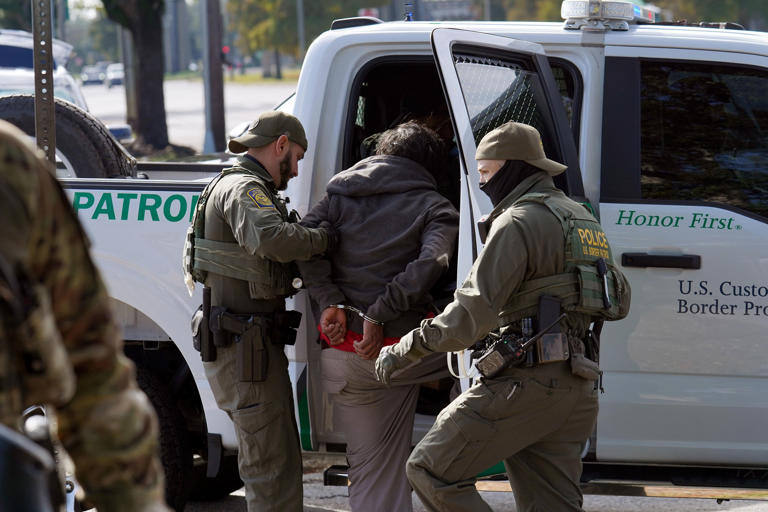
The New Orleans operation is the latest in a series of large-scale immigration enforcement efforts under Trump’s second term in Democratic-controlled cities. The administration has already deployed hundreds of Border Patrol agents to urban areas far from the southern border, including Los Angeles, Chicago and Charlotte, North Carolina.
These deployments, led by the controversial Commander Bovino, have drawn sharp backlash from some local residents and elected officials. Critics have accused Bovino and his agents of stoking tensions through aggressive arrests and heavy-handed tactics against protesters and bystanders. A federal judge in the Chicago area concluded that Border Patrol’s use of force there had been excessive.
Supporters, however, portray Bovino as a tough enforcer of the president’s mass deportation campaign. He has defended his agents’ conduct, including their use of force against protesters, arguing that it was warranted in response to violent actions by some individuals.
The question of who is actually being arrested in these operations has become another flashpoint. In Los Angeles, Chicago and Charlotte, Border Patrol agents have been captured on video breaking car windows and detaining day laborers and other workers during “roving patrols” in Home Depot parking lots and other public spaces.
While Bovino and other Trump administration officials insist that Border Patrol is primarily focused on immigrants in the country illegally who have committed serious crimes, CBS News reported last month that in the Charlotte area, of roughly 270 arrests, fewer than 90 detainees — about one-third — were classified as criminals.