
President Donald Trump’s administration announced it is revoking the security clearances of 37 current and former national security officials, citing concerns over the “politicization or weaponization of intelligence.”
Why It Matters
The move is part of a broader effort by the White House to penalize officials it views as hostile to its objectives. It has also reignited debate over whether security clearances are being used as a political tool.
In March, Trump revoked the security clearances of several political opponents, including former President Joe Biden, former Vice President Kamala Harris, former Secretary of State Hillary Clinton, former Representatives Liz Cheney and Adam Kinzinger, and New York Attorney General Letitia James.
What To Know
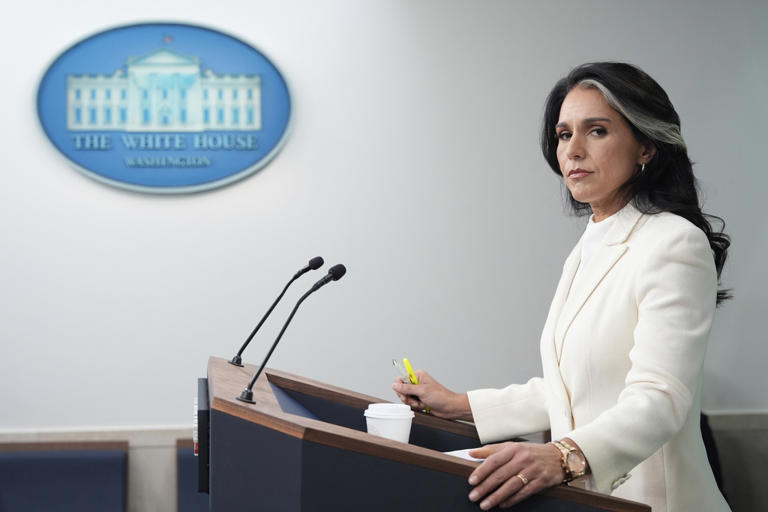
In a memo posted on X, Director of National Intelligence Tulsi Gabbard accused the individuals of “manipulating intelligence, leaking classified intelligence without authorization, and/or committing intentional egregious violations of tradecraft standards.”
Gabbard added: “Being entrusted with a security clearance is a privilege, not a right. Those in the intelligence community who betray their oath to the Constitution and put their own interests ahead of the interests of the American people have broken the sacred trust they promised to uphold. In doing so, they undermine our national security, the safety and security of the American people and the foundational principles of our democratic republic.”
The memo did not provide evidence to support these claims. It stated that the affected individuals engaged in actions such as: “Politicization or weaponization of intelligence to advance personal, partisan, or non-objective agendas inconsistent with national security priorities; failure to safeguard classified information in accordance with applicable laws, regulations and agency policies; failure to adhere to professional analytic tradecraft standards; and other conduct detrimental to the trust and confidence required for continued access to national security information.”
The 37 individuals affected include: Andrew Cedar, Andrew P. Miller, Benjamin A. Cooper, Beth E. Sanner, Brett M. Holmgren, Charles A. Kupchan, Christopher Center, Corinne A. Graff, Dilpreet K. Sidhu, Edward Gistaro, Emily J. Horne, Harry Hannah, Heather R. Gutierrez, Jamie S. Jowers, Jeffrey M. Prescott, Joel T. Meyer, Joel Willett, John W. Ficklin, Julia S. Gurganus, Julia Santucci, Loren DeJonge Schulman, Luke R. Hartig, Maher B. Bitar, Mark B. Feierstein, Mary Beth Goodman, Megan F. Doherty, Michael P. Dempsey, Perry J. Blatstein, Richard H. Ledgett, Samantha E. Vinograd, Sarah S. Farnsworth, Shelby L. Pierson, Stephanie O’Sullivan, Thomas W. West, Vinh X. Nguyen, William J. Tuttle, and Yael Eisenstate.
The memo noted that these individuals would immediately lose access to classified systems, facilities, materials, and information, and that any related contracts or employment would be terminated. Agencies are required to report to the Office of the Director of National Intelligence once the revocations are completed.
Many of those affected left government service years ago, according to The Associated Press, and some were involved in matters that have long frustrated Trump, including investigations into Russian interference in the 2016 presidential election.
What People Are Saying
Gabbard wrote on X that the intelligence community must remain committed to the values of the U.S. Constitution while focusing on its mission to ensure the safety, security, and freedom of the American people.
The memo emphasized that intelligence professionals must remain nonpartisan, fact-driven, and committed to truth. “Holding a clearance is a privilege, not a right, and this privilege is contingent upon continued adherence to the principles and responsibilities of our profession. Any betrayal of these standards compromises not only our mission, but also the safety and security of the American people,” it said.
Mark Zaid, a national security lawyer whose own clearance was previously revoked by Trump, told The Associated Press, “These are unlawful and unconstitutional decisions that deviate from well-settled, decades-old laws and policies that sought to protect against just this type of action.”