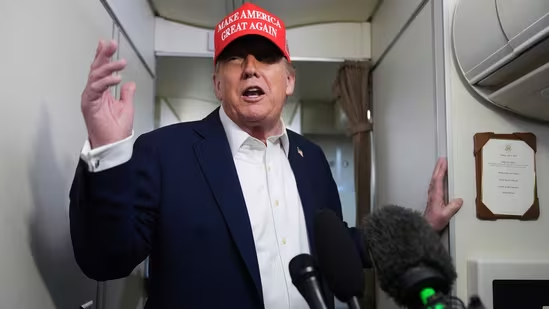

President Donald Trump ramped up pressure on U.S. trading partners Monday, issuing tariff ultimatum letters to leaders of 14 countries, warning of steep new duties set to take effect August 1—with China notably excluded from the deadline extension.
The move follows Trump’s signing of an executive order Monday that delays the rollout of the so-called “reciprocal” tariffs—which were initially slated to begin Wednesday—giving most nations more time to negotiate. However, the reprieve does not apply to China, which remains under an earlier enforcement timeline.
While the White House confirmed some countries will face higher or lower rates than those announced in April, most of the letters maintained or increased the proposed tariffs. Asked whether the new August 1 deadline was fixed, Trump said, “I would say firm, but not 100% firm,” adding he’s open to talks if countries “want to do something a different way.”
Japan and South Korea Face 25% Tariff
The first letters went to Japan’s Prime Minister Shigeru Ishiba and South Korean President Lee Jae-myung, informing them of a 25% tariff set to begin August 1. Despite the warning, both nations signaled they’re ready to keep negotiating. Japan said it’s working toward a bilateral trade agreement, while South Korea pledged to closely monitor developments and hinted at “bold” countermeasures if needed.
Trump later announced similar letters had been sent to leaders in Malaysia, Kazakhstan, South Africa, Myanmar, and Laos, with some tariffs reaching as high as 40%. Hours later, he posted seven more letters online, bringing the total to 14. The newly added countries included Tunisia, Bosnia and Herzegovina (facing a 30% tariff), Indonesia, Bangladesh, Serbia, Cambodia, and Thailand.
Tariffs Tied to Trade Deficits and Market Barriers
In each letter, Trump cited the U.S. trade deficit with the respective country, accusing them of selling more to America than they buy and imposing policies that restrict American exports. He urged leaders to move manufacturing to the U.S. to avoid the new tariffs.
The letters come just ahead of Trump’s original July 9 deadline—set for 12:01 a.m. ET—for countries to make deals or face new penalties. Since April, the U.S. has levied a minimum 10% tariff on affected imports, with reciprocal rates paused temporarily.
A White House official clarified that these new country-specific tariffs will not stack on top of existing sectoral tariffs like the 25% auto duty, but could be adjusted higher if retaliation occurs.
EU Not on the List—Yet
Despite frequent clashes with the European Union over trade, no EU country has received a letter—at least publicly. “We’re not going to comment on letters that we haven’t received,” a European Commission spokesperson said. However, Irish Foreign Minister Simon Harris said both sides appear to have agreed to maintain the status quo until August 1 to allow time for negotiations.
Global Reactions Mixed
Many of the 14 nations have welcomed the delay, viewing it as a window to avert deeper trade disruptions:
- Japan’s PM Ishiba convened a cabinet meeting Tuesday, expressing “regret” over the tariffs but vowing continued engagement with Washington.
- South Korea’s finance ministry warned it would act swiftly if markets become unstable.
- Thailand’s finance minister said Bangkok has submitted a “good faith” proposal and hopes for a better deal.
- Malaysia’s trade ministry echoed similar optimism, calling for a “balanced and mutually beneficial” agreement.
- South Africa’s President Cyril Ramaphosa criticized the 30% tariff rate as based on “inaccurate trade data” but said diplomacy would continue.
CNN has reached out to foreign ministries in Indonesia, Cambodia, Myanmar, Kazakhstan, and Bangladesh for comment.
Billions in Trade at Stake
The 14 countries targeted in Monday’s letters exported $465 billion in goods to the U.S. last year, according to Commerce Department data. Japan and South Korea alone accounted for 60% of that total, with top exports including automobiles, semiconductors, pharmaceuticals, and machinery.
Some examples of what’s at stake:
- South Africa, facing a 30% tariff, was the top U.S. source of platinum last year.
- Malaysia, hit with a 24% tariff, ranked second in semiconductor shipments to the U.S., worth $18 billion.
- Bangladesh, Cambodia, and Indonesia are major suppliers of clothing and accessories to American markets.
Notably, Cambodia’s 36% tariff is down 13 points from the rate originally proposed in April, before the pause.
Markets React: Stocks Fall
Markets slid as Trump unveiled the first batch of letters and continued to decline with each additional announcement:
- S&P 500 dropped 0.79%, posting its worst day in three weeks.
- Dow Jones fell 422 points (0.94%).
- Nasdaq Composite declined 0.92%.
Auto stocks were among the hardest hit. U.S.-listed shares of Toyota dropped 4%, Nissan fell 7.16%, and Honda slid 3.86%, reflecting investor fears that auto tariffs could increase further if Japan or South Korea retaliate.
In a closing note of ambiguity, each of Trump’s letters ended with a warning:
“These tariffs may be modified, upward or downward, depending on our relationship.”
Asian markets opened flat Tuesday, as the world watches to see whether more tariffs—or more diplomacy—will follow.