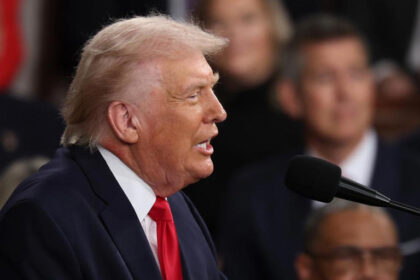
President Donald Trump delivered the longest State of the Union address in American history on Tuesday, February 24, 2026, presenting a defiant defense of his second-term agenda. While a flash CNN poll conducted by SSRS indicates the speech resonated with a majority of its viewers, the findings reveal a stark disconnect between the President’s “rosy” economic outlook and the lived reality of an American public grappling with a persistent cost-of-living crisis.
The address, which clocked in at approximately 1 hour and 48 minutes, served as a critical pivot point for a White House facing sagging approval ratings and a high-stakes midterm election cycle.
Flash Poll: High Marks from a Friendly Audience
According to the CNN/SSRS poll, 64% of speech-watchers had a positive reaction to the address. This figure is a notable jump from the 54% who felt his policies would benefit the nation prior to the speech. However, analysts caution that these figures may not reflect the broader national sentiment. The audience for the address was roughly 13 percentage points more Republican than the general public, creating a “home-field advantage” for the 79-year-old President.
Despite the immediate post-speech bump, the data underscores a precarious political standing:
- Approval Rating: Just days before the address, Trump’s general job approval stood at a meager 36%.
- Independent Exodus: Support among Independents has cratered to 26%, a 15-point drop from the same period last year.
- Policy Direction: Before the speech, 61% of Americans believed the country was moving in the “wrong direction.”
The “Affordability Gap” and Economic Skepticism
While Trump touted “plummeting” inflation and gas prices below $2.30 per gallon in many states, his rhetoric faced immediate scrutiny. Federal data shows that while headline inflation eased to 2.4% in January, the prices for core essentials like housing, electricity, and groceries remain significantly higher than four years ago.
The poll revealed a glaring vulnerability in the President’s economic narrative:
- 45% of the audience—despite being Republican-heavy—admitted Trump is paying “too little attention” to the cost of living.
- 40% of viewers expressed “no confidence” in the administration’s ability to make life more affordable.
- Tariff Tension: Listeners were nearly evenly split on the President’s aggressive use of tariffs, particularly following a recent Supreme Court ruling that struck down some of his trade measures as an overstep of executive power.
Immigration and National Security Take Center Stage
In a bid to shore up his base, Trump leaned heavily into “peace through strength” and hardline border policies. He claimed a “colossal victory” regarding military intervention in Venezuela and reiterated his “zero tolerance” stance on illegal immigration.
The poll suggests these themes remain his strongest pillars, with 62% of viewers agreeing his immigration strategies align with the national interest. However, the address largely avoided the growing controversy surrounding recent federal enforcement actions in Minnesota, which resulted in the fatal shooting of two U.S. citizens by immigration agents in January.
A Look Ahead: The Midterm Battleground
The 2026 State of the Union was less a legislative roadmap and more a campaign manifesto. By focusing on culture war “hobby horses” and base mobilization, the President signaled that his strategy for the upcoming midterms will rely on turning out his most loyal supporters rather than expanding his appeal to a skeptical center.
With Democrats already seizing on the “affordability gap” in their rebuttal, the next six months will likely be defined by a battle over whose economic reality the American voter believes: the President’s “turnaround for the ages” or the checkbook pressure felt at the kitchen table.
Would you like me to draft a follow-up analysis focusing on the specific legislative proposals, such as the “SAVE America Act” or the “TrumpRX” healthcare framework mentioned in the address?