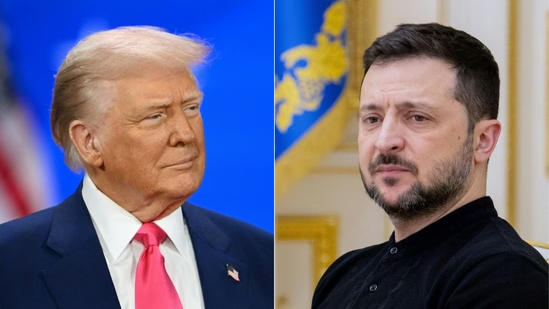

Retired Lt. Gen. Keith Kellogg, U.S. President Donald Trump’s special envoy to Ukraine and Russia, arrived in Kyiv on Monday, signaling a potential turning point in the Trump administration’s approach to the war in Ukraine. A senior Ukrainian official confirmed Kellogg’s visit as expectations rise for a broader shift in U.S. policy following intensifying Russian attacks.
Though Trump has often highlighted his cordial relationship with Russian President Vladimir Putin and claimed Moscow was more willing than Kyiv to reach a peace agreement, his tone has hardened in recent months.
Trump, who had promised a “major statement” on Russia, has grown visibly frustrated with Putin’s continued escalation. After Russia ramped up aerial assaults on Ukrainian cities, including Kyiv, Trump lashed out on social media in May, saying Putin “has gone absolutely CRAZY!” and urging him to “STOP!”
“I’m very disappointed with President Putin,” Trump said on Sunday. “He’ll talk so beautifully, and then he’ll bomb people at night. We don’t like that.”
U.S. to Send Patriot Missiles, EU to Cover Costs
In a notable shift, Trump confirmed that the U.S. will send Patriot air defense missiles to Ukraine to help repel Russia’s growing aerial offensives. He added that the European Union will compensate the U.S. for “various pieces of very sophisticated” weaponry—though EU treaties prohibit direct arms purchases. Instead, individual EU nations are funding supplies and replenishing stockpiles through the European Peace Facility.
Russia’s strikes have become increasingly deadly. According to the U.N. human rights mission, June saw the highest monthly civilian toll in three years, with 232 deaths and over 1,300 injured. Ukrainian air defenses are struggling to keep up as Russia has increased its use of drones and ballistic missiles tenfold compared to the same time last year.
Trump Ally Graham: “Putin Played the Wrong Hand”
Sen. Lindsey Graham, a key Trump ally, said the conflict is reaching a decisive moment, suggesting Trump is now ready to ramp up U.S. aid to Ukraine—despite having previously criticized such efforts as wasteful.
“In the coming days, you’ll see weapons flowing at a record level to help Ukraine defend themselves,” Graham told CBS’ Face the Nation. “Putin miscalculated by trying to play Trump. There will be a massive effort to bring him to the table.”
Meanwhile, Kremlin investment envoy Kirill Dmitriev claimed that Russia remains open to dialogue with Washington, dismissing what he called “doomed-to-fail pressure tactics.”
NATO Chief Rutte in D.C. for High-Level Talks
As Kellogg landed in Kyiv, NATO Secretary-General Mark Rutte began his visit to Washington. Rutte is scheduled to meet with President Trump, Secretary of State Marco Rubio, Defense Secretary Pete Hegseth, and members of Congress to discuss NATO’s role, defense aid, and the broader regional security situation.
In Kyiv, the head of President Zelenskyy’s office, Andrii Yermak, said talks with Kellogg would focus on security cooperation, sanctions, civilian protection, and enhanced bilateral defense ties.
“Russia does not want peace. President Trump believes in peace through strength, and we fully support that,” Yermak stated.
Russia Escalates Strikes as Diplomacy Intensifies
On the ground, the war continues to exact a heavy toll. Early Monday, Russian forces launched a deadly strike on the northern Ukrainian city of Shostka, killing two and injuring four—including a 7-year-old child—using glide bombs and drones, according to prosecutors.
Overnight, Ukraine’s air force reported downing 61 Shahed drones and jamming 47 others out of a total 136 launched. Russia also fired multiple S-300/400 missiles.
Russia’s Defense Ministry claimed its air defenses intercepted 11 Ukrainian drones targeting regions near the border, Crimea, and the Black Sea.
As both diplomacy and military activity intensify, Trump’s evolving stance—and Kellogg’s visit—could mark a pivotal shift in how the U.S. approaches the deadliest European conflict in decades.