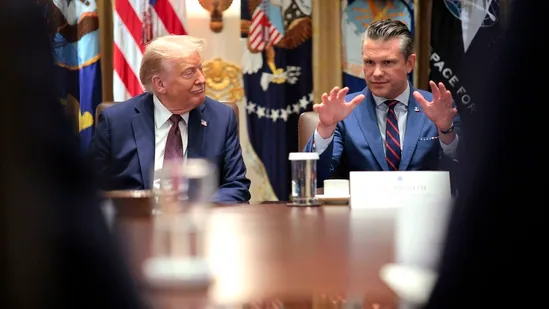

President Donald Trump and Defense Secretary Pete Hegseth are set to meet with hundreds of U.S. military officials in person on Tuesday, following a sudden order from the Pentagon for top commanders around the world to assemble at Marine Corps Base Quantico in Virginia. The Pentagon has not disclosed the reason for the gathering, sparking speculation in Washington and abroad.
The meeting comes as the U.S. faces the threat of a government shutdown and as Hegseth continues to make sweeping and sometimes unexplained moves, including reductions in the number of general officers and the removal of several senior military leaders.
While such meetings between senior military leadership and civilian officials are not unusual, the scale, urgency, and secrecy of this event have drawn attention.
“The notion that the secretary is going to talk to the generals and give them his vision for running the department — and maybe also for strategy and organization — that’s perfectly reasonable,” said Mark Cancian, a senior adviser at the Center for Strategic and International Studies and a retired Marine colonel. “What’s mystifying is why it’s on such short notice, why it’s in person and what else might be involved.”
News of the meeting first surfaced Thursday. Pentagon spokesman Sean Parnell confirmed it but declined to share details. Asked about it the same day, Trump said he was unaware of the plans but added, “I’ll be there if they want me, but why is that such a big deal?”
By Sunday, the White House confirmed that Trump would also deliver remarks. The president later told NBC News that he and Hegseth would be “talking about how well we’re doing militarily, talking about being in great shape, talking about a lot of good, positive things.”
Vice President JD Vance downplayed the development, arguing last week that the media had exaggerated its importance. “It’s not particularly unusual that generals who report to Hegseth are coming to speak with him,” Vance said.
Still, some allies have noted its rarity. Italian Adm. Giuseppe Cavo Dragone, chair of NATO’s Military Committee, said during a NATO meeting in Riga, Latvia, “As far as my 49 years of service, I’ve never seen that before.”
Analysts say the lack of transparency has fueled speculation. Michael O’Hanlon of the Brookings Institution suggested the gathering may serve a symbolic role as much as a substantive one. “Just the sheer scale makes you wonder what kind of meaningful interaction can occur. And therefore it smacks more of theatrics or of trying to impose than of trying to exchange views,” he said.
Bryan Clark of the Hudson Institute predicted the meeting will highlight the Trump administration’s evolving defense strategy. According to Clark, the U.S. military is preparing to focus less on Europe and Asia and more on the Northern Hemisphere — a significant departure from decades of precedent.
Hegseth has been outspoken about expanding the military’s domestic role, from securing the U.S.-Mexico border to deploying in American cities during law enforcement surges, and overseeing Caribbean strikes the administration describes as targeting drug traffickers.
“I think they’re trying to set the tone, set the context, for these generals and admirals to say the strategy we have coming out is very different than what you’re used to — we need you to all be on board with it,” Clark said.
He added that convening leaders in person, rather than relying on video teleconferencing across time zones, underscores the significance. “It’s a way of demonstrating that this is important.”