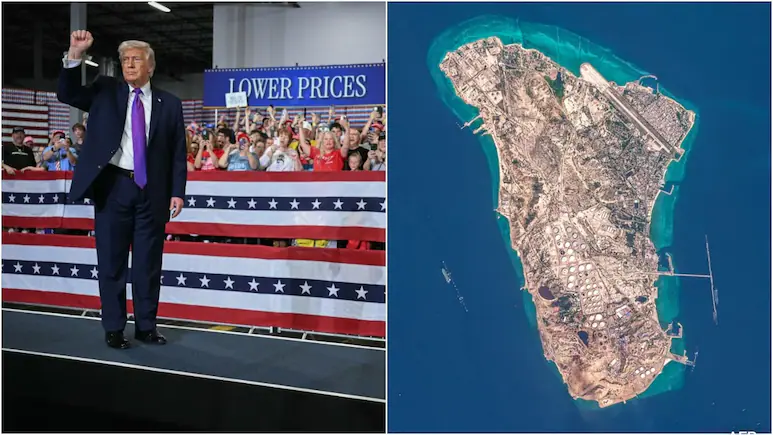

WASHINGTON — President Donald Trump is considering a high-stakes military operation to seize Iran’s Kharg Island, a move that would put U.S. “boots on the ground” inside Iranian territory for the first time in the current conflict.
Sources familiar with the administration’s internal deliberations told Axios on Monday that the President is increasingly inclined toward a ground assault to secure the island, which he has described as the “crown jewel” of Iran’s economy. The proposed seizure aims to force an “economic knockout” of the Tehran regime by physically controlling the terminal responsible for roughly 90% of Iran’s crude oil exports.
The deliberations come as the White House struggles to break a weeks-long maritime blockade of the Strait of Hormuz, which has choked off a fifth of global oil supplies and sent crude prices soaring above $105 per barrel.
Operation Epic Fury: From Airstrikes to Occupation
The possible shift to a ground campaign follows a series of massive precision strikes on Friday. Under Operation Epic Fury, U.S. Central Command (CENTCOM) reportedly “obliterated” over 90 military targets on Kharg Island, including naval mine storage and missile bunkers, while intentionally sparing oil infrastructure.
However, the administration’s strategy appears to be evolving from deterrence to direct control.
“There are big risks. There are big rewards,” a senior U.S. official said. “The president isn’t there yet, and we’re not saying he will be, but if tankers remain bottled up, it’s a live option.”
Senator Lindsey Graham (R-SC), a leading hawk on the Hill, publicly endorsed the escalation on Monday, stating that “he who controls Kharg Island controls the destiny of this war.”
The “Hormuz Coalition” and Allied Hesitation
Simultaneously, President Trump is working to assemble a “Hormuz Coalition” to reopen the strait later this week. The administration is reportedly pressuring allies including Japan, France, South Korea, and the U.K. to contribute warships to escort commercial tankers.
The diplomatic push has met significant resistance:
- Japan and Australia have reportedly declined to send naval vessels for escort duty.
- South Korea is currently reviewing its options amid fears of Iranian retaliation.
- The International Energy Agency (IEA) warned that the current crisis is the largest supply disruption in market history, cutting global supply by roughly 10 million barrels per day.
Escalation Risks and Regional Fallout
The move to seize Kharg Island carries extreme geopolitical risks. Military analysts warn that a U.S. occupation could trigger Iranian retaliatory strikes against energy infrastructure across the Gulf, specifically targeting Saudi Arabian pipelines and UAE desalination plants.
Despite the aggressive rhetoric from Washington, Israel—America’s primary regional ally—has sought to distance itself from the prospect of a full-scale invasion. Speaking in New Delhi, Israeli Ambassador Reuven Azar emphasized that neither Jerusalem nor Washington intends a permanent military occupation.
“The focus remains on encouraging change within Iran through pressure from its own people,” Azar said, framing the current military actions as a means to weaken the regime’s “oppression forces.”
Economic Deadlock
For the Trump administration, Kharg Island represents the ultimate leverage. Located 19 miles off the Iranian coast, the 8-square-mile island is the cornerstone of the Iranian Revolutionary Guard’s (IRGC) revenue stream.
As long as the Strait of Hormuz remains “effectively closed,” the global energy crisis continues to threaten the U.S. domestic economy. If the “Hormuz Coalition” fails to materialize or reopen the shipping lanes by week’s end, the White House may view the physical capture of the “Crown Jewel” as the only remaining path to ending the deadlock.