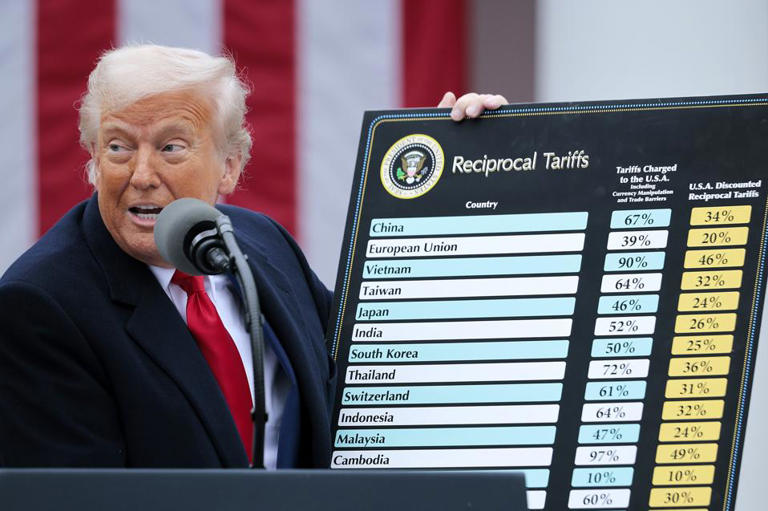

President Donald Trump on Sunday claimed his tariffs have brought in “trillions of dollars.” While that figure matches some economists’ long-term projections, it does not reflect the actual revenue collected so far this year.
Key Facts
“Without tariffs, and all of the TRILLIONS OF DOLLARS we have already taken in, our Country would be completely destroyed, and our military power would be instantly obliterated,” Trump wrote on Truth Social.
Earlier this month, Trump also said “trillions of dollars are being taken in on tariffs” and argued his policies have not caused inflation, but instead brought “massive amounts of CASH pouring into our Treasury’s coffers.”
However, tariffs are not paid by foreign governments. They are paid by U.S. companies that import foreign goods. Those costs are often passed down to American consumers through higher prices.
Trump’s remarks came after a ruling late Friday from the U.S. Court of Appeals. The court found Trump overstepped his authority by issuing reciprocal tariffs, saying that power was “vested exclusively” as a “core Congressional power.”
The ruling will not take effect until October 14, giving the Trump administration time to appeal to the Supreme Court.
How Much Revenue Has Been Collected?
The U.S. has collected $142 billion in tariff revenue so far this fiscal year, which ends in September, according to Treasury Department data. Since Trump’s tariffs began in April, they have generated about $96 billion. Customs duties jumped to $28 billion in July, a 273% increase from the previous year. In June, customs duties brought in $27 billion, $22 billion in May, and $16 billion in April.
By comparison, customs duties before the tariffs were much lower—$8 billion in March and $7 billion in both February and January. These duties are essentially taxes importers pay when bringing goods into the U.S., costs that usually end up being felt by consumers.
How Much Could Tariffs Generate?
Treasury Secretary Scott Bessent recently told MSNBC he expects tariffs could bring in $300 billion each year, possibly even more by 2026.
The Tax Foundation projects Trump’s tariffs could raise about $2.5 trillion over the next decade. But the group also warned that the levies could increase household costs by nearly $1,300 in 2025 and $1,700 in 2026.
The Committee for a Responsible Federal Budget, a nonpartisan group, estimated Trump’s tariffs could add $2.8 trillion to the U.S. economy by fiscal year 2034 if they stay in place.
Have Tariffs Affected Inflation?
Inflation eased to 2.7% in July, though core prices—excluding food and energy—rose 3.1% year over year, tying the highest rate this year. Economists say Trump’s tariffs appear to have raised prices and could push costs higher later in the year.
JPMorgan Chase economist Michael Feroli warned that the tariffs could lead to “meaningfully larger increases” in consumer prices. Federal Reserve Chair Jerome Powell also noted last month that while the economy remains strong, the full effects of tariffs on growth and inflation “remain to be seen.”
Possible Rebate Checks
Trump said last month his administration might consider sending checks to Americans based on tariff revenue.
Following that idea, Sen. Josh Hawley (R-Mo.) introduced a bill that would provide at least $600 to each eligible adult and child this year. If revenue exceeds expectations, the rebate could be higher. However, the bill also lowers payments for higher earners—for example, about $570 for joint filers making over $150,000.
The proposal has not yet been voted on in Congress.