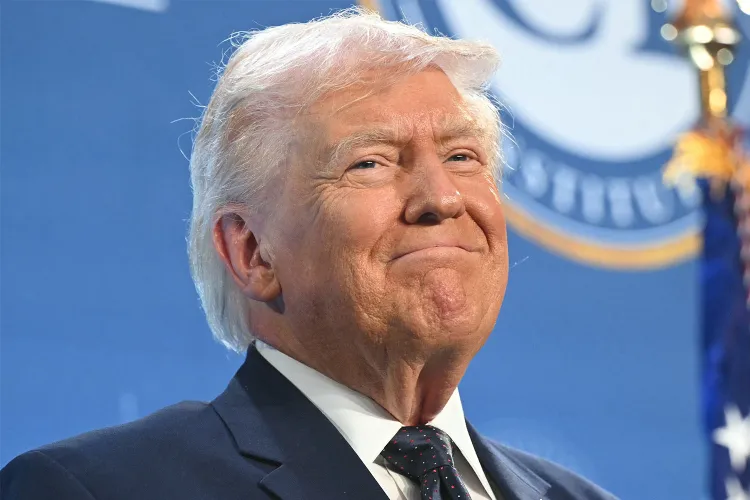

In a series of high-profile addresses spanning from Pennsylvania to the Capitol, President Donald Trump has pivoted his economic narrative toward a “crushing” victory over inflation. However, a deep dive into federal labor statistics and market indices reveals a more complex reality: while the rate of price increases has decelerated, the “affordability squeeze” on the American household remains historically tight.
During his 2026 State of the Union address, the President asserted that his administration’s policies are “rapidly ending” the era of high costs, claiming that for many sectors, “prices are plummeting downward.” He further contended that the primary upward trajectory in the current economy belongs to “the stock market and your 401(k).”
The Statistical Disconnect: Disinflation vs. Deflation
The administration’s optimism finds its strongest footing in the Consumer Price Index (CPI). As of January 2026, the annual inflation rate cooled to 2.4%, a significant retreat from the 9.1% peak seen in mid-2022.
However, economists warn against conflating disinflation (a slower rate of price increases) with deflation (an actual drop in prices). For the average consumer, the “plummet” described by the Oval Office hasn’t materialized at the checkout counter. Since 2020, essential costs have seen a permanent step-change:
- Groceries: Up approximately 30%
- Electricity: Surged 41%
- Auto Insurance: Spiked 56%
“The rate of increase is slowing, which is a positive metric, but the price plateau is significantly higher than it was four years ago,” says one senior market analyst. “Voters don’t feel the ‘percentage change’; they feel the absolute dollar amount leaving their bank accounts.”
The Fed’s Hawkish Pause
Despite the President’s celebratory tone, the Federal Open Market Committee (FOMC) remains cautious. In its most recent policy statement, the Federal Reserve characterized inflation as “somewhat elevated,” maintaining interest rates at their current levels rather than proceeding with anticipated cuts.
The central bank’s hesitation is underscored by two primary volatility drivers:
- Geopolitical Instability: The ongoing conflict in Iran has injected fresh volatility into global energy markets, threatening to reverse progress on gas prices.
- Wage Parity: While the President highlighted “bigger paychecks,” Bureau of Labor Statistics data shows a 3.3% wage increase through late 2025—effectively neutralizing inflation but failing to provide the “dramatic” increase in purchasing power claimed by the administration.
The “401(k)” Defense: Markets as a Hedge
Trump’s most statistically accurate claim rests on Wall Street. Retirement accounts saw a robust recovery through 2025, with the average 401(k) balance hitting an all-time high of $144,400 in Q3.
Yet, even this “win” is under scrutiny. Both the S&P 500 and Nasdaq have signaled a cautious start to 2026, retracting slightly as investors weigh the risks of a prolonged high-interest-rate environment and Middle Eastern instability.
Investor Strategy: Navigating the “Affordability Squeeze”
For those looking to safeguard wealth against a backdrop of political rhetoric and “elevated” inflation, market experts point toward three institutional-grade hedges:
- Gold as a Non-Fiat Anchor: With a nearly 80% surge over the last 12 months, gold remains the preferred diversifier for hedge fund titans like Ray Dalio. Unlike currency, the “yellow metal” cannot be devalued by central bank printing.
- Real Estate Appreciation: Despite high mortgage rates, property values (measured by the Case-Shiller Index) have jumped nearly 40% over five years. Modern platforms now allow for fractional ownership in multifamily and industrial sectors, providing a hedge that adjusts alongside rising rents.
- The Index Fund Standard: Following Warren Buffett’s long-standing directive, the S&P 500 continues to be the benchmark for consistent, long-term growth, allowing investors to capture the earnings of the 500 largest U.S. companies as they pass on costs to consumers.
While the administration markets a “plummeting” cost of living, the data suggests a period of “sticky” prices. For the American consumer, the path forward involves less reliance on political promises and more on strategic diversification into assets that historically outpace the CPI.