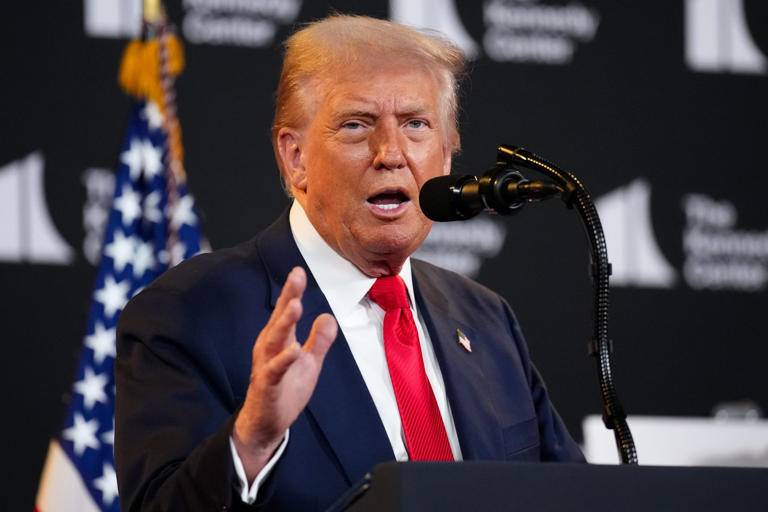

President Donald Trump’s tariff increases are projected to generate enough revenue to reduce federal deficits by $4 trillion over the next decade, according to the latest analysis from the Congressional Budget Office (CBO).
The nonpartisan agency said its updated estimates of tariff revenues are part of a short-term economic forecast for 2025 through 2028, scheduled for release on Sept. 12.
The report shows that the higher tariffs—covering a wide range of imports including goods from China, Mexico, Canada, and the European Union, as well as automobiles and steel—have pushed effective tariff rates up by roughly 18 percentage points compared to last year. If those levels hold, primary deficits would decline by $3.3 trillion, while lower interest costs on the national debt would add another $700 billion in savings, for a total of $4 trillion over 10 years.
Tariffs and Deficit Reduction
By boosting revenue, tariffs reduce the need for federal borrowing, which in turn lowers interest payments on the national debt. The findings represent a major revision from the CBO’s June outlook, which estimated a $2.5 trillion reduction in deficits and $500 billion in lower interest payments. The agency said the updated forecast relies on the same methodology, using data from the Census Bureau, Customs and Border Protection, and the Treasury.
The analysis also notes that tariff revenue may help offset new costs from recent tax and spending measures such as the One Big Beautiful Bill Act (OBBBA), which the CBO estimates will increase deficits by $3.4 trillion. Still, the agency cautioned that future tariff revenues could be affected by ongoing legal challenges and shifting trade negotiations.
Broader Economic Picture
The federal debt now stands at roughly $37 trillion. Rising debt levels continue to fuel concerns about higher interest rates and borrowing costs. Lawmakers are also approaching a government funding deadline at the end of September, which will intensify debates over fiscal policy and deficit management.
Outside government, the Committee for a Responsible Federal Budget (CRFB) has estimated that if Trump’s tariffs remain permanent, they could shrink the deficit by as much as $2.8 trillion over the next decade. The group described the revenue impact as both “meaningful” and “significant.”
Even so, CRFB has previously warned that tariffs alone would not cover the costs of OBBBA, and it has modeled scenarios where large portions of the tariffs could be struck down in court. The group said the nation’s fiscal outlook has worsened since January, but the CBO’s sharply higher deficit-reduction projection challenges that assumption.
Still, the question remains: who ultimately bears the cost of tariffs? Economists frequently note that tariffs operate much like a sales tax, raising prices for U.S. consumers. In that sense, the deficit savings ultimately come from households themselves.
While Trump and his allies argue that tariffs provide a way to reduce deficits without raising direct taxes on American families, critics continue to warn about potential downsides—higher consumer prices, weaker trade relationships, and risks of escalating global tensions. The CBO stressed that its forecast depends on current policies holding steady and could shift if trade rules change in the years ahead.