
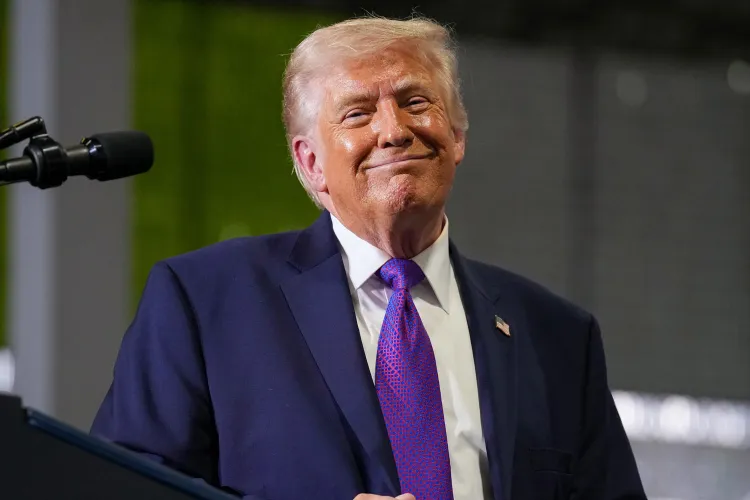

President Donald Trump intensified his intra-party warfare this week, using a campaign-style event to level scathing personal attacks against Kentucky Representative Thomas Massie while citing his family’s academic pedigree as evidence of his own “better blood.”
The President’s remarks, delivered during a speech purportedly focused on the economy and the ongoing conflict between Israel and Iran, highlight a widening rift within the Republican Party over executive war powers and the disclosure of sensitive federal records.
A Bitter Primary Challenge
The confrontation began when President Trump pivoted from Middle East policy to address Rep. Massie (R-KY), one of only two House Republicans who recently broke ranks to support an Iran war powers resolution. The resolution seeks to restrict the administration’s ability to engage in military action without explicit congressional authorization.
“Massie is a complete and total disaster as a congressman and frankly as a human being,” Trump told the Hebron crowd. “He is mad, disloyal to the Republican Party, disloyal to the people of Kentucky, and most importantly, disloyal to the United States of America.”
The President concluded the broadside by calling for Massie’s immediate removal from office, signaling a high-stakes endorsement of a primary challenge.
:max_bytes(150000):strip_icc():focal(749x0:751x2):format(webp)/donald-trump-thomas-massie-072225-60af1e2e59a843a09e176fc2bdae53ce.jpg)
‘Better Blood’: The MIT Connection
In an unusual rhetorical turn, Trump contrasted his intellectual standing with Massie’s, referencing his uncle, the late Dr. John G. Trump, a longtime professor at the Massachusetts Institute of Technology (MIT).
“My uncle was the longest-serving professor… at MIT… 41 years,” the President said. “That means I have much better blood.” He further bolstered his credentials by citing his own alma mater: “I went to the hardest college of all to get into, the Wharton School of Finance. That means I’m real smart.”
The “better blood” comment has reignited discussions regarding the President’s frequent use of hereditary traits to explain his leadership and intelligence. However, the President’s specific claims regarding his uncle’s tenure at MIT have been subject to recent clarification by the university.
:max_bytes(150000):strip_icc():focal(749x0:751x2):format(webp)/mit-campus-121625-fa86c3ed0afc4dc9b18847a3df9746bc.jpg)
Fact Check: The MIT Record and the ‘Unabomber’ Claim
This week’s speech follows a pattern of misleading statements regarding the President’s late uncle. Investigative reviews of the President’s previous remarks in Pennsylvania (July 2025) reveal several factual discrepancies:
- Tenure Duration: While the President repeatedly identifies John G. Trump as the “longest-serving professor in the history of MIT,” the university has officially corrected this. An MIT spokesperson confirmed that while the elder Trump was a “highly valued member” of the community, he was among the longest-serving, not the single record-holder.
- The Kaczynski Link: During the 2025 Pennsylvania event, the President claimed that Theodore “Ted” Kaczynski, the notorious “Unabomber,” was one of his uncle’s students.
- The Reality: Records show no such connection. Kaczynski attended Harvard University and the University of Michigan, not MIT. Furthermore, Kaczynski’s identity as the Unabomber was not revealed until 1996—eleven years after John G. Trump’s death in 1985.
The Epstein Files Friction
Beyond the war powers resolution, sources indicate the animosity between the President and Rep. Massie is fueled by Massie’s aggressive push for the full release of the Jeffrey Epstein investigative files. The congressman has frequently used his platform to demand total transparency regarding the deceased financier’s high-profile associates, a move that has reportedly caused friction within the administration.
As the 2026 election cycle approaches, the President’s focus on Kentucky suggests that loyalty to the executive branch—rather than traditional party platforming—will be the primary litmus test for Republican incumbents.


