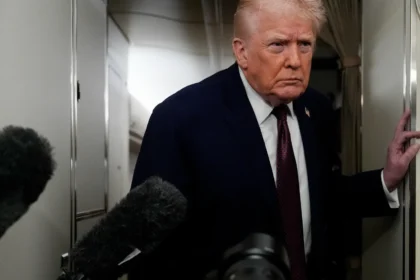
U.S. President Donald Trump escalated tensions with Japan for a third consecutive day, threatening to slap tariffs of up to 35% on Japanese goods — a move that alarmed global markets and cast doubt on the trajectory of trade talks between Washington and Tokyo.
“Japan should be paying 30%, 35%, or whatever we decide — because we have a massive trade deficit with them,” Trump said, floating the idea that blanket tariffs could far exceed the 24% figure initially suggested for implementation on July 9. “I’m not sure we’ll get a deal. Probably not. Japan’s tough — very spoiled,” he added.
Market Reacts to Tariff Threats
Analysts and market watchers cautioned against interpreting Trump’s rhetoric too literally, noting his history of aggressive negotiating tactics. Still, the warning has rattled investor confidence and raised concerns that Japan’s strategy of maintaining a calm, cooperative posture is pushing both sides closer to a standoff.
“There’s a real risk of a U.S. blow-up that triggers harsh punitive actions,” said Kurt Tong, a former senior U.S. diplomat now with The Asia Group. “If that happens, Japan might have to retaliate with targeted countermeasures.”
Japan’s benchmark Nikkei 225 dipped 0.6% to close at 39,762 on Wednesday, while the yen weakened slightly to 143.88 against the dollar. Analysts said the index could fall to the 38,000 range — a 4% drop — if talks collapse, though few expect a total market rout.
Pressure on Japan’s Auto Industry
Central to the dispute are U.S. demands that Japan accept across-the-board reciprocal tariffs — including on autos, steel, and aluminum — while Japan insists all such duties be lifted as part of a comprehensive agreement. Auto exports are particularly vulnerable: the sector makes up nearly 10% of Japan’s GDP and employs roughly 8% of its workforce.
Prime Minister Shigeru Ishiba has maintained that Japan won’t accept a “bad deal,” especially with the July 20 upper house elections looming. On Wednesday, he reiterated that Japan’s investments in U.S. industry and jobs should count for something.
“Japan is the world’s largest investor in the U.S. and the biggest contributor to American jobs,” Ishiba said. “That makes us fundamentally different from other trade partners.”
Diplomacy at a Crossroads
With the July 9 deadline approaching, some observers say Japan must do more to sway Trump personally. Former Japanese Ambassador to the U.S. Ichiro Fujisaki emphasized the need to appeal to the president directly.
“We need to influence Trump himself and head off these tariffs,” Fujisaki said. “We don’t have rare earths, but the U.S. depends on Japan’s semiconductor materials — that’s real leverage.”
The implications of failed talks could be severe. According to Bloomberg Economics, if Japan is forced to pay tariffs up to 35% on top of the 24% rate announced on so-called “Liberation Day” — currently suspended at 10% — the GDP hit could reach 1.2%, twice the damage under current levies.
Political Theater or Real Threat?
Some analysts view Trump’s tariff threats as part of his high-stakes negotiation playbook — used effectively with China in the past — designed to pressure other nations into last-minute concessions.
“There’s definitely an element of theater here,” said Phillip Wool, portfolio manager at Rayliant Global Advisors. “Trump wants to look tough. But eventually he’ll need a face-saving deal that avoids mutual destruction.”
Wool warned against panic selling based on Trump’s comments, noting that any major selloff could be a buying opportunity for long-term investors.
Yen Outlook and Interest Rates
Strategists are divided on how the yen might respond in a worst-case scenario. Some, like SBI Liquidity Market’s Marito Ueda, believe safe-haven flows could strengthen the yen to the 138 level. Others expect the opposite — that trade tensions and delayed Bank of Japan rate hikes could push the currency weaker beyond 145.
Akira Moroga, chief strategist at Aozora Bank, said a prolonged impasse would likely stall any rate increases and slow momentum beyond the 147 mark.
Deal Still Expected — But On U.S. Terms
Despite the bluster, most observers expect a deal to eventually materialize — though one skewed in Washington’s favor.
“If we get an agreement, it won’t be a win-win,” Fujisaki said. “It’ll be a big, bold ‘WIN’ for the U.S. and a lowercase ‘win’ for Japan.”