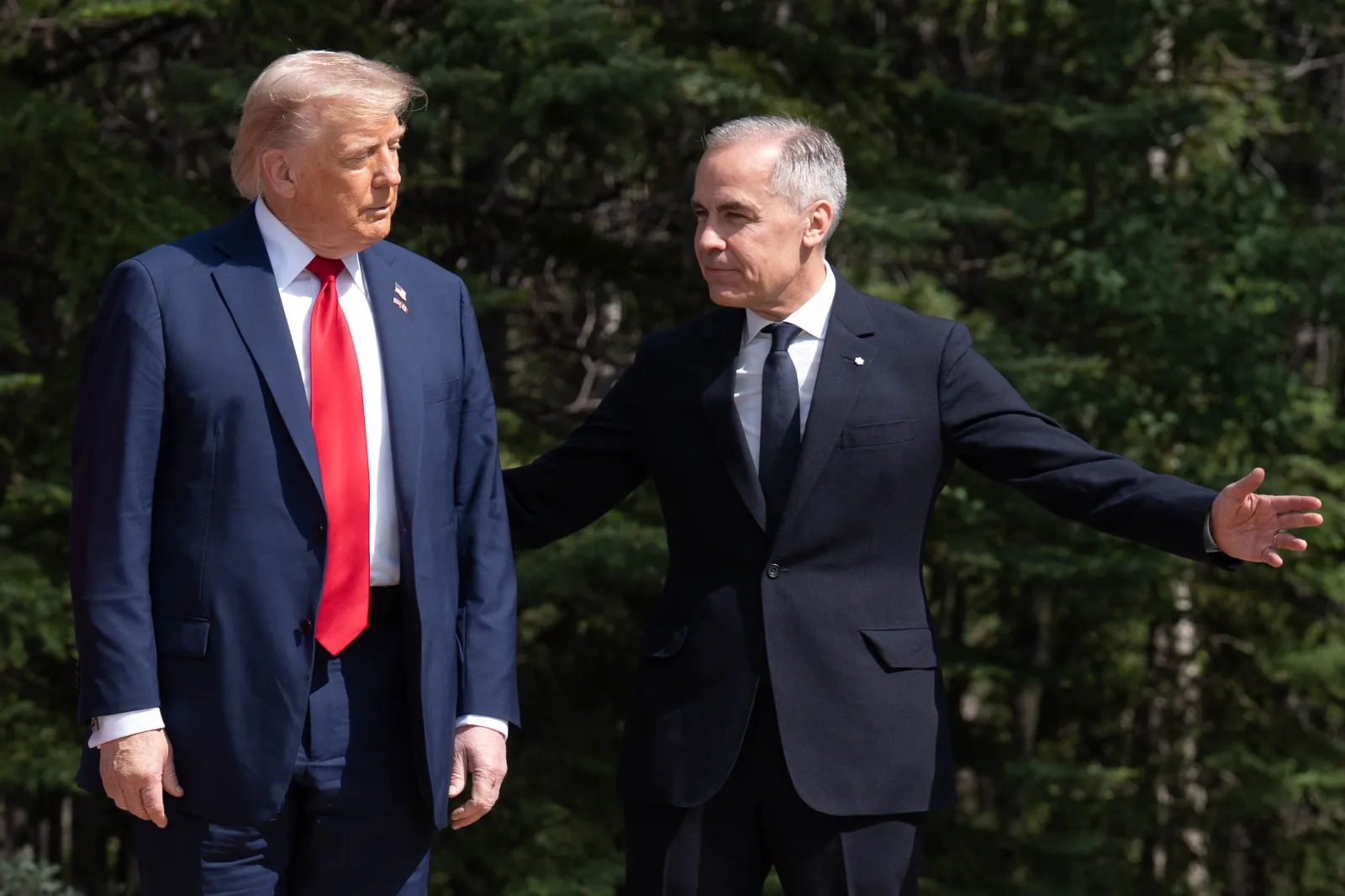

President Donald Trump threatened to impose a 100 percent tariff on all Canadian imports if Canada moves forward with a trade agreement with China.
“If Governor Carney thinks he is going to make Canada a ‘Drop Off Port’ for China to send goods and products into the United States, he is sorely mistaken. China will eat Canada alive, completely devour it, including the destruction of their businesses, social fabric, and general way of life,” Trump wrote on Truth Social.
“If Canada makes a deal with China, it will immediately be hit with a 100% Tariff against all Canadian goods and products coming into the U.S.A.,” he added.
Trump has repeatedly referred to Canada’s prime minister, Mark Carney, as a “governor”—language that matches his broader rhetoric suggesting Canada should become the 51st U.S. state. Canada has pushed back on that idea.
Carney recently returned from China, where he met with President Xi Jinping—Canada’s first prime ministerial trip to China in eight years. Canadian officials said the visit was meant to reduce tensions and rebuild ties after a long stretch of strained relations, while also expanding Canada’s trade options as tariff threats and trade pressure from the United States intensify.
Why It Matters
Since Trump returned to the White House, he has repeatedly threatened—and in some cases implemented—tariffs aimed at Canadian goods. His latest warning, tied directly to Canada’s outreach to China, signals an escalation in the trade conflict between two neighboring allies.
Canada’s push to deepen economic engagement with China is also being read as a hedge: an attempt to diversify trade relationships amid uncertainty and friction with the U.S.
What To Know
Earlier this month, Prime Minister Mark Carney announced a new “strategic partnership” between Canada and China designed to expand trade and investment, with a focus on agriculture, agri-food, energy, and finance.
Last week, the two countries finalized an agreement that would allow 49,000 Chinese electric vehicles into the Canadian market at a reduced tariff rate of 6.1 percent, in exchange for China lowering tariffs on Canadian canola exports.
Trump initially told reporters outside the White House that Carney’s agreement was something he “should be doing” and called it “a good thing” for him to sign—before appearing to shift his stance on Saturday with the threat of sweeping tariffs.
Aggressive tariff threats and trade penalties have been a defining feature of Trump’s economic approach, which he has framed as protecting U.S. industry and countering what he calls unfair trade practices. Canada, China, and the European Union have all been frequent targets under that strategy.
What People Are Saying
Trump said at Davos: “Canada gets a lot of freebies from us, by the way. They should be grateful, also, but they’re not. I watched your prime minister yesterday. He wasn’t so grateful. Canada lives because of the United States. Remember that, Mark, next time you make your statements.”
Carney said at Davos: “Middle powers must act together because if you are not at the table, you are on the menu. Great powers can afford to go it alone. They have the market size, the military capacity, the leverage to dictate terms.”
Eric Miller, a Washington DC based trade adviser, told BBC News: “The prime minister is saying, essentially, that Canada has agency too, and that it’s not going to just sit and wait for the United States.”
What Happens Next
It’s still unclear whether—or how soon—Trump would move to implement the threatened 100 percent tariffs on Canadian goods if Canada proceeds with a trade deal with China.