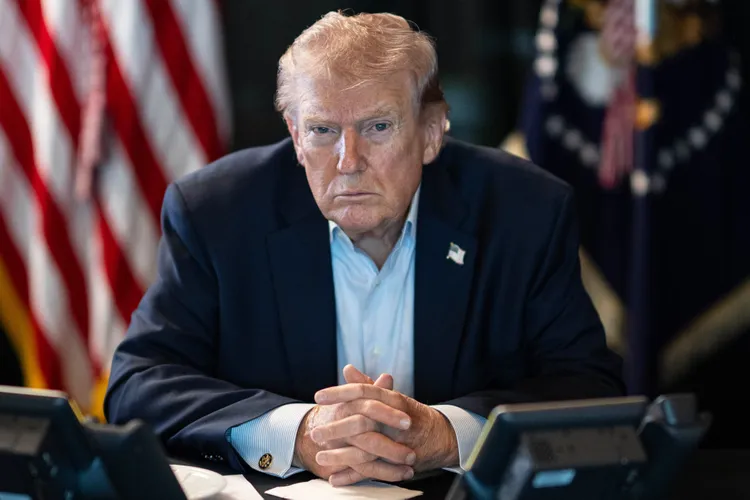

WASHINGTON — President Donald Trump has issued a formal demand for a seven-nation naval coalition to deploy warships to the Strait of Hormuz, escalating pressure on global allies to secure the world’s most critical energy chokepoint. The move comes as a three-week-old war between a U.S.-Israeli alliance and Iran has effectively shuttered the waterway, sending Brent crude prices soaring past $105 per barrel.
Speaking to reporters aboard Air Force One on Sunday, Trump asserted that the United States would no longer carry the primary burden of policing the Persian Gulf. He identified a coalition of nations—including China, France, Great Britain, Japan, and South Korea—as those with the greatest “territorial” and economic interest in reopening the passage.
“I’m demanding that these countries come in and protect their own territory, because it is their own territory,” Trump said, referring to the heavy reliance of Asian and European economies on Middle Eastern crude. “China gets about 90% of its oil from the strait, while the U.S. gets a minimal amount. We don’t need it, but they do.”
A Chokepoint Under Siege
The Strait of Hormuz, a 21-mile-wide artery through which approximately 20% of the world’s petroleum flows, has been in a state of “functional closure” since March 2. Intelligence reports indicate that commercial transits have plummeted by more than 80% following a series of Iranian drone and missile strikes on tankers.
| Key Stat | Impact of Conflict (as of March 16, 2026) |
| Brent Crude Price | $105.00+ per barrel |
| Hormuz Traffic | Down 80-85% |
| Vessels Attacked | At least 18 since Feb 28 |
| Global LNG Flow | 25% of seaborne supply disrupted |
Military analysts suggest that while the U.S. has significantly degraded Iran’s conventional naval assets, Tehran has successfully utilized “asymmetric” tactics—including GPS jamming, sea mines, and shore-based suicide drones—to make the waterway uninsurable for commercial operators.
Allies Hesitate Amid Escalation Risks
Despite the White House’s urgent rhetoric, the international response has been characterized by caution and, in some cases, outright refusal.
- Japan: Prime Minister Sanae Takaichi informed Parliament on Monday that Tokyo has “no plan” to dispatch naval vessels, citing constitutional constraints and the need for further legal review.
- Australia: Canberra confirmed it has not been formally asked and does not intend to contribute military hardware to the reopening effort.
- United Kingdom: Prime Minister Keir Starmer has discussed “options” with the White House but has so far only committed to exploring the use of mine-hunting drones.
- European Union: Kaja Kallas, the EU’s foreign policy chief, stated the bloc is weighing an expansion of its existing Aspides mission, though member states remain divided on entering a high-intensity combat zone.
The reluctance stems from a fear of being “dragged” into a broader regional war. Iran’s new Supreme Leader, Mojtaba Khamenei, warned last week that any vessel belonging to “enemies or their allies” would be targeted. Tehran has notably offered “safe passage” to Chinese vessels, a move seen by many as an attempt to fracture the proposed U.S.-led coalition.
Fact-Check: The “U.S. Doesn’t Need the Oil” Claim
Trump’s assertion that the U.S. is energy-independent enough to ignore the Hormuz closure is only partially accurate. While the U.S. is a net exporter of petroleum, global oil is a fungible commodity. A sustained closure of the Strait would drive up domestic gasoline prices and trigger a global recessionary shock that would inevitably hit American consumers.
Furthermore, U.S. Secretary of Defense Pete Hegseth noted that the U.S. Navy is already “dealing with” the threat, though the administration appears to be using the threat of a full withdrawal of escort services as leverage to force allied participation.
Investigative Outlook: What Happens Next?
The standoff in the Gulf is entering a critical phase. With Dubai International Airport recently targeted by drone strikes and GPS spoofing reaching “critical” levels, the risk of a catastrophic maritime accident is at an all-time high.
Trump is expected to meet with Prime Minister Takaichi on Thursday to personally press the case for Japanese involvement. If a coalition fails to materialize, the administration has signaled it may escalate its bombing campaign against Iranian coastal infrastructure to “forcibly” clear the waterway—a move that would mark a significant expansion of the current conflict.