
President Donald Trump on Tuesday praised his own handling of the U.S. economy, claiming he has reversed the “disaster” left by his predecessor and awarding current conditions an “A+++++” grade — even as many Americans say 2025 still feels financially difficult.
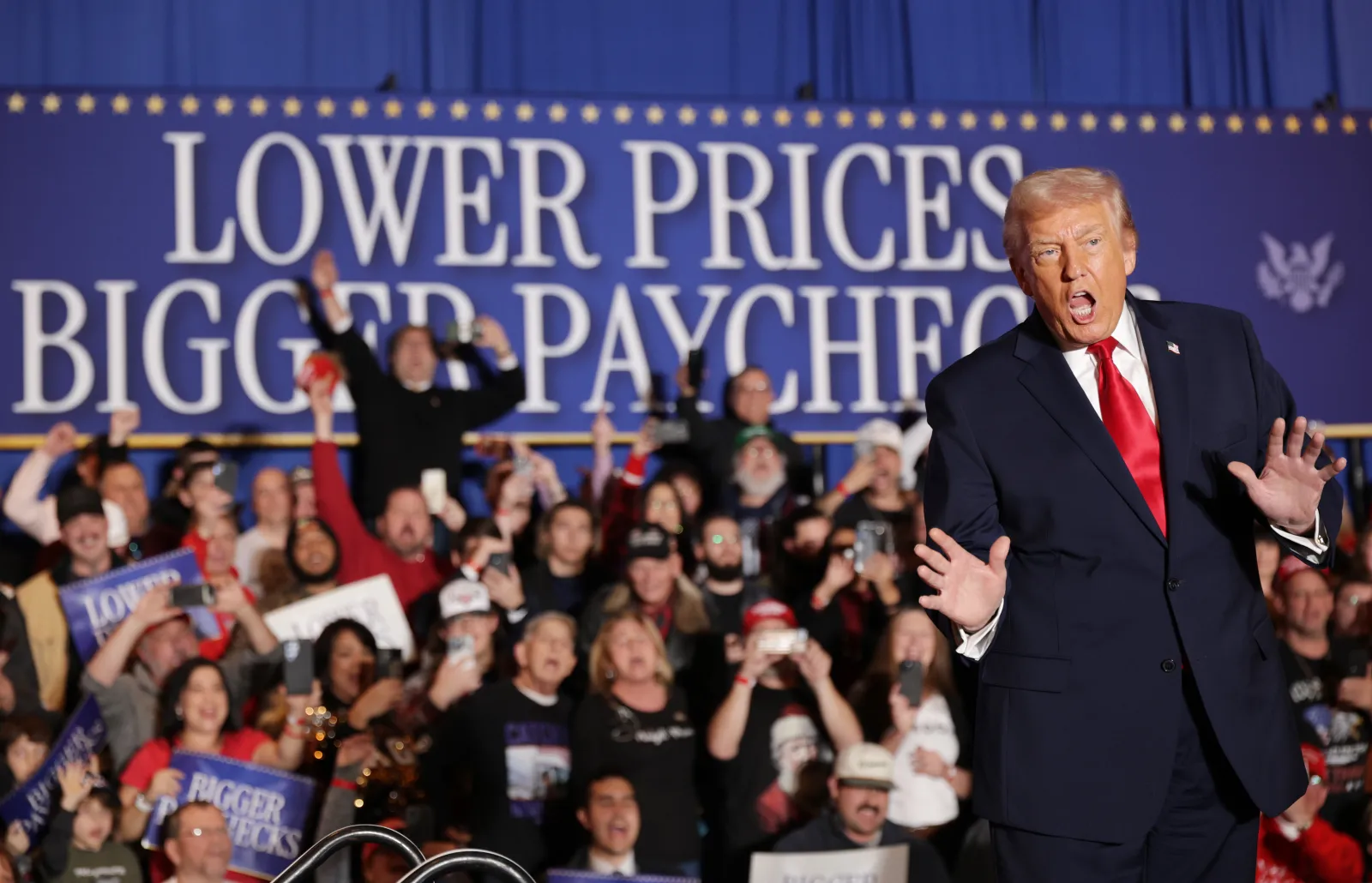
Speaking at a campaign-style event at a casino in Pennsylvania, beneath a banner that read “LOWER PRICES BIGGER PAYCHECKS,” Trump insisted his administration was driving costs down “rapidly” after what he called “the highest inflation in history.” Once again, he described worries about the cost of living as a “hoax” pushed by political opponents.
The same day, Politico published an interview in which Trump defended his self-given A+++++ rating and said he had inherited “a total mess” from Joe Biden.
Why It Matters
Since Trump took office in January, prices have continued to climb, and soft spots in the labor market have shaped how Americans feel about the economy. A range of polls and confidence surveys show a public mood that is far less upbeat than Trump’s, and some analysts say brushing off affordability concerns could backfire on Republicans in the coming elections.
The administration has pointed to its efforts to ease household costs — including rolling back some food tariffs and fuel-efficiency rules — as evidence that it is acting on voters’ concerns. But Democrats have made affordability central to their criticism of Trump’s record, and even some Republicans are uneasy about how economic frustration could affect their midterm prospects.
What To Know
At Tuesday’s rally, described as the kickoff to a series of affordability-focused stops in key swing states, Trump blamed Democrats for having “blew up our economy,” while claiming it is now thriving thanks to tariffs and expanded domestic energy production.
Public opinion data suggests most people do not share that optimism.
- In a mid-November Fox News poll, 76 percent of Americans said the economy was either “not so good” or “poor,” and three times as many respondents said Trump’s economic policies had hurt them rather than helped.
- A November survey by the New York Federal Reserve found that households’ views of both their current and future finances worsened further, even as inflation expectations held steady and perceptions of job opportunities ticked up slightly from October.
- The Conference Board’s latest report showed consumer confidence in November dropping to its lowest point since April. Views of both business conditions and the labor market deteriorated, and the Expectations Index slid deeper below the level that often signals a coming recession.
Jonathan Portes, a professor of economics at King’s College London, said there is limited value in reacting to Trump’s self-evaluation, and described the real economy as “performing poorly, in part because of Trump’s policies on tariffs and immigration, but not disastrously, in part because of the AI investment boom.”
“His claim that ‘prices are coming down tremendously’ is obviously untrue,” Portes told Newsweek. “Prices are rising by about 3 percent a year, and that rate has accelerated slightly in the last year.”
The White House nonetheless argues that Trump is making “substantial progress” on cost-of-living pressures, pointing to lower gas prices, easing mortgage rates and moderate real wage growth. Portes, however, doubts this message will resonate with a public that is acutely sensitive to prices.
“Trump is p***ing on his supporters’ legs and telling them that it’s raining,” he said. “I doubt that’s a winning strategy.”
What People Are Saying
Trump, at his Pennsylvania event, told supporters:
“They gave you high prices. They gave you the highest inflation in history. And we’re giving you—we’re bringing those prices down rapidly. Lower prices, bigger paychecks. You’re getting lower prices, bigger paychecks. We’re getting inflation. We’re crushing it. And you’re getting much higher wages.”
The White House said in a Tuesday press release:
“The Trump Administration’s whole-of-government effort will continue driving prices down, boosting take-home pay, and strengthening the economy so all Americans can feel relief.”
Senator Bernie Sanders told CNN:
“If this is an A+++++ economy, God help us if we ever get to a B or a C.”
Moody’s Chief Economist Mark Zandi wrote on LinkedIn:
“Many Americans are deeply unhappy with their financial situation, and with good reason. They are grappling with a severe affordability squeeze. Prices for many things, from groceries to car insurance, are high and continue to climb. Meanwhile, pay increases are slowing as job growth has stalled and unemployment is on the rise. Addressing the affordability squeeze will be challenging, but revisiting tariffs and immigration policy could help.”
What Happens Next
Tuesday’s Pennsylvania rally marked the start of a series of events designed to promote Trump’s economic message and defend his record on prices and pay ahead of next year’s midterm elections, according to Reuters and Axios. The president and his allies are expected to keep emphasizing the theme of “lower prices, bigger paychecks” even as polling shows many voters remain unconvinced.