
Liberia has had deep ties with the United States for centuries. The country was first established with the aim of relocating freed slaves from the United States.
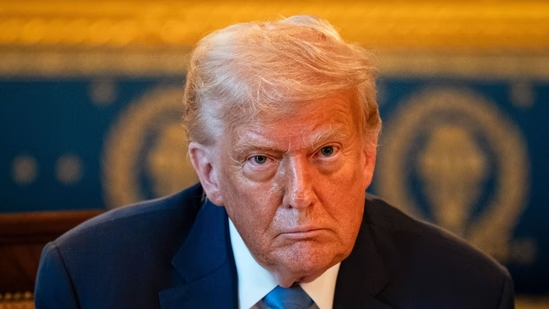
Confusion and outrage spread across Liberia on Thursday after U.S. President Donald Trump made comments about President Joseph Boakai’s English during a meeting at the White House.
“Such good English,” Trump said with apparent surprise. “Such beautiful English.”
He then followed up with, “Where did you learn to speak so beautifully? Where? In Liberia?” as Boakai responded quietly.
The remarks, made during a meeting with five West African leaders on Wednesday, drew criticism for what many Liberians saw as a patronizing tone — especially given that English has been Liberia’s official language since the 1800s and the country shares deep historical ties with the United States.
Foday Massaquio, chairman of the opposition Congress for Democratic Change–Council of Patriots, said Trump’s comments reflected a broader Western attitude toward African nations.
“Trump was condescending. He disrespected an African head of state,” Massaquio said. “This proves again that the West still struggles to take us seriously.”
The exchange came as the U.S. shifts its foreign policy approach from aid to trade, a move that has already unsettled many in Liberia. Earlier this month, the U.S. announced the dissolution of USAID programs based on what it called an outdated “charity-based foreign aid model.” The decision shocked Liberians, as American assistance made up nearly 2.6% of the country’s gross national income — the highest rate of U.S. support anywhere in the world.
Given their historical connection, many Liberians believed they would be shielded from such cuts. Liberia was founded in the 19th century by formerly enslaved African Americans and has long modeled its political system, flag, and institutions on those of the United States. American culture is visible across Liberia, from New York-style taxis to public school buses.
Moses Dennis, a Monrovia businessman, said Trump’s comments showed a lack of awareness.
“Liberia has been speaking English for over a century,” he said. “President Boakai didn’t fly to Washington for an English competition.”
Siokin Civicus Barsi-Giah, a leadership analyst and associate of former President George Weah, called Trump’s remarks “condescending and ridiculing.”
“Boakai wasn’t being praised — he was mocked by the president of the world’s most powerful country,” Barsi-Giah said. “Liberians speak English because of our history with the U.S., not because it’s foreign to us.”
Boakai’s spokesperson, Kula Fofana, attempted to downplay the controversy, urging media to focus on the summit’s substance.
“As journalists, your attention should be on the meaningful discussions that took place,” she told The Associated Press.
Some academics, however, offered a more nuanced interpretation. Abraham Julian Wennah, director of research at the African Methodist Episcopal University, acknowledged that while the comment may have echoed colonial-era surprise at African eloquence, it also fit Trump’s rhetorical style.
“In postcolonial societies, language is often used to question someone’s legitimacy or intelligence,” Wennah said. “But in this case, it could be seen as Trump’s way of recognizing Boakai’s intellect and readiness for global leadership.”
Still, the incident has reopened old wounds and underscored the fragile nature of Liberia’s relationship with its “big brother” — a nation that once played a central role in its founding and remains deeply intertwined with its national identity.