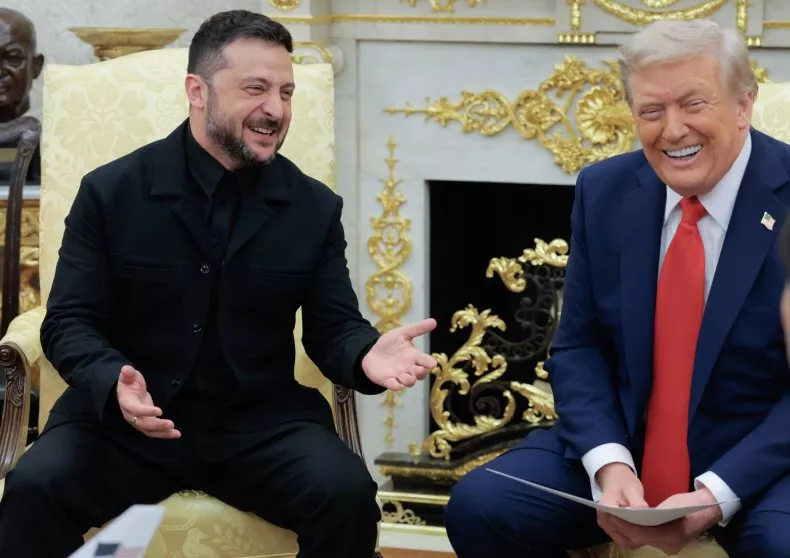

Back in February, Ukrainian President Volodymyr Zelensky left the White House early after a tense meeting with Donald Trump that ended in a heated exchange. This week, he returned to the same room, smiling for cameras, trading jokes with Trump, and receiving compliments on his suit from the assembled press pool as European leaders looked on.
The contrast in tone was striking. Administration officials described the atmosphere as “terrific” and “really productive,” while Vice President JD Vance — who had clashed with Zelensky during the previous visit — remained notably low-key.
Yet for Trump’s MAGA base, the warmer reception did little to quell concerns about what comes next.
Trump’s sudden openness to providing NATO-style security guarantees for Ukraine has drawn sharp criticism from his staunchest allies, reigniting debate over America’s role in the conflict.
Steve Bannon, former White House strategist and a leading voice in the “America First” movement, directly criticized the proposed security framework. On his War Room podcast, Bannon condemned the talks as globalist overreach, though he did not mention Trump by name.
“I want to give a security guarantee to the citizens of the United States on these invaders right now. That’s the security guarantee I want,” Bannon said. “This entire war is so that Ukraine could be a Western country. Well, I don’t give a tinker’s d—.”
His objections reflect growing unease among conservatives, who see potential Article 5-style protections — NATO’s mutual defense clause — as a fundamental betrayal of the movement’s anti-interventionist core.
“There can’t be any guarantee here from the United States, because that’s going to inextricably link us to this conflict,” Bannon told Politico. “If we don’t fund this, it stops happening. The Europeans don’t have the hardware or the money.”
Online, grassroots supporters echoed that frustration. “All I heard were Article 5 and security guarantees,” one user wrote on X. “If POTUS agrees with that, we MAGA are out. Sorry, but you broke your promise.”
Another added: “Get out of Ukraine! No more US money! No more US weapons! No Article 5 US security guarantees! World War II is over!”
Trump, for his part, has drawn a firm line. In posts ahead of the summit, he reiterated that Ukraine would not join NATO, stating “no going into NATO by Ukraine” and claiming Zelensky “can end the war with Russia almost immediately, if he wants to.”
Instead, Trump has supported the idea of a standalone security framework — short of NATO membership — that would still provide Ukraine with significant protection.
According to U.S. envoy Steve Witkoff, the framework could include “security guarantees,” obligating the U.S. and European allies to respond if Ukraine is attacked. Witkoff described the potential agreement as “game-changing,” though the details remain unclear.

“When we talk about security guarantees, we’re talking about the security of the entire European continent,” French President Emmanuel Macron said. NATO Secretary General Mark Rutte added that discussions would involve guarantees similar to those already extended to alliance members.
While Trump said he gave “his assurance” that no U.S. troops would be deployed to defend Ukraine’s borders, a senior official told Politico the president might support a U.S. peacekeeping role “if it was the final piece of the puzzle.”
That uncertainty has fueled anxiety among MAGA-aligned Republicans. Many view any military commitment abroad as a step back toward the endless wars Trump once promised to end.
“The war we got to win is right here in this country,” Bannon said. “That’s the war that we got to be focused on.”
Ukraine, too, has been cautious about what the security guarantees will ultimately entail. Zelensky said the U.S. had sent a strong signal but added he could not provide concrete details until agreements are finalized in the coming days.
Still, Zelensky emphasized that any peace must be “lasting” and avoid the pitfalls of the “so-called ‘security guarantees’ of 1994.”
“They didn’t work,” Zelensky said on Monday.