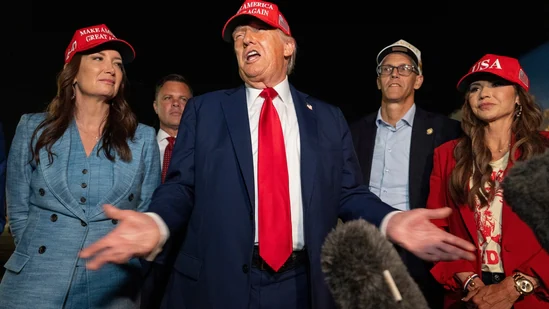

Washington: A new analysis from the JPMorganChase Institute reveals that President Donald Trump’s latest round of proposed tariffs could directly cost mid-sized American businesses $82.3 billion, raising concerns about the impact on employment, prices, and profit margins.
The study examined companies with annual revenues between $10 million and $1 billion—a group that employs about one-third of private-sector U.S. workers. These businesses are particularly reliant on imports from countries like China, India, and Thailand, and operate mainly in retail and wholesale sectors, which are especially vulnerable to import taxes.
Tariffs Hit U.S. Firms, Not Foreign Exporters
The findings challenge Trump’s repeated claim that foreign exporters would absorb the costs of tariffs. In reality, the analysis shows U.S. companies are likely to bear the brunt of these import taxes. Many large retailers like Amazon, Costco, Walmart, and Williams-Sonoma had temporarily avoided higher costs by stockpiling inventory ahead of previous tariff hikes.
While inflation hasn’t surged yet, economists warn that the delayed effects are starting to emerge. According to Goldman Sachs, companies may pass up to 60% of tariff costs on to consumers. The Atlanta Federal Reserve estimates firms could absorb about half the cost of a 10% or 25% tariff before seeing reduced demand.
Average Cost per Employee: $2,080
Under Trump’s current tariff structure, the $82.3 billion cost equates to an average of $2,080 per employee, or 3.1% of annual payroll. That figure includes both importing and non-importing firms. Without adjustments made since April, companies would have faced an even steeper hit—$187.6 billion in direct costs.
Deadline Approaches for New Tariff Rates
Trump is expected to announce final tariff rates by July 9, following a 90-day negotiating window that was set in motion after financial markets reacted negatively to his April announcements. Currently, most imports face a 10% baseline tariff, with higher rates for China, Mexico, and Canada, and 50% tariffs on steel and aluminum.
So far, only the United Kingdom has signed a trade framework with the U.S., though Trump claims Vietnam has also reached an agreement, while India is reportedly nearing a deal.
In a post on his social platform, Trump stated Vietnam would agree to a 20% tariff on all goods sent to the U.S., and a 40% tariff on transshipped goods (i.e., Chinese goods routed through Vietnam). In exchange, the U.S. would gain “total access” to Vietnam’s markets, allowing products to enter tariff-free—a deal Trump said would especially benefit U.S. SUV manufacturers.
Domestic Manufacturers Could Benefit—But With Limits
The report notes that some domestic manufacturers may benefit from reduced reliance on foreign imports, but retailers and wholesalers, already operating on slim margins, are likely to pass costs onto customers.
The broader outlook for tariffs remains murky. Trump has vacillated on trade talks—recently restarting negotiations with Canada after it abandoned plans to tax digital services. He also threatened Japan with more tariffs unless it increased U.S. rice imports.
Political Stakes and Economic Risks
Treasury Secretary Scott Bessent told Fox News that the concessions secured so far have “impressed” career officials across trade agencies. The administration is also juggling negotiations with efforts to push through a multitrillion-dollar domestic spending package, which passed the Senate on Tuesday.
Trump has set a Friday deadline for the bill’s passage, hoping tariff revenues will help offset its massive costs.
As the July 9 tariff deadline looms, businesses across the country are preparing for what could be one of the most consequential shifts in U.S. trade policy in recent years.