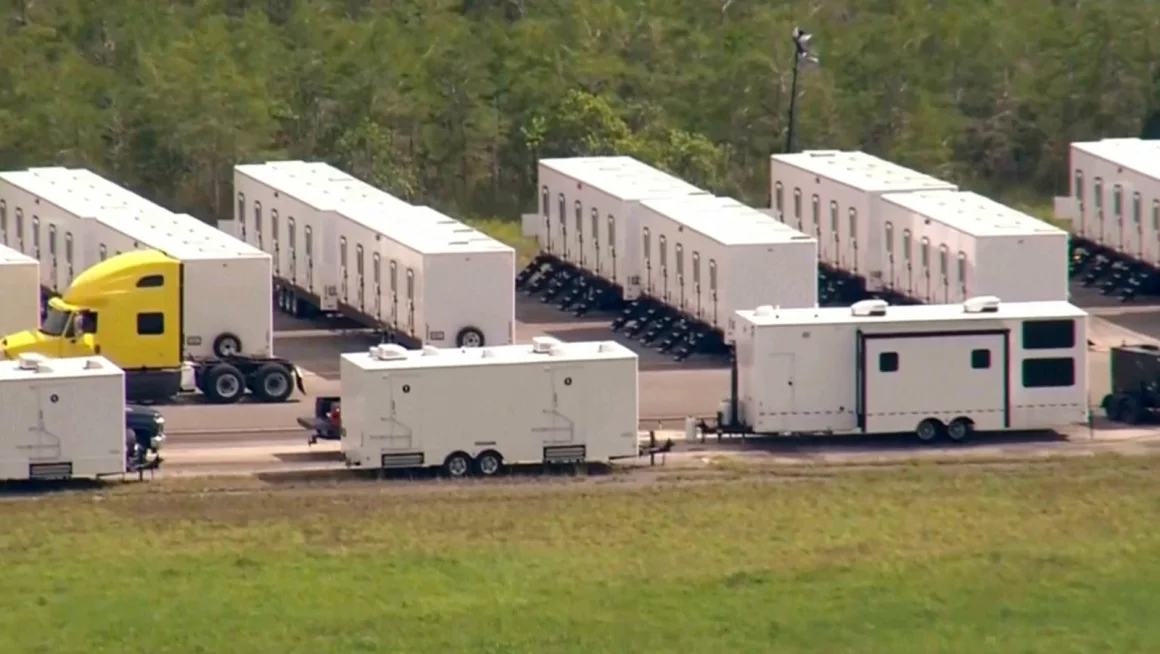

President Donald Trump is set to visit a newly constructed migrant detention facility in the Florida Everglades on Tuesday, dubbed “Alligator Alcatraz”—a name as provocative as the policies it represents.
Located at the remote Dade-Collier Training and Transition Airport near Ochopee, west of Miami, the sprawling tent city is designed to hold 5,000 undocumented migrants awaiting deportation. Surrounded by swamp, venomous snakes, and razor-toothed alligators, the facility has become the centerpiece of Trump’s hardline immigration push and the administration’s latest symbol of what critics call dehumanizing border enforcement.
White House Press Secretary Karoline Leavitt leaned into the harsh optics, calling the site a powerful deterrent:
“When you have illegal murderers, rapists, and heinous criminals in a facility surrounded by alligators and unforgiving terrain—yes, I do think that’s a deterrent.”
Trump’s visit comes as immigration rights advocates, environmental groups, and Florida’s Indigenous communities sound the alarm. They’re raising concerns about everything from inhumane conditions to the facility’s threat to sacred lands. Yet for Trump, the camp offers a striking backdrop for a familiar brand of political theater—appealing to base voters, antagonizing liberals, and dominating the media cycle.
A Dark Echo in U.S. History
The imagery—military tents in a swamp, surrounded by wildlife—has evoked comparisons to some of the country’s most troubling historical chapters, including the internment of Japanese Americans during World War II. Critics say Trump’s increasingly aggressive immigration tactics flirt with authoritarianism and undermine America’s democratic values.
“It’s the kind of place you’d expect a strongman to showcase,” said one rights advocate. “Not a U.S. president.”
Yet the Trump administration isn’t backing down. Leavitt said the Florida visit underscores the need for Trump’s “One Big Beautiful Bill,” which would pump billions into expanding detention and deportation infrastructure nationwide.
“We need more camps like this,” she said. “This is just the beginning.”
Political Theater Meets Policy Goals
Trump’s visit to “Alligator Alcatraz” follows a pattern: shocking imagery and controversial stunts designed to rally his base and dominate the news cycle. Whether it’s sending National Guard troops into Los Angeles or staging a military-style parade in Washington for his 79th birthday, Trump consistently uses visuals to drown out critics and position himself as a hard-edged leader.
Florida Gov. Ron DeSantis, once a fierce Trump primary rival, has thrown his support behind the project, describing the facility as a “one-stop shop” and comparing it to emergency camps built for hurricane response crews.
“Conditions are humane,” DeSantis told Fox News, pointing to rows of air-conditioned units outside the tents.
But concerns persist. ICE confirmed Sunday that a 75-year-old Cuban migrant died at a Miami detention center, prompting fresh scrutiny of medical care in ICE custody. Homeland Security Secretary Kristi Noem shrugged off the incident, saying deaths occur in all detention systems and arguing that ICE maintains “the highest standards in the industry.”
Mugs, Merch, and Misleading Claims
The spectacle of “Alligator Alcatraz” has become so theatrical that the Florida GOP is now selling branded merchandise—caps, mugs, even baby onesies. But beneath the gimmick lies a troubling narrative: the conflation of all undocumented migrants with violent criminals.
Noem described the camp as a holding zone for “the worst scumbags,” highlighting migrants with convictions for homicide, rape, and child abuse. Yet ICE data tells a different story. According to internal figures from October 2024 to May 2025, only about 10% of migrants in ICE custody were convicted of serious crimes. More than 75% had no convictions beyond immigration or traffic violations.
A Crisis of Compassion and Policy
The Trump administration argues that its immigration crackdown is a response to years of inaction and broken asylum laws. And in truth, the U.S. immigration system is under immense strain—clogged courts, inadequate holding space, and legal frameworks ill-equipped for modern migration patterns.
But critics say “Alligator Alcatraz” and facilities like it reflect not just dysfunction but cruelty—built for spectacle as much as enforcement.
“They say they’re saving lives,” said one immigration attorney. “But they’re making a show of punishment.”
The migrants who will soon fill the camp include many who fled violence, poverty, and persecution—people with few options, and in some cases, legitimate asylum claims. Trump’s visit may bolster support among his base and further his legislative agenda. But for the thousands who may soon be detained in the Everglades wilderness, it’s a chilling reminder of what America’s immigration system has become.