
Students in Ukraine returned to school on Monday, beginning the new academic year under the continuing threat of Russia’s invasion.
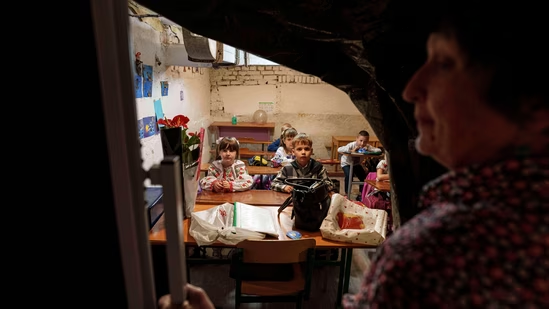
In Bobryk, a small village in the northern Sumy region near the front line, one school has moved all classes into a basement so students can continue learning in person. Their education had already been disrupted by the COVID lockdowns, and teachers are determined not to let the war take away more time.
“We must do everything so this generation is not lost,” said principal Oleksii Korenivskyi. “Time is the only thing you cannot make up. This is our future, and we must give it everything we have.”
The school relocated underground two years ago when air raid sirens sometimes lasted up to 20 hours, halting classes. To protect students and teachers, lessons continued in hiding. Now, narrow basement rooms serve as classrooms, divided in some places by thick plastic sheets. There are no windows or doors, and the sounds of different classes often blend together.
On the first day of school, children arrived wearing embroidered traditional shirts, known as vyshyvanka. Teachers’ desks were covered in flowers — a tradition for the start of the school year.
The basement was once damp and dark, but it has since been renovated with ventilation, electricity, and new flooring. For Bobryk’s 2,000 residents, this small school is a symbol of resilience. Class sizes are small, with about 10 children each, and this year only seven students filled the first-grade classroom.
During one lesson, a teacher showed a map of Ukraine without any occupied territories marked. Pointing to the Sumy region, she explained, “Our region is next to Russia. That’s why it’s so hard, why they bomb us so often — because we are close to this difficult neighbor.”
The school currently has just over 100 students, though about 10 percent have left since the start of Russia’s full-scale invasion. For such a small school, every student who leaves is deeply missed.
Among those preparing to leave is 15-year-old Vlada Mykhailyk, who will soon move to Austria with her younger brother. Their mother feels conditions are too unsafe to stay. “We live well, but sometimes it’s sad. We often hear Shaheds [drones] and explosions,” Vlada said. She has gotten used to learning underground and added, “If you have to choose between online or in the basement, the basement is better.” Still, she admits she would prefer to finish school with her friends.
In a younger classroom, the first day was filled with stories about summer — bike rides, helping parents, and meeting new friends. But one child added quietly: “A Shahed drone was intercepted above us and there were fragments.” The teacher responded softly, “All this is because of the war.”
Because space is limited, the school operates in two shifts with shorter breaks. The original school building, a beautiful structure from the early 20th century, now stands empty, waiting for the day it can reopen.
Seven-year-old Eva Tui, starting her third year underground, remembers her old classroom just 400 meters away. It was warmer in winter and felt more comfortable. “We’re here because it’s wartime and there are a lot of sirens,” she explained. She admitted she had been too excited the night before to sleep, looking forward to the first day back.
Her wish for the year is simple: “To go back to the classroom. It feels more like home.” Her bigger dream: “For the war to end.”