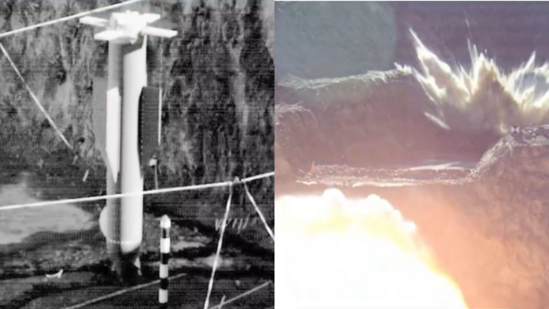

The White House shared test footage of bunker-buster bombs to support Donald Trump’s claim that American airstrikes “obliterated” Iran’s nuclear sites at Fordo.
In an effort to counter skepticism surrounding the recent U.S. airstrikes on Iran’s underground nuclear facilities, the White House on Thursday released dramatic test footage of bunker-buster bombs used in the operation at Fordo.
The video, shared on X (formerly Twitter), featured a quote from U.S. Defense Secretary Pete Hegseth:
“Because of the hatred of this press… your people are trying to leak & spin that it wasn’t successful. It’s irresponsible.”
General Dan “Razin” Caine, who oversaw the mission, added, “I have chills… talking about this.”
Strike Effectiveness Questioned
President Donald Trump had previously declared the strikes had “obliterated” Iran’s key nuclear sites, but questions arose following a preliminary report from the Defense Intelligence Agency. The DIA noted the sites at Fordo, Natanz, and Isfahan sustained “significant” damage—but not full destruction.
While Israel has said the strike set Iran’s program back by “many years,” and the International Atomic Energy Agency confirmed “extensive damage,” experts say full impact assessments are still underway.
Satellite images taken just days before the June 22 attack also showed trucks and bulldozers near Fordo, raising speculation that Iran may have tried to shield or relocate materials.
Responding to this, Hegseth told Reuters:
“I’m not aware of any intelligence… that says things were not where they were supposed to be — moved or otherwise.”
Inside the Fordo Strike
According to Gen. Caine, the U.S. had been preparing for a strike on Fordo for over a decade. Military engineers studied everything—from rock composition to tunnel layouts—to perfect the weapon’s effectiveness.
“We had so many PhDs working on the mock program… we were quietly the biggest users of supercomputer hours in the U.S.,” he said.
The bombs were specially designed to delay detonation until they penetrated deep into Fordo’s underground chambers, using shockwaves to destroy nuclear equipment through tunnel networks.
12 Bombs Hit Fordo
Seven B-2 stealth bombers participated in the operation, each carrying two bombs. At Fordo, each of the site’s two main underground ventilation structures—shaped like pitchforks—was targeted with six bunker-buster bombs.
Iran had placed large concrete slabs over the ventilation shafts, but the first bombs were designed to neutralize these barriers. Subsequent bombs detonated inside the facility’s central shafts at speeds exceeding 1,000 feet per second. A sixth bomb was held in reserve as a backup.
Overall, 12 bombs struck Fordo, and two more hit the Natanz facility.
Pilots reportedly witnessed bright flashes from the explosions. “It looked like daylight,” one recalled. Caine confirmed the entire mission—from loading the bombs to detonation—went as planned.
Defense Secretary Hegseth concluded:
“Iran’s nuclear facilities have been destroyed.”