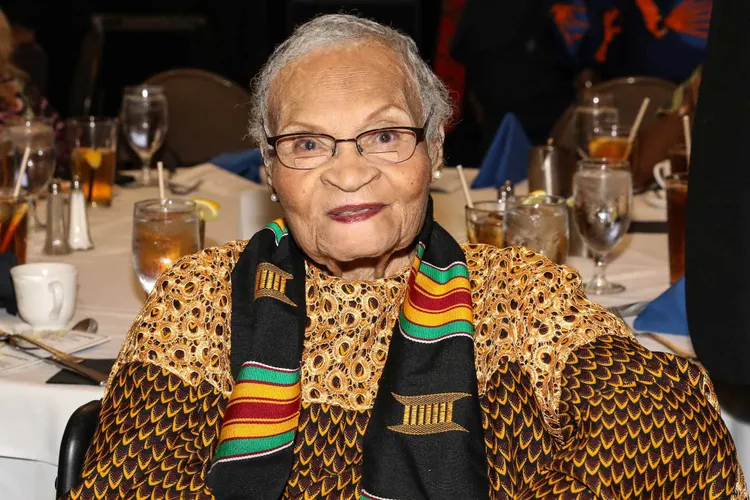

Viola Ford Fletcher, the oldest known living survivor of the 1921 Tulsa Race Massacre, has died at the age of 111.
Her grandson, Ike Howard, told CNN and the Associated Press that she died on Monday, Nov. 24, surrounded by family.
“She had a beautiful smile on her face,” Howard said. “She loved life, she loved people.”
Oklahoma Sen. Regina Goodwin also confirmed her death and shared that she was with Fletcher’s family at a local hospital.
Known affectionately as “Mother Fletcher,” she was just 7 years old when a white mob launched a two-day attack on Tulsa’s Greenwood neighborhood beginning May 31, 1921, according to CNN. The massacre left as many as 300 Black residents dead, per the Oklahoma Historical Society, and 35 city blocks burned. In its wake came decades of segregation, trauma and financial devastation for Tulsa’s Black community.
:max_bytes(150000):strip_icc():focal(999x0:1001x2):format(webp)/Viola-Ford-Fletcher-112425-112e69e073174430a9af78cfd0c5bafb.jpg)
“Mother Fletcher endured more than anyone should, yet she spent her life lighting a path forward with purpose,” Tulsa Mayor Monroe Nichols told the AP.
Born in Oklahoma on May 10, 1914, Fletcher spent most of her childhood in Greenwood. As reported by the AP, she remembered life there before the massacre as idyllic — a rare oasis for Black families during segregation.
Her family was forced to flee during the violence and later lived in a tent while working as sharecroppers. She received a fourth-grade education, CNN reported.
“I could never forget the charred remains of our once-thriving community, the smoke billowing in the air, and the terror-stricken faces of my neighbors,” she wrote in her 2023 memoir, Don’t Let Them Bury My Story.
Fletcher returned to Tulsa at 16 and found work in a department store. There she met Robert Fletcher, whom she married before the couple moved to California. According to her memoir, she worked as a welder in Los Angeles during World War II.
She eventually left her husband, who was physically abusive, and later gave birth to their son, Robert Ford Fletcher. Seeking to be closer to relatives, she moved back to Oklahoma and settled in Bartlesville, just north of Tulsa. She went on to have another son, James Edward Ford, and a daughter, Debra Stein Ford, from other relationships.
:max_bytes(150000):strip_icc():focal(999x0:1001x2):format(webp)/1921-Black-Wall-Street-Memorial-112425-8eefb8f6eb284cf09479fe1f89b8e88d.jpg)
Fletcher worked as a housekeeper until the age of 85, and eventually moved back to Tulsa once again. Howard told the AP that his grandmother hoped returning to the city would support her efforts to seek justice.
When she began publicly sharing her memories of the massacre decades later, speaking about what she had endured became a healing process, Howard said.
“This whole process has been helpful,” he told the outlet.
Fletcher joined fellow survivors Hughes Van Ellis and Lessie Benningfield Randle in a 2021 lawsuit seeking reparations from the city of Tulsa for the harms they suffered. The Oklahoma Supreme Court dismissed the case in June 2024, ruling that their grievances did not fall under the state’s public nuisance statute, according to the AP.
“For as long as we remain in this lifetime, we will continue to shine a light on one of the darkest days in American history,” Fletcher and Randle said in a statement after the dismissal.
Fletcher told CNN she “never got over” what she witnessed and still remembers “people getting killed, houses, property, schools, churches, and stores getting destroyed with fire.”
“It just stays with me, you know, just the fear,” she said. “I have lived in Tulsa since but I don’t sleep all night living there.”
The Tulsa Race Massacre remains one of the deadliest incidents of racist violence in U.S. history.
On May 30, 1921, a young Black shoe shiner named Dick Rowland entered an elevator in the Drexel Building in Tulsa with a white elevator operator, Sarah Page, on his way to the bathroom. Accounts differ on what happened next, but it is widely said that Rowland bumped into Page, who screamed. Tulsa police later arrested Rowland, according to the Tulsa Historical Society and Museum.
The next day, May 31, the Tulsa Tribune published a story alleging that Rowland had assaulted Page, sparking a confrontation between Black and white residents outside the courthouse where Rowland was being held.
The report was seen by many as a vehicle for inflaming racist resentment and undermining a Black community that had begun to prosper in Tulsa’s Greenwood District — a thriving center of Black business and culture often called Black Wall Street. The neighborhood was home to numerous businesses, homes, schools, churches and even a public library.
As tensions escalated, shots were fired and Black residents retreated to Greenwood. By the early hours of June 1, the district had been reduced to ashes and hundreds of people were dead.
“It really is a bloody, shameful stain on American history,” MSNBC’s Trymaine Lee recently said. “Some people have struggled to recoup what was stolen from them, and others have inherited pain and trauma from the massacre that continues to bear down on them today.”