
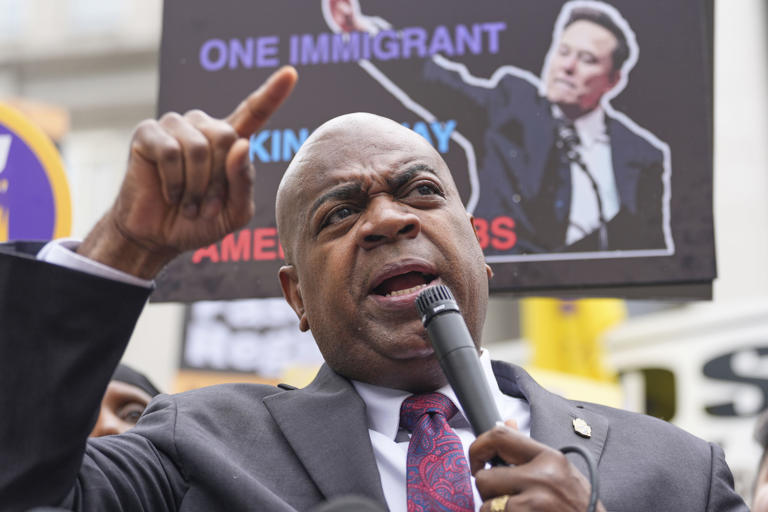

A federal officer who arrested Newark Mayor Ras Baraka outside an immigration detention center in May claimed he was acting on direct orders from the Justice Department’s second-in-command, Todd Blanche, according to body camera footage described in a recent court filing.
The filing, submitted by Rep. LaMonica McIver (D-N.J.), sheds new light on the chaotic events of May 9, when Baraka and several Democratic lawmakers clashed with immigration officials during an oversight visit. Baraka was arrested for trespassing—charges later dropped—while McIver herself was accused of assaulting federal agents. She is now pushing to have her case dismissed.
According to McIver’s attorneys, a Department of Homeland Security special agent was on the phone as tensions unfolded. Citing the unreleased bodycam footage, the attorneys wrote that the agent, after ending the call, told colleagues: “We are arresting the mayor right now, per the deputy attorney general of the United States. Anyone that gets in our way, I need you guys to give me a perimeter so I can cuff him.”
Although POLITICO has not reviewed the footage, it was filed as part of McIver’s court case. The Justice Department has not commented, while Homeland Security declined to confirm whether Blanche ordered the arrest.
The claim that Blanche directed the arrest underscores how senior DOJ officials under President Donald Trump have used federal law enforcement against political opponents. Investigations have targeted figures such as Jack Smith, James Comey, and former Homeland Security aides critical of Trump. Federal officers have also detained New York City Comptroller Brad Lander and handcuffed California Sen. Alex Padilla.
Conflicting accounts of Baraka’s arrest
For months, Democrats have questioned whether agents at Newark’s detention center were told by superiors to arrest Baraka. Witnesses say Baraka had been allowed inside the gate by a guard, stood calmly for nearly an hour, and left only after agents threatened him with arrest.
That same day, Rep. Rob Menendez (D-N.J.) told POLITICO he saw an agent on the phone being instructed to arrest Baraka, who was already outside the gate. McIver echoed that account in a press conference.
McIver’s attorneys say the bodycam footage confirms it. The agent reportedly stated during the call: “Even though he stepped out, I am going to put him in cuffs.” Minutes later, Baraka was arrested, sparking a scuffle involving the mayor and lawmakers.
McIver faces a three-count indictment alleging she struck and shoved federal agents. She has pleaded not guilty.
Less than two weeks later, prosecutors dropped the trespassing charge against Baraka. But U.S. Magistrate Judge André M. Espinosa sharply criticized the arrest, calling it an “embarrassing retraction” that suggested federal authorities acted hastily without fully weighing the consequences.
Baraka, a progressive who recently lost his bid for the Democratic gubernatorial nomination, has since sued the Trump administration for “malicious prosecution.” His lawsuit names acting U.S. Attorney Alina Habba and Ricky Patel, a Homeland Security Investigations official who appears to be the agent identified in the bodycam footage.
McIver invokes Trump’s immunity ruling
McIver is now citing the Supreme Court’s decision granting Trump partial immunity to argue for dismissal of her charges. Her lawyers say her visit to the detention facility, Delaney Hall, was a legislative act shielded from prosecution under the Constitution’s “Speech or Debate” Clause.
The clause protects lawmakers from legal action tied to their official duties. McIver’s attorneys argue that prosecuting her undermines those protections and risks intimidating members of Congress who scrutinize the administration.
The Department of Homeland Security rejected the claim outright. “Suggesting that physically assaulting a federal law enforcement officer is ‘legitimate legislative activity’ makes a joke of all three branches of government at once,” DHS Assistant Secretary Tricia McLaughlin said in a statement.
McIver’s attorneys countered that failing to apply the clause could discourage lawmakers from holding the executive branch accountable. They cited past court rulings, including a 2016 decision against former Sen. Bob Menendez, to argue that her case is fundamentally different.
In another motion, McIver also accused prosecutors of “selective” and “vindictive” prosecution, noting the Justice Department declined to pursue many Jan. 6 cases despite video evidence of violence against police.


