
WASHINGTON — While the number of Black women in Congress has remained consistent in recent years, a new report reveals a historic milestone: more Black women are now serving in state legislatures than ever before — a common stepping stone to higher political office.
The report, Black Women in American Politics 2025, shared with USA TODAY ahead of its July 31 release, tracked the growth of Black women serving in state legislatures, statewide positions, and Congress over the past decade. At one point in 2025, 402 Black women held seats in state legislatures, a dramatic rise from 240 just over ten years ago.
“It’s steady progress,” said Chelsea Hill, one of the report’s authors, reflecting on the 2024 election cycle.
According to the report — a collaboration between Higher Heights and the Center for American Women and Politics at Rutgers University — the number of Black women in state legislatures has grown by 67% since 2014.
Historically, these state-level positions have been springboards to national office. “There’s been a clear acceleration in Black women moving through the pipeline,” said Glynda Carr, president of Higher Heights.
Last year was a turning point, featuring several firsts — including Vice President Kamala Harris’ high-profile presidential campaign. Harris, the first woman of African American and Asian American heritage to serve as vice president, announced on July 30 that she would not run for governor of California. She has not confirmed whether she will seek the presidency again in 2028.
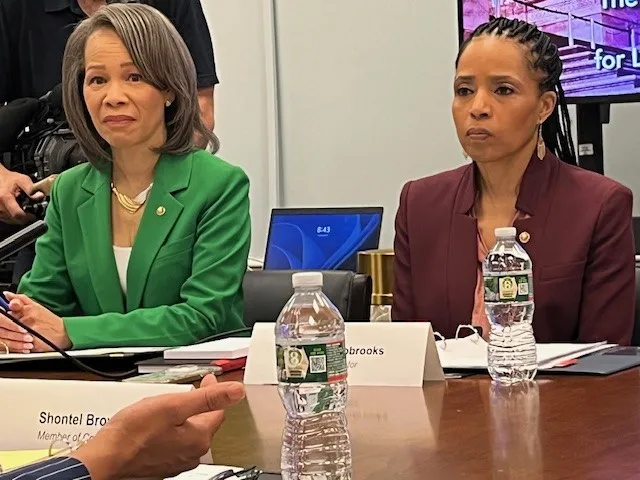
Other notable breakthroughs: Lisa Blunt Rochester of Delaware and Angela Alsobrooks of Maryland, both Democrats, made history by becoming the first two Black women to serve simultaneously in the U.S. Senate.
“When we first issued the report in 2014, there were no Black women in the Senate,” Carr noted. “That shift underscores the impact of sustained efforts to build political power.”
‘When Black women run, they do win’
Carr and Hill say that over the past decade, there have been increased opportunities and more initiatives focused on recruiting and preparing Black women to run for office.
“When Black women run, they do win,” said Hill, who serves as director of data at the Center for American Women. “They have high win rates. At the congressional level, Black women outperform their peers.”
In the 2024 general election, 63% of Black female congressional nominees won their races — surpassing win rates for all female candidates (49%) and male candidates (53%) across racial and ethnic groups, according to the report.
Many of the Black women now in Congress previously served in state legislatures. Since 2014, their numbers have nearly doubled — from 17 to 31, including nonvoting delegates.
The ‘Kamala effect’
Hill called Harris’ presidential run a “galvanizing force” for women — particularly Black women. Carr agreed, pointing out that Harris has successfully run for office at every level of government.
“She’s shown that there’s a viable leadership pipeline for Black women,” Carr said. “Her decision not to run for governor doesn’t diminish her influence — it reinforces the idea that women can shape politics at every level.”
Carr believes Harris has created a playbook for future leaders: “It’s a model for how to serve locally and build toward higher office.”
The report also highlighted progress at the city level. Eight Black women currently serve as mayors in the 100 largest U.S. cities, including Karen Bass (Los Angeles), Muriel Bowser (Washington, D.C.), and LaToya Cantrell (New Orleans).
Persistent challenges remain
Despite the strides, Black female candidates continue to face significant obstacles, including fundraising challenges and a lack of institutional support.
Some have voiced frustration that party organizations are slow to back their campaigns, even when they’re strong contenders. While some of those barriers are being dismantled, Carr said a growing wave of misinformation and political threats now targets Black women in particular.
Most Black women elected to Congress have been Democrats. Black Republican women face their own challenges — navigating party pushback against diversity, equity, and inclusion efforts.
Only one Black Republican woman — the late Mia Love of Utah — has ever served in Congress. “I certainly hope that I won’t be the last one. I really do,” Love told USA TODAY in 2022.
Even with a record number of Black women serving in state legislatures, five states — Hawaii, Idaho, Montana, North Dakota, and South Dakota — have none, Hill noted.
Governorships: Still uncharted territory
Governorships remain one of the few offices where Black women have yet to break through. While several high-profile candidates — including Stacey Abrams in Georgia — have made strong bids, no Black woman has won a governor’s race to date.
That could soon change. Republican Lt. Gov. Winsome Earle-Sears is campaigning for governor in Virginia this year, and Democrat Keisha Lance Bottoms has declared her intention to run for Georgia’s governorship in 2026.
“The 2026 cycle will offer new possibilities,” Hill said, noting that there will be 36 gubernatorial contests, compared to just 11 in 2024.
“Hopefully, we can retire that old statistic — that there’s never been a Black woman governor,” she added.
Looking ahead: 2026 and beyond
Carr and Hill say that 2026 presents an even greater opportunity to expand representation. While there were 73 statewide races in 2024, that number will jump to 200 next year.
Hill hopes more Black women will be recruited, supported, and encouraged to run in these races — and not just in predominantly Black districts.
“In 2026, the focus has to be on maintaining momentum,” Carr said. “That means building infrastructure to help Black women run for reelection, pursue higher office, and expand their political power.”