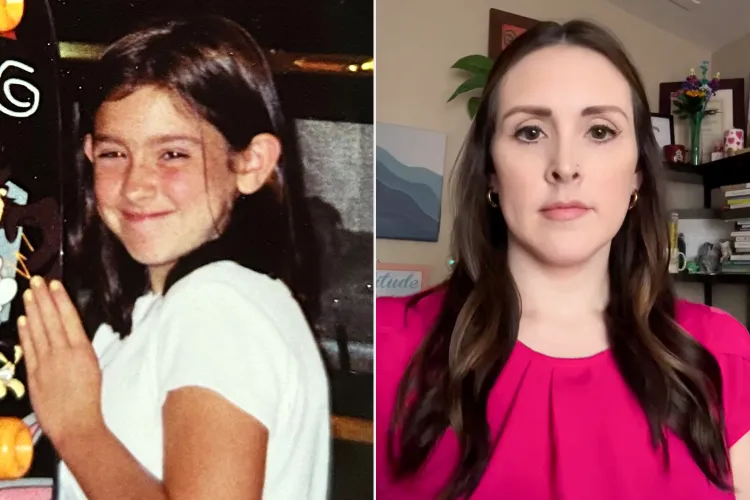

As a child, Erica Trocino had little understanding of plastic surgery or why anyone would choose it. Yet at just 11 years old, she found herself undergoing a procedure that would leave a lasting imprint on her life.
Trocino describes her early years as generally happy, but says her parents insisted she undergo an otoplasty — commonly known as ear pinning — believing it would shield her from judgment and bullying by peers. The procedure, which can be performed for medical or cosmetic reasons, alters the shape, position, or size of the ears, according to Mayo Clinic.
Now 36 and working as a licensed counselor in Arizona, Trocino says she has no memory of being included in the decision. What stands out instead is her father recounting his own childhood experience with ear pinning, framing the surgery as a way to spare her the bullying he had endured.
She recalls that the operation itself was never openly discussed — before or after — and quickly became something she felt she had to hide. When a friend saw her wrapped in bandages, Trocino became acutely aware of feeling different. She worried others would see her as strange for having had surgery, a fear that stayed with her.
Appearance, she says, carried significant weight in her household. From a young age, she was aware of how she looked, and she and her sister were frequently compared. One moment in particular stuck with her: after spotting a modeling advertisement in a tween magazine, she excitedly mentioned it to her mother. The response — that she wasn’t “model material” — landed not as realism, but as a blunt message that she wasn’t pretty enough.
:max_bytes(150000):strip_icc():focal(499x0:501x2):format(webp)/Erica-Trocino-121725-82963bfe5ace4f969fcf41c17131aae6.jpg)
Over time, Trocino learned to seek validation through achievement rather than appearance, turning to sports as a way to prove her worth. But the emotional impact of her surgeries ran deep. After a second revision procedure — required following a soccer injury — she became increasingly fixated on how others perceived her ears and whether the changes were noticeable.
She describes feeling ashamed of a body that, in her mind, needed painful intervention just to look “normal.” That shame intensified when she moved across the country six months after the initial surgery, amplifying her fear of rejection.
Eventually, her anxiety manifested as an eating disorder, which she felt gave her a sense of control over her body and how she was accepted by others. As her health declined, her performance in competitive soccer suffered, followed by struggles with depression, self-harm, and substance abuse. When she began therapy, the idea that her family dynamics might be contributing to her mental health challenges was briefly raised — but the sessions ended quickly. She internalized the belief that she alone was the problem and that seeking help wasn’t necessary.
In the years since, Trocino has focused on healing — a process that has taken on new meaning now that she is a mother herself. She says she is intentional about checking in with her children’s emotions rather than assuming she knows how they feel. Encouraging body autonomy is central to her parenting, with the goal of helping her children feel empowered to make choices about self-expression without being driven by social pressure.
:max_bytes(150000):strip_icc():focal(665x0:667x2):format(webp)/Erica-Trocino-121725-2-e5a9501c3afa46528ea60bef78b65ff1.jpg)
The experience has also taught her to sit with discomfort and uncertainty, allowing her to show up as a more emotionally present and safe parent.
More recently, Trocino shared her story publicly on social media, writing in a now-viral post that she has done her healing and intends to break the cycle. The reaction within her family was painful — she says her mother described the post as “ammunition” and “public shaming,” interpretations she strongly disputes. Public response has been divided, but Trocino says her intention is clear: to highlight how body autonomy in childhood can have lifelong effects on self-esteem, and how unresolved wounds in parents can shape a child’s life, even when actions are driven by love.
:max_bytes(150000):strip_icc():focal(540x0:542x2):format(webp)/Erica-Trocino-121725-3-868c82885c9b444988f68213f24a5ffc.jpg)
Today, Trocino is estranged from her parents and sister, whose experiences she chooses not to discuss out of respect for privacy. Despite the distance, she says she still feels gratitude for what she believes was her parents’ attempt to protect her from bullying and judgment.
At the same time, she acknowledges the anger that remains. Through therapy as an adult, she has been able to validate the emotions of her 11-year-old self — recognizing how her parents’ insecurities were projected onto her and how she wasn’t taught confidence or self-esteem during a crucial stage of development.