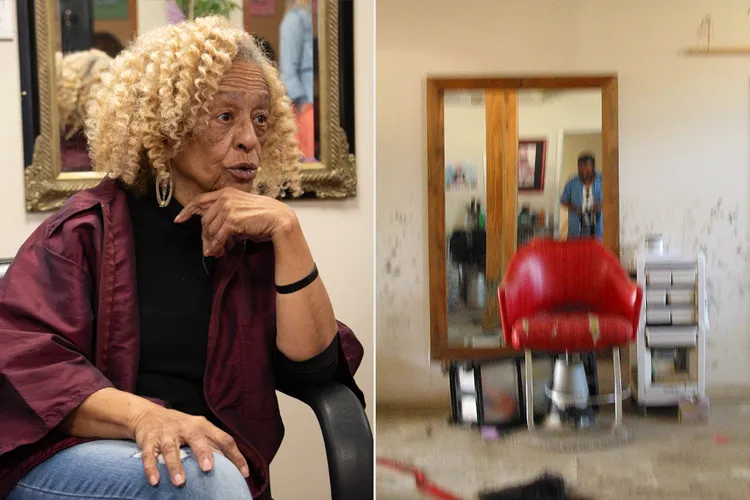

Lynette Boutte never planned to leave her beloved salon when Hurricane Katrina struck New Orleans in August 2005 — but within hours, she realized she had no choice.
On the morning of Tuesday, Aug. 30, a day after the storm made landfall, armed men in uniform pounded on her door. The levees had already broken, sending floodwaters rushing into the Tremé neighborhood where both her salon, Image Makers, and her home stood.
“They held guns at us and told us we had to leave,” recalls Boutte, now 77, speaking with PEOPLE for the magazine’s special issue marking the 20th anniversary of the disaster.
Boutte is among the survivors featured in the new National Geographic five-part documentary, Hurricane Katrina: Race Against Time. It would take her more than a decade to restore and reopen the building she had poured her life into.
Despite all she lost, she says the struggle was worth it. “My heart’s in this place,” Boutte says.
:max_bytes(150000):strip_icc():focal(999x0:1001x2):format(webp)/Lynette--Salon--2-eddecc3b180943d480fe43d9635ed908.jpg)
Katrina remains one of the deadliest and costliest hurricanes in U.S. history. By Aug. 31, 2005, roughly 80% of New Orleans was underwater after the levees separating the city from Lake Pontchartrain collapsed. According to the National Weather Service, the storm caused 1,833 deaths and more than $100 billion in damages.
The new National Geographic series revisits the catastrophe through archival footage and firsthand accounts from officials and survivors. It highlights not only government missteps and misinformation but also the courage of first responders and residents who fought to survive.
“This series goes beyond the headlines. It reveals stories of survival, heroism and resilience,” executive producers Ryan Coogler, Zinzi Coogler and Sev Ohanian said in a joint statement. “It’s a vital historical record and a call to witness, remember and reckon with the truth of Hurricane Katrina’s legacy.”
Boutte’s own story begins decades earlier. Born in the 1940s, she grew up with nine siblings, worked for a telephone company climbing poles, and eventually became a stylist deeply rooted in Tremé. Her grandmother had lived just down the street, and Boutte purchased her building in 1995, paying off the loan exactly 10 years later.
Her salon became a hub for musicians, politicians, and artists. “I’m from an artistic family, so my color is not always what you would wear to go to church,” says the veteran color specialist.
In January 2005, Boutte had invested in major repairs, including a new roof. Just three days later, Katrina erased everything she had built.
She sheltered with her sister, a friend, and three children in her building, which housed the salon downstairs and living quarters above. At first, she wasn’t alarmed — she had radios, dry food, and water. But then came the sound of an explosion: the levees had given way.
“We had three feet nine inches of water on the street, which meant my salon became breached and flooded,” she recalls.
As boats passed by, the group realized the city was in crisis. When uniformed men arrived, they were told to evacuate to a nearby facility — even though it meant trudging through chest-high water.
“We went from three feet nine inches of water to nearly five feet of water,” Boutte says. “I’m 4’11”. That meant we had to try and maneuver so we would not drown.”
:max_bytes(150000):strip_icc():focal(999x0:1001x2):format(webp)/Lynette--Salon--3-5578fb880fa1486fb719be2ff4dbffd2.jpg)
On the way, they picked up elderly twins and a male relative, placing them in a boat and ensuring they reached safety before moving on. Eventually, they climbed onto the interstate, one of the highest points nearby.
The journey was grueling — marked by exhaustion, searing heat, and a lack of drinking water. Boutte was eventually evacuated to Texas, where she and others were searched before being dropped at a stadium. Later, she flew to Florida to stay with a sibling, but her health quickly deteriorated. Dehydration, high blood pressure, and an eye infection landed her in the hospital.
By October 2005, she returned to New Orleans to assess the damage. Her insurance payout was immediately claimed by the bank, leaving her devastated but determined. “I done paid for this building three times,” she says. “There’s nothing really I can do about it because I want to stay where I am — this is where I’m established.”
For years, she worked elsewhere as a stylist and educator, saving until she could finally reopen her Tremé salon in 2017. Looking back, she says her choice to reclaim her space was never in doubt.
As her mother once told her: “New Orleans is a boomerang city. You’re going to come right back.”