
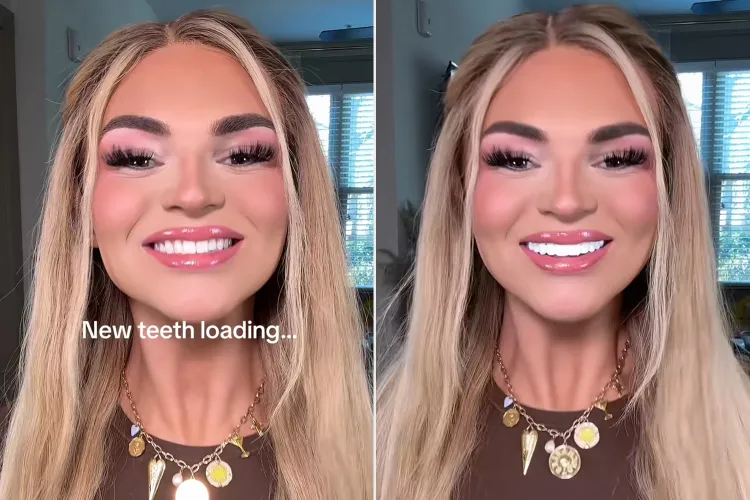

A 25-year-old content creator’s decision to pursue a “bigger and brighter” aesthetic has amassed over 38 million views, highlighting a growing tension between clinical dental standards and influencer-driven beauty ideals.
NEW YORK — Bay Stone, a 25-year-old digital creator, has ignited a massive online discourse regarding the cost and aesthetics of cosmetic dentistry after sharing her $20,000 veneer transformation. The video, which features Stone’s second set of dental porcelain, has rapidly climbed to over 38.6 million views on TikTok since its February 12 release, raising questions about the evolving definition of the “perfect” smile in the age of high-definition social media.
Seeking to elevate her appearance, Stone returned to her dentist for a second round of veneers, specifically requesting a look that moved away from natural proportions toward a more striking, uniform aesthetic.
“I decided to go whiter and brighter with my smile,” Stone told reporters. “I have such small natural teeth, I told [the dentist] to go bigger and more level with my new set because to me, your teeth and smile are the most important feature on your face.”
The procedure, which Stone confirmed cost $20,000, aimed for a “flawless” finish. For Stone, the result—straight, bright, and substantial—was exactly what she envisioned. However, the sheer scale and opacity of the work have divided the internet, triggering a broader conversation on the “uncanny valley” of modern cosmetic enhancements.
Rather than shying away from potential criticism, Stone leaned into the spectacle. Her viral post featured a self-deprecating sound effect of a horse, captioned: “No way I paid $20,000 for this.”
This strategic use of humor served as a catalyst for engagement. While a segment of the 38 million viewers praised her confidence and the “perfect” symmetry of the work, others expressed concern that the trend toward “ultra-white” and oversized teeth is moving too far away from biological realism.
Comments on the platform have ranged from aesthetic advice—such as staining the porcelain to look more natural—to nostalgic pleas for her original smile. Despite the polarized feedback, Stone maintains a resilient stance. “If you can’t laugh at yourself, you’re missing the best joke,” she remarked.
The visibility of the transformation has also caught the attention of the medical community. Stone reports that “several” professional dentists have reached out to her privately, offering their services to “fix” or adjust the smile to more traditional clinical proportions.
This professional intervention highlights a growing trend in the industry where “influencer veneers”—often characterized by a lack of translucency and a monochromatic white hue—conflict with traditional dental schools of thought that prioritize facial harmony and natural gradients.
Key Data Points: The Stone Transformation
| Metric | Detail |
| Total Investment | $20,000 USD |
| View Count | 38.6 Million+ |
| Primary Goal | Increased size and brightness |
| Viral Element | Self-deprecating humor/Horse audio |
Stone’s case is indicative of a shift in consumer behavior within the $30 billion global cosmetic dentistry market. As high-profile influencers like Kelsey Anderson and Alix Earle share their own dental journeys—often involving complications or “scary” revision processes—the public’s fascination with the “Hollywood Smile” shows no signs of waning.
For Stone, the outcome is a personal success regardless of the digital noise. “Beauty is in the eye of the beholder and I personally love my teeth,” she stated, noting that the interaction—positive or negative—only fuels her desire to create more content.
As dental technology continues to advance, the line between medical necessity and elective body modification continues to blur. Whether Stone’s “bigger and brighter” look becomes the new gold standard or remains a cautionary tale for traditionalists remains to be seen.


