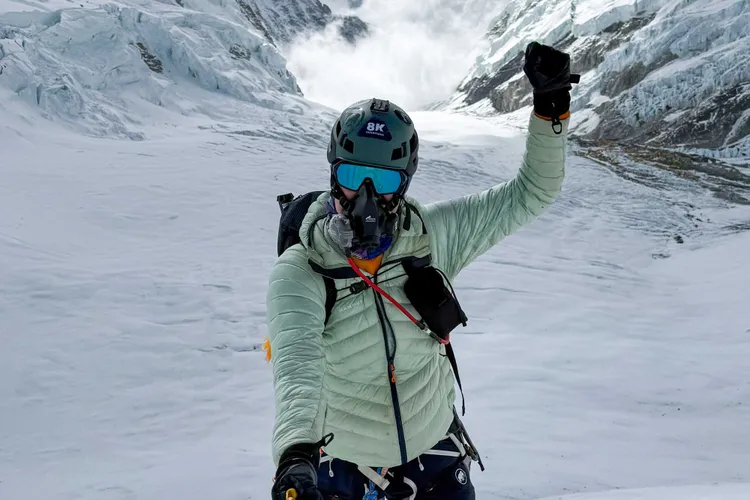

Julia Lyubova has spent a decade mountaineering, yet even she was struck by how much a climb up Mount Everest demands from those who attempt it.
At 29,032 feet, the Himalayan giant requires a level of preparation that many hopeful climbers simply don’t meet. In the spring of 2025, Lyubova made her own ascent of the world’s tallest mountain and says she saw “quite a few people” who weren’t ready for the month-long expedition — and, as a result, never reached the summit.
“People come, they pay all this money, but then they haven’t given enough time for training,” says Lyubova, 44, who estimates that climbing Everest typically costs around $40,000 to $45,000. “It’s crazy to suggest that you will get there without the proper training. How will you survive without proper training?”
:max_bytes(150000):strip_icc():focal(999x0:1001x2):format(webp)/julia-lyubova-110425-7cdfb0f6631f4929bdf6d4066be285e1.jpg)
Lyubova stresses that the physical effort required is often underestimated. Even if a climber hires multiple Sherpa guides to carry bags and set up camps along the way, the journey is still an “enormous job,” she explains. “You still have to do that pushing in your head, pushing on your legs. You still have to make the effort.”
An experienced alpine climber with more than 55,000 followers on Instagram, Lyubova says would-be summiters also tend to overlook just how extreme the mountain’s conditions can be. Violent storms can sweep across Everest, and climbers risk getting lost or trapped in dangerous cold.
Altitude sickness is another serious threat. Lyubova herself developed high-altitude pulmonary edema (HAPE) on her way down from the summit — a potentially fatal condition that causes fluid to build up in the lungs, according to Cleveland Clinic. The illness left her struggling to breathe and ultimately led to an emergency helicopter rescue off the mountain.
But HAPE is not the only life-threatening reaction to extreme altitude. Everest climbers must also be aware of high-altitude cerebral edema (HACE), which Cleveland Clinic describes as swelling in the brain caused by a lack of oxygen.
:max_bytes(150000):strip_icc():focal(665x0:667x2):format(webp)/julia-lyubova-110425-2-9f5cbbb2fff0479285650a97c2e4b36d.jpg)
Lyubova admits she was especially worried about HACE after hearing frightening accounts of fatal cases. “The person becomes totally disoriented. They cannot make decisions themselves,” she explains.
On the very day she reached the summit, another climber died with symptoms consistent with HACE. Lyubova later learned that after she began her descent, the climber “refused to move down.”
“He summited at 2 p.m., and then on the way down, he had altitude sickness … He died at Hillary Step,” she says, referencing the section often considered the final push of the climb. “His Sherpa guide waited with him for a long time until [the Sherpa guide] ran out of oxygen and had to move down himself.”
“This happens quite often, actually, from what I hear,” Lyubova adds. “People get affected by HACE, and they cannot think properly for themselves anymore, and that’s what leads to their death.”
Overall, Lyubova urges anyone dreaming of standing on the world’s highest point to take the preparation phase seriously — long before they ever arrive at Base Camp.
“A lot of people say things about Everest like, ‘Oh, it’s easy. There’s so many unexperienced people,’ ” she says. “I think there are a lot of misconceptions about Everest. It’s the biggest mountain in the world, and I understand why people are attracted to it. People will always be attracted to it — but it takes training.”