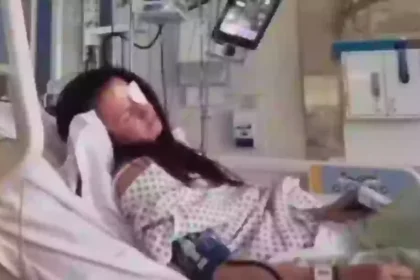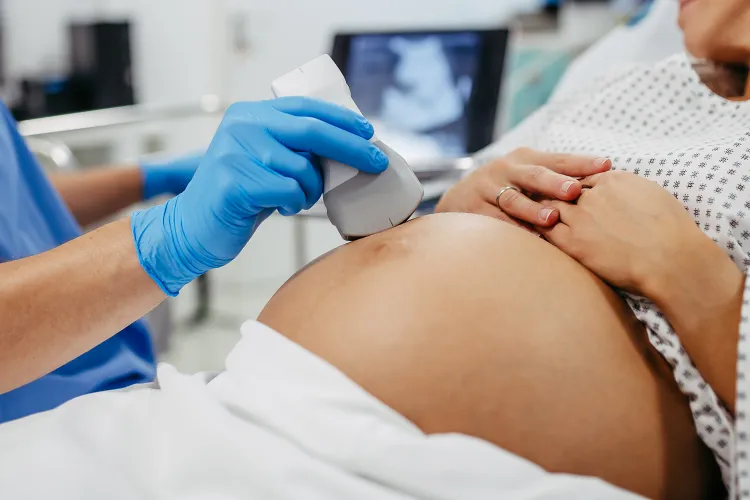

A woman went in for her final ultrasound before giving birth. What happened in that appointment changed her life forever.
Ashleigh Rousseaux was expecting her second child, a baby boy she planned to name Dominic, in 2014.
At her last ultrasound, when she was 39 weeks pregnant, she learned something was terribly wrong. There was no heartbeat, and the room fell silent.
“I don’t even remember the doctor saying the words,” Rousseaux told Mamamia. “I knew immediately what had happened.”
Doctors had previously identified a heart defect, but her medical team had remained cautiously optimistic. Rousseaux said she wasn’t prepared for how quickly everything shifted.
“I remember going out to the front desk and trying to pay, and [the staff] shooing me out the front door,” she recalled. “I was just on autopilot, behaving like I had to keep it all together.”
:max_bytes(150000):strip_icc():focal(749x0:751x2):format(webp)/doctor-with-clipboard-021326-fa5a1fbe41d44a65b087c38f902adf0b.jpg)
Outside, she called her husband.
“The worst moment of my life was making that phone call and telling my husband that his baby had died,” she said. “It was his first day at a new job. It could not possibly have been more horrendous timing.”
She was sent to a hospital across the street, where technicians confirmed Dominic’s death.
“It was a really odd thing to be sitting in both of those spaces at once,” she said, “like the awe and wonder of becoming a new parent to a new baby, but also nothing was how it was supposed to be anymore.”
Rousseaux gave birth at 3:49 a.m. the following morning. Dominic’s funeral was held one week later, on what would have been his due date.
Even after he was gone, Rousseaux said she still felt an intense urge to care for him in any way she could.
Recalling a torn onesie she had bought before he died, she described carefully repairing it by hand.
:max_bytes(150000):strip_icc():focal(749x0:751x2):format(webp)/hospital-room-021326-430c90c66e3646aa9eceef8aa0be0471.jpg)
“I just felt this overwhelming need to mend it for him,” she said. “I remember the day before the funeral getting out my sewing kit and really slowly taking my time to hand stitch this onesie back together. It felt like everything at the time. I had this sense all of my parenting opportunities had gone away — all of those milestones had disappeared, and it became about what I can do right then.”
Today, Rousseaux works at Red Nose, a nonprofit that supports families through child loss and is dedicated to helping prevent sudden infant death.
She said she and her husband have made a conscious effort to keep Dominic’s memory present in their lives. They speak about him openly with their other children and with new people they meet.
“My kids love talking about their brother and aren’t used to judgment or awkwardness when they do so,” she said. “Everyone around us knows and loves our whole family and accepts and embraces that we speak about Dominic openly.”
Rousseaux also hopes that sharing stories like hers can make child loss feel less isolating for other families, including surviving siblings.
“People have the misconceptions that grief is linear. It’s really not — it comes in waves,” she said. “That’s how it is generally for adults, but for a child, you also have development happening at the same time.”
:max_bytes(150000):strip_icc():focal(749x0:751x2):format(webp)/person-holding-teddy-bear-021326-6e5478f1710c470aa3e214c830283046.jpg)
“It can be that a child is quite unfazed by the death of a sibling when they are little,” she added. “But as they get older, they start to understand how life would be different with their sibling here.”
She said her children have found that many other kids respond with curiosity, and that compassion can be taught.
“Our kids have found that other kids meet the topic with curiosity,” Rousseaux said. “If [other kids are] mean about it, they just haven’t been taught yet how to be kind to families like ours. Everyone can learn to do better.”