
An urgent diplomatic push is waiting for President Donald Trump in Davos after several days of escalating rhetoric toward U.S. allies over Greenland.
Top European officials plan to use this week’s annual gathering of global leaders to try to defuse a fast-growing crisis that has rattled the continent — and could now threaten the durability of the seven-decade alliance between Europe and the United States, three people familiar with the discussions told CNN.
That outreach comes as even some figures around Trump have expressed private unease about his language and have been searching for a way to dial down the confrontation.
In the immediate term, Europe’s effort is aimed at lowering tensions after Trump vowed to impose new tariffs on any ally that resists his push for “complete and total control” of Greenland. But the broader goal is to steer the president away from a campaign that has put Denmark and its territory at the center of a geopolitical standoff.
Among the routes under consideration by Trump advisers and Western diplomats: expanding existing agreements that already allow the U.S. to operate military bases and deploy resources on the island, while adding new commercial and economic deals. Supporters of that approach say a formal signing event could give Trump a headline moment he can present as a win, according to people familiar with the matter.
Another option being floated is placing Greenland under a Compact of Free Association, which would preserve its current status while granting the U.S. expanded security access in exchange for financial support. Palau, the Marshall Islands and the Federated States of Micronesia have similar arrangements with the United States.
There have also been early discussions about proposing changes to the 1951 agreement between the U.S., Denmark and Greenland that would more explicitly bar Chinese investment in Greenland, the sources said.
And while Denmark has shown little interest in surrendering its territory, some senior Trump administration officials have spent the past several weeks developing a proposal to purchase the island, according to the people familiar.
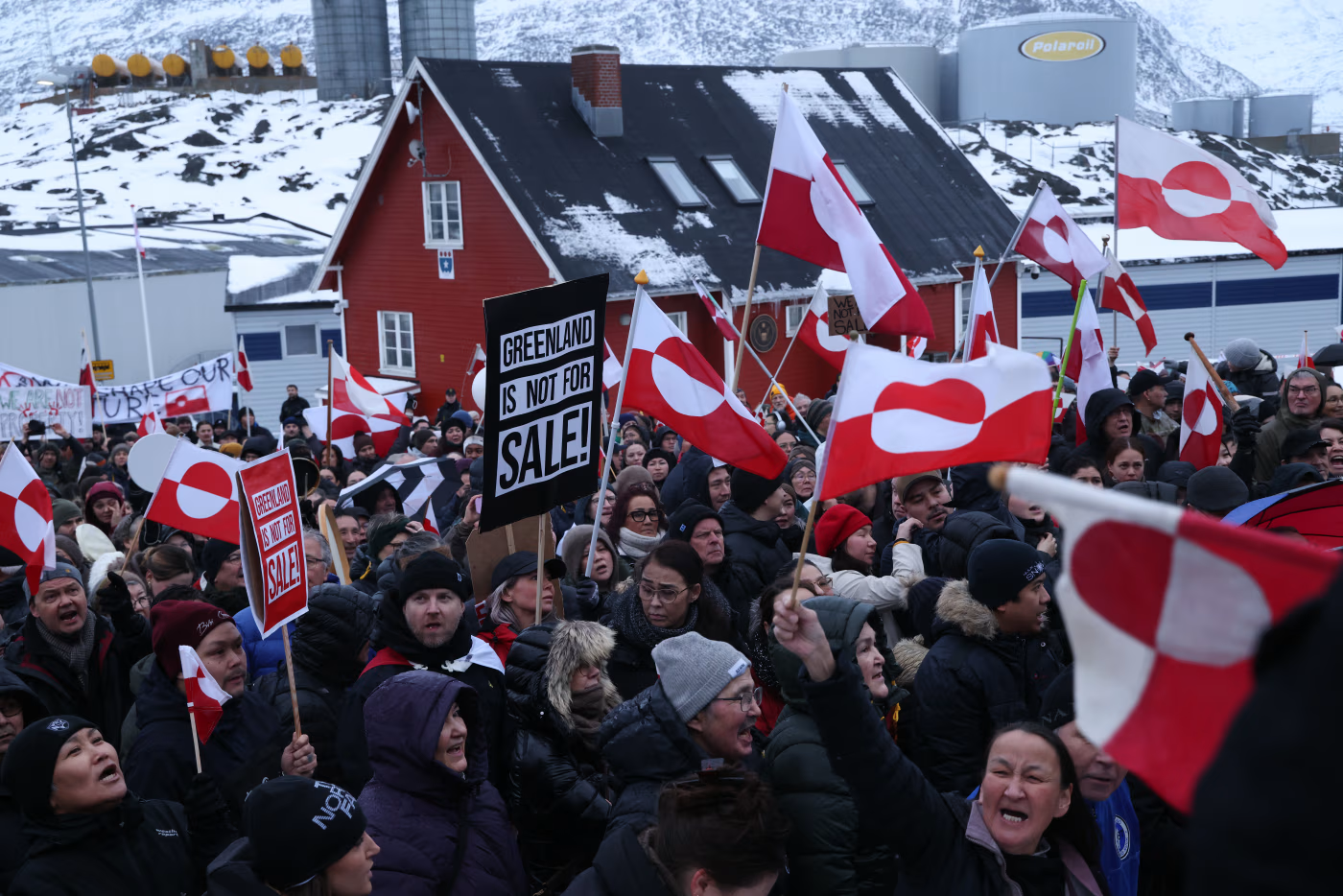
Trump — who arrives in Davos early Wednesday — told reporters before departing Tuesday that he plans to hold a series of meetings focused on Greenland while there, predicting he would land a deal that’s “very good for everybody.” He said NATO would be “very happy,” and claimed Greenlanders — who have protested threats of American annexation — would be “thrilled.”
NATO Secretary General Mark Rutte, who has worked to establish a close relationship with Trump, is among those expected to meet with the president privately on the sidelines of the summit, sources familiar with the plans said.
Despite Trump’s upbeat predictions, he continued to harden his position. On Tuesday, he again insisted “we need” Greenland. Asked how far he would go to gain control of the Arctic island, Trump offered only: “You’ll find out,” before suggesting he could pursue alternative approaches if the U.S. Supreme Court rules against his use of tariffs.
In a statement, White House spokesperson Anna Kelly framed U.S. acquisition of Greenland as a potential advantage for NATO, arguing it “becomes far more formidable and effective with Greenland in the hands of the United States, and Greenlanders would be better served if protected by the United States from modern threats in the Arctic region.”
European allies weigh how to respond
Among Washington’s closest partners in Europe, there is still no unified playbook for how to respond if Trump escalates further.
“They have to respond,” said Ian Bremmer, the president of global risk assessment firm Eurasia Group. “And there’s lots of things they can do, but they have to be willing to do them with sufficient numbers and force that it makes the difference.”
The standoff expected over the next 48 hours underscores how seriously European governments now view Trump’s territorial demands amid his repeated clashes with foreign leaders.
The Greenland dispute has also shifted the calculus in some European capitals after a year in which many U.S. allies tried to placate Trump rather than confront him — often deciding it was safer to give ground than to risk a direct showdown.
Trump has long argued Greenland is vital to U.S. national security and strategically valuable for its mineral reserves. But his push has intensified sharply over the past week, with his threat to target eight European countries with tariffs and his public attacks on the leaders of Norway and France.
The prospect of using economic punishment against allies has alarmed officials across Europe, with warnings that such actions could crack NATO’s foundation — an alliance of 32 member states across Europe and North America.
In Davos, French President Emmanuel Macron condemned the “endless accumulation of new tariffs that are fundamentally unacceptable — even more so when they are used as leverage against territorial sovereignty.”
European Commission President Ursula von der Leyen, in her own World Economic Forum remarks, called for building “a new form of European independence.”
“Threatening to impose economic sanctions means it has moved beyond an abstract issue and a diplomatic crisis into a real economic and political crisis,” said Erik Brattberg, a nonresident senior fellow at the Atlantic Council’s Europe Center. “There’s still a desire to avoid further escalation, but they also feel the need to take a stand and put their foot down.”
Inside European diplomatic circles, officials have discussed a spectrum of possible retaliation — beginning with €93 billion ($109 billion) in counter-tariffs that the European Union previously paused after reaching a trade deal with the U.S. last year, the sources said.
Beyond that opening move, however, officials remain divided on what would most effectively deter Trump if he launches a sustained drive over Greenland. Options under discussion include stepping up sales of U.S. Treasuries, tightening restrictions on American companies, limiting U.S. access to European military bases, or even withdrawing from the upcoming World Cup that Trump has touted as a personal point of pride, the people familiar said.
The EU also has another set of sweeping economic tools meant to punish countries it deems to be coercing the bloc. But deploying that mechanism — known as the Anti-Coercion Instrument — would require unanimous backing and is widely viewed as a last-resort step.
For now, European officials are largely hoping Trump chooses an off-ramp before the situation reaches that level.
Some around Trump believe he is posturing — testing how far he can push to get what he wants — and that there is little appetite for military action. Still, the aggressive tone has raised fears that the damage to critical relationships could be lasting.
And even as leaders on both sides of the Atlantic explore diplomatic exits, the moment remains fraught. Trump has declared that outright ownership of Greenland has become “psychological” in importance — a win he appears increasingly determined to claim.
“It’s trepidation,” Bremmer said, describing the mood among European officials bracing for Trump’s arrival in Davos. “Nobody knows what he’s going to say — including, maybe, him.”