
Ukrainian President Volodymyr Zelensky said on Monday that any roadmap to end the war must require Russia—the “aggressor”—to shoulder the full cost of the conflict it launched with its 2022 invasion.
“The aggressor must pay fully for the war he started, and this is why decisions on Russian assets are essential,” Zelensky told Sweden’s parliament in a video address, stressing that an agreement on using frozen Russian assets is a non-negotiable part of any peace proposal.
He again firmly rejected ceding Ukrainian territory, putting him at odds with the Trump Administration’s 28-point peace plan that leaked last Thursday.
“Putin wants legal recognition for what he has stolen, to break the principle of territorial integrity and sovereignty. That is the main problem,” Zelensky said.
The remarks followed a weekend of talks in Geneva between Ukrainian and U.S. officials about the peace plan originally drafted by Washington.
In a joint statement released Sunday, the U.S. and Ukraine said the discussions produced “meaningful progress toward aligning positions and identifying clear next steps.”
According to the statement, the U.S. agreed to adjust the plan and an “updated” version has now been drawn up.
“The parties drafted an updated and refined peace framework. The Ukrainian delegation reaffirmed its gratitude for the steadfast commitment of the United States and, personally, President Donald J. Trump for their tireless efforts aimed at ending the war and the loss of life,” the statement said.
“Ukraine and the United States agreed to continue intensive work on joint proposals in the coming days. They will also remain in close contact with their European partners as the process advances.”
So far, neither government has published the details of the revised framework or explained precisely how it differs from the widely leaked original U.S. draft.
TIME has reached out to the White House and the Ukrainian government for comment.
As of Monday afternoon, Moscow said it had not received any official update on the plan.
“We are, of course, closely monitoring the media reports that have been pouring in from Geneva in the past few days, but we have not yet received anything officially,” Kremlin spokesperson Dmitry Peskov said, according to Russian state news agency TASS.
Mixed European Reactions
Several European leaders have spoken out more directly about the reported changes to the proposal.
German Foreign Minister Johann Wadephul said Monday that the Geneva talks had produced a “decisive success” for Europe.
“All issues concerning Europe, including those concerning NATO, have been removed from this plan—this is a decisive success that we achieved yesterday,” Wadephul told Deutschlandfunk radio. “It was clear from the outset, as we have repeatedly said, that any agreement must not be reached over the heads of Europeans and Ukrainians.”
Finnish Prime Minister Alexander Stubb, after a morning call with Zelensky, said “steps were taken toward a just and lasting peace” in Sunday’s negotiations, though he acknowledged that “there are still unresolved issues.”
Hungary, which maintains close ties with Moscow, is urging full acceptance of the original proposal. Foreign Minister Péter Szijjártó on Monday called the plan “a major chance to end the war in Ukraine” and accused “some Western European leaders” of trying to block it.
“Our position is clear: every European politician has a duty to support this plan fully and unconditionally, as this is the rational and humane choice,” Szijjártó said.
Questions Over Who Really Wrote the Plan
At the same time, doubts are mounting in Washington about who actually authored the 28-point plan, with some U.S. senators suggesting it may have been shaped by Russia or its allies.
Senator Mike Rounds, a Republican from South Dakota, said at a security conference in Canada that “This Administration was not responsible for this release in its current form,” adding that it “looked more like it was written in Russian to begin with.”
Independent Senator Angus King of Maine voiced similar concerns, saying U.S. Secretary of State Marco Rubio had told him it “was not the Administration’s plan” but more of a Russian “wish list.”
Rubio strongly denied those claims over the weekend.
“The peace proposal was authored by the U.S. It is offered as a strong framework for ongoing negotiations. It is based on input from the Russian side. But it is also based on previous and ongoing input from Ukraine,” Rubio said.
Trump’s Criticism of Ukrainian Leadership
These developments are unfolding as President Trump continues to criticize Kyiv’s leadership.
“The war between Russia and Ukraine is a violent and terrible one that, with strong and proper U.S. and Ukrainian leadership, would have never happened,” Trump wrote on Sunday on Truth Social, appearing to criticize both former President Joe Biden and Zelensky.
“Ukraine ‘leadership’ has expressed zero gratitude for our efforts and Europe continues to buy oil from Russia,” he added.
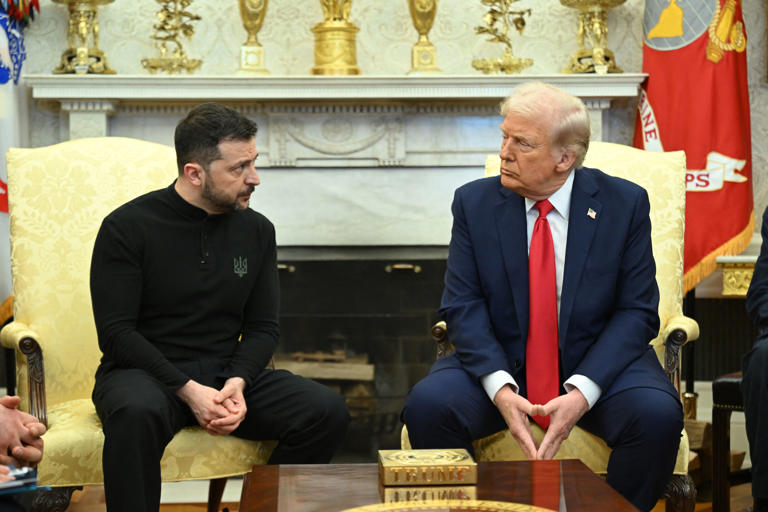
His comments echoed those made by Vice President J.D. Vance during Zelensky’s visit to the Oval Office in February, which ended in an on-camera confrontation. Vance accused Zelensky of being “disrespectful” and “ungrateful,” and the meeting wrapped up abruptly.
On Monday morning, Trump again commented on the ongoing talks, suggesting that “something good” might be emerging.
Zelensky, however, is under time pressure. Trump has set a deadline for the Ukrainian president to respond to the peace plan.
On Friday, Trump said Zelensky has until the U.S. Thanksgiving holiday—Nov. 27—to answer, calling it “an appropriate [amount of] time.” He added that the deadline could be extended if negotiations are “going well.”
In a public address released the same day, Zelensky warned that Ukraine was facing “one of the most difficult moments” in its history, caught between the risk of “losing its dignity” and losing a crucial partner, the United States.
What’s at Stake: Land Concessions at the Core of the Debate
The leaked 28-point draft proposes both military limitations and territorial concessions by Ukraine, outlined in a section labeled “territories.” (These provisions may be among those the U.S. is now willing to amend in response to Zelensky’s firm rejection.)
“Crimea, Luhansk, and Donetsk will be recognized as de facto Russian, including by the United States,” the initial leak stated. “Kherson and Zaporizhzhia will be frozen along the line of contact, which will mean de facto recognition along the line of contact.”
One of the most contentious elements is the idea that Ukraine would also give up some territory it still controls.
Under the proposed terms, Russia would “relinquish other agreed territories it controls outside the five regions” while “Ukrainian forces will withdraw from the part of Donetsk Oblast that they currently control.”
That withdrawal zone would become a “neutral demilitarized buffer zone, internationally recognized as territory belonging to the Russian Federation. Russian forces will not enter this demilitarized zone.”
Earlier this year, Trump told Zelensky to abandon the goal of retaking Crimea, saying there was “no getting” it back. In comments to TIME on Friday, the White House argued that both sides would ultimately “gain more than they must give.”
“Any deal must provide full security guarantees and deterrence for Ukraine, Europe, and Russia to ensure the end of the war, in addition to financial opportunities for Ukraine to rebuild, and for Russia to rejoin the global economy, to benefit the people in both countries,” press secretary Karoline Leavitt said.
Rubio has said that “a durable peace will require both sides to agree to difficult but necessary concessions.”
Why Donetsk and the Donbas Matter
George Barros, senior analyst and Russia and Geospatial Intelligence Lead at the Institute for the Study of War (ISW), says the proposed territorial concessions are particularly troubling because Donetsk Oblast is “Ukraine’s best fortified, best defended terrain at this time.”
Russia is “adamant about having all of the Donetsk Oblast,” he said, emphasizing the strategic importance of the region.
“The Russians are therefore trying to have the Ukrainians diplomatically surrender terrain that the Russian military is very unlikely to actually seize through war fighting. And then once they have this terrain, they have the gate to the center of Ukraine,” Barros argued. “If you give the Russians this terrain, it [increases] the likelihood of them being able to advance much deeper.”
In a Friday interview with FOX News Radio, Trump downplayed such concerns, arguing that Ukraine is already “losing land” and would likely lose it “in a short period of time” if the war continues.
ISW analysis estimates that it would take Russian forces between 635 and 720 days to capture the remaining Donetsk territory still held by Ukraine, although TIME has not independently verified those numbers.
“I reason to assess that they would actually advance slower than that, because of how deep the Ukrainian fortifications are now,” Barros added.
Charles Kupchan, a senior fellow at the Council on Foreign Relations, agrees that Donetsk and Luhansk are strategically crucial.
“The Donbas is an area of potential wealth in the sense that it’s got a lot of minerals, it is part of Ukraine’s industrial heartland and it also has a lot of productive farmland,” he said, warning that any concessions there would further Russian President Vladimir Putin’s ideological ambitions.
“It’s part of his ideological war aim to reattach these regions to Mother Russia. After World War II, the Soviet Union sent a lot of ethnic Russians to this region, and so he’s claiming that he needs to protect ethnic Russians because they’re being persecuted by the Ukrainians, which is not true,” Kupchan argued.
Natia Seskuria, an associate fellow at the Royal United Services Institute (RUSI), voiced similar concerns, saying that such territorial concessions would “basically fulfil what Russia’s plan has been in terms of taking the Donbas region.”
If Russia were granted de facto control over all of Donbas, she added, “then it makes Ukraine much more vulnerable in the future, should Russia decide to wage another offensive.”