President Donald Trump’s letter to Norwegian Prime Minister Jonas Gahr Støre urging U.S. acquisition of Greenland has triggered backlash from critics—and revived a familiar question: could the 25th Amendment be used to remove a president without impeachment?
Newsweek spoke with legal experts about what the amendment does, what invoking it would actually look like, and how realistic it is that President Trump could be removed under its provisions.
Why It Matters
Trump wrote to Støre that the United States needed “Complete and Total Control of Greenland,” adding that he “no longer feel[s] an obligation to think purely of Peace.” He also complained that Norway did not award him the Nobel Peace Prize—despite the fact that the prize is decided by the independent Norwegian Nobel Committee, not the Norwegian government.
After Støre responded, some Democrats called for invoking the 25th Amendment, a constitutional process that allows a president to be declared unfit by members of his own administration.
Since returning to office exactly one year ago, Trump has intensified his rhetoric about annexing Greenland, an autonomous territory within the Kingdom of Denmark. Greenland is also home to the U.S. space base at Pituffik, which Trump has pointed to as evidence the island is vital to American security. The White House has declined to rule out military action to acquire the territory.
The stakes are amplified by NATO: the United States and Denmark are allies under Article 5, which treats an attack on one member as an attack on all. Experts have warned that a U.S. military move against a NATO member would severely fracture the alliance.
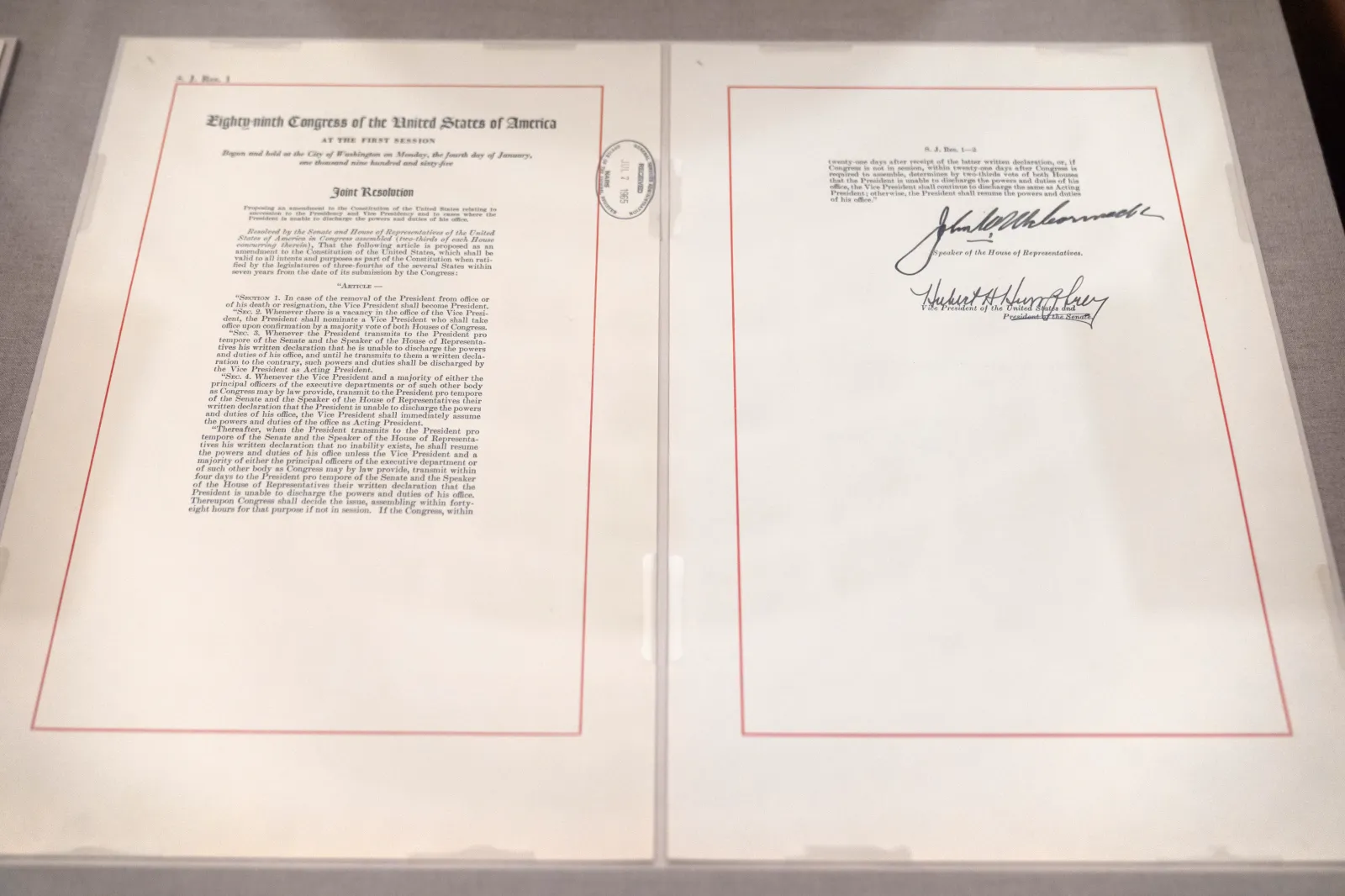
What Is the 25th Amendment?
Ratified in 1967 after the assassination of President John F. Kennedy, the 25th Amendment was designed to address situations in which a president cannot perform the duties of office—especially because of medical emergencies or incapacitation. It has four sections:
- Section 1: If a president dies, resigns, or is removed, the vice president becomes president.
- Section 2: If the vice presidency is vacant, the president nominates a replacement who takes office after majority approval in both chambers of Congress.
- Section 3: A president can temporarily transfer power by sending a written declaration to the House speaker and the Senate president pro tempore stating he is unable to perform his duties. The vice president becomes acting president until the president submits another written declaration saying he can resume. This has been used during medical procedures.
- Section 4: The vice president and a majority of the Cabinet can submit a written declaration that the president is “unable to discharge the powers and duties of his office,” making the vice president the acting president. If the president disputes it, Congress decides—requiring a two-thirds vote in both the House and Senate to keep the president sidelined. Congress has 21 days to resolve the question once formally triggered.
What Does Invoking It Actually Look Like?
“There are both political and legal problems with efforts to invoke the 25th Amendment,” University of Maryland, Baltimore law professor Mark Graber told Newsweek.
He said the primary legal hurdle is that the amendment was built for incapacitation—such as a president being unconscious or physically unable to carry out duties. Graber added that one could imagine a president whose mental condition made the job impossible, but he argued Trump was not suffering from that kind of psychosis.
Graber said Trump’s “platform and characteristics” may be seen by critics as political disqualifications—but that the 2024 election reflected the public’s judgment. He added that impeachment is the constitutional pathway for misconduct, though it faces similar political barriers.
Democrats including Reps. Yassamin Ansari and Sydney Kamlager-Dove, and Sen. Ed Markey, have urged invoking the 25th Amendment after Trump’s message to Støre.
Michigan State University College of Law professor Brian Kalt told Newsweek it is unlikely the vice president and Cabinet would interpret Trump’s message as a new threshold-crossing moment. In his view, many people believed Trump crossed “a line” long ago, but the decision rests with the president’s inner circle.
Still, Kalt noted that Cabinet officials may have a closer view than the public of whether a president is functioning normally—and if they truly believed he could not function, they would be expected to act.
What Happens Next
Trump is expected to speak in Davos on Wednesday as global leaders continue to push back against his Greenland claims. Tariffs he announced targeting European countries backing Denmark are set to take effect on February 1.
Even with growing calls from critics, the 25th Amendment still appears unlikely to be invoked. But pressure for impeachment could rise if Trump takes steps toward acquiring Greenland by force—especially if opposition grows inside his own party, as Bacon suggested.