
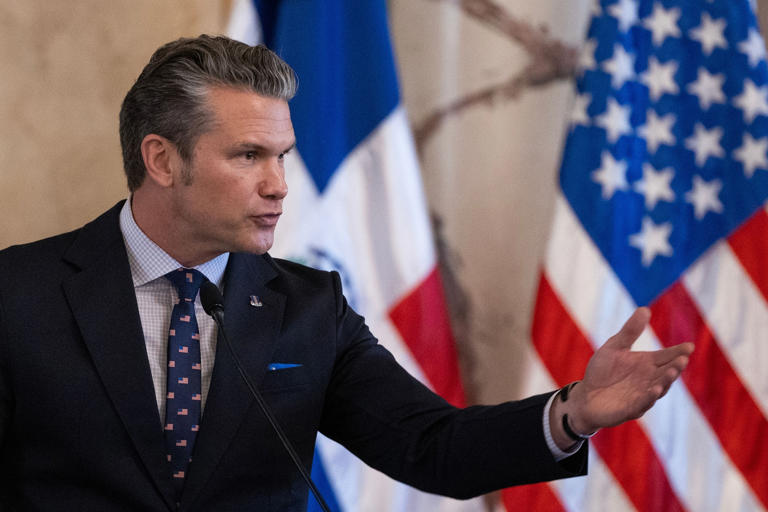

Defense Secretary Pete Hegseth and a top military commander are under intense scrutiny over why U.S. forces killed survivors of a Sept. 2 strike on a suspected drug-smuggling boat in the Caribbean Sea, despite laws of war that require rescuing wounded and shipwrecked individuals on the battlefield.
The White House has acknowledged that a second strike was ordered on a vessel that had already been hit, and ABC News has confirmed that survivors from the initial attack were killed in that follow-up strike.
Democratic lawmakers say that alone could raise the possibility that a war crime was committed, since the laws of armed conflict require all sides to provide care and protection to wounded and shipwrecked combatants.
Hegseth has defended the mission as lawful, telling Fox News that he watched the operation unfold in real time. His public comments suggest he is relying on legal frameworks developed during the post-9/11 war on terror, when the U.S. justified targeting people transporting weapons it said posed an imminent threat to American forces.
“We’re going to conduct oversight, and we’re going to try to get to the facts,” Sen. Roger Wicker, the Republican chairman of the Senate Armed Services Committee, told reporters on Monday. “And to the extent that we’re able to see videos and see what the orders were, we’ll have a lot more information other than just news reports.”
Here are three central questions now confronting the Pentagon and Congress:
1. What exactly did Hegseth order?
Lawmakers are focused on Hegseth’s initial “execute order” and the intelligence that underpinned it.
According to The Washington Post, sources allege that Hegseth instructed the military to ensure that none of the 11 people on board the suspected smuggling vessel were left alive. After the first strike left two individuals clinging to debris, the report says Adm. Mitch Bradley, then leading Joint Special Operations Command, ordered a second strike to carry out that directive and ensure everyone was killed.
Hegseth has dismissed that account as a “fabrication,” and his chief spokesman, Sean Parnell, denounced the allegation as a “fake news narrative that Secretary Hegseth gave some sort of ‘kill all survivors’ order.”
The Pentagon has declined to clarify what, precisely, was contained in Hegseth’s initial order.
On Monday, White House press secretary Karoline Leavitt confirmed that a second strike took place but did not address questions about survivors. Asked whether Adm. Bradley made the decision on his own, she suggested that was the case, saying, “And he was well within his authority to do so.”
2. Why did Adm. Bradley authorize follow-up strikes after seeing survivors?
Multiple sources describe Bradley, a former Navy SEAL, as a highly experienced and widely respected commander. By the time of the Sept. 2 operation, he had already overseen special operations missions in the Middle East under U.S. Central Command and had assumed leadership of Joint Special Operations Command, which is responsible for planning and executing complex missions in some of the world’s most demanding environments.
When President Donald Trump nominated Bradley this fall to lead U.S. Special Operations Command, the Senate confirmed him by voice vote, signaling broad support.
Eric Oehlerich, an ABC News contributor and former Navy SEAL who served under Bradley during the war on terror, said he has never seen Bradley push the legal boundaries in combat.
Oehlerich said that if Bradley did order subsequent strikes on Sept. 2, as the White House has indicated, the decision likely rested on Hegseth’s initial directive and on intelligence assessments about why the alleged smugglers were considered a threat to the United States.
He added that Bradley would have consulted a military lawyer during the operation.
“There isn’t a single commander that’s sitting in a position of authority that does not have a lawyer as the closest person to him sitting there watching the entire time,” Oehlerich said.
Hegseth has said he personally oversaw the mission, telling Fox News on Sept. 3 that he watched the operation “live.” Yet in a post on X on Monday, he appeared to shift focus to Bradley, writing that the operation was the admiral’s call.
“I stand by him and the combat decisions he has made — on the September 2 mission and all others since,” Hegseth wrote.
Bradley declined to comment publicly but was expected to brief lawmakers later in the week.
3. Who was killed — and did they pose a threat to the U.S.?
Hegseth’s justification for targeting suspected drug smugglers appears to mirror the legal authority used after the Sept. 11 attacks, when Congress approved the use of military force against groups linked to al-Qaida. That authorization allowed U.S. commanders in places like Iraq and Syria to attack individuals transporting improvised explosive devices, which were considered an immediate threat to American troops.
Earlier this year, President Donald Trump argued that narcotics traffickers are as dangerous to Americans as al-Qaida terrorists. He designated several drug cartels as “foreign terrorist organizations.”
Legal experts, however, have challenged the comparison between drug smugglers and fighters for groups like al-Qaida or ISIS, and they note that Congress has not approved any separate authorization to use force in this context.
A crucial unresolved issue is who, exactly, was on the targeted boats and what level of threat they posed — an assessment that would have been developed by the intelligence community and approved by Hegseth.
Rep. Jim Himes, the top Democrat on the House Intelligence Committee, said he is still waiting for details on how U.S. intelligence supported the strikes and whether the operations are achieving any broader strategic goals. Bradley was expected to brief House lawmakers on Thursday.
“If it is substantiated, whoever made that order needs to get the hell out of Washington,” said Sen. Thom Tillis, R-N.C. “And if it is not substantiated, whoever the hell created the rage bate should be fired.”


