
Inoperable pistols gifted by FBI Director Kash Patel to senior New Zealand security officials — and later surrendered for destruction because they were illegal to possess — were actually 3D-printed revolvers modeled on toy Nerf guns and popular among home-made weapons enthusiasts, documents obtained by The Associated Press show.
The AP previously reported that Patel presented the plastic 3D-printed replica revolvers to New Zealand’s police and intelligence chiefs, as well as two cabinet ministers, during a visit in July. Newly released police documents identify the weapons as the Maverick PG22, a functioning revolver based on the brightly colored toy gun of the same name.
Under New Zealand law, pistols are tightly controlled and require a special permit in addition to a standard firearms license. Authorities have not said whether the officials who received Patel’s gifts held such permits. Without them, they were not legally allowed to keep the guns.
After the officials handed over the revolvers, email exchanges between senior police staff and firearms specialists confirmed that the gifts met New Zealand’s legal definition of firearms. In the eyes of the law, 3D-printed guns are treated no differently from conventionally manufactured weapons.
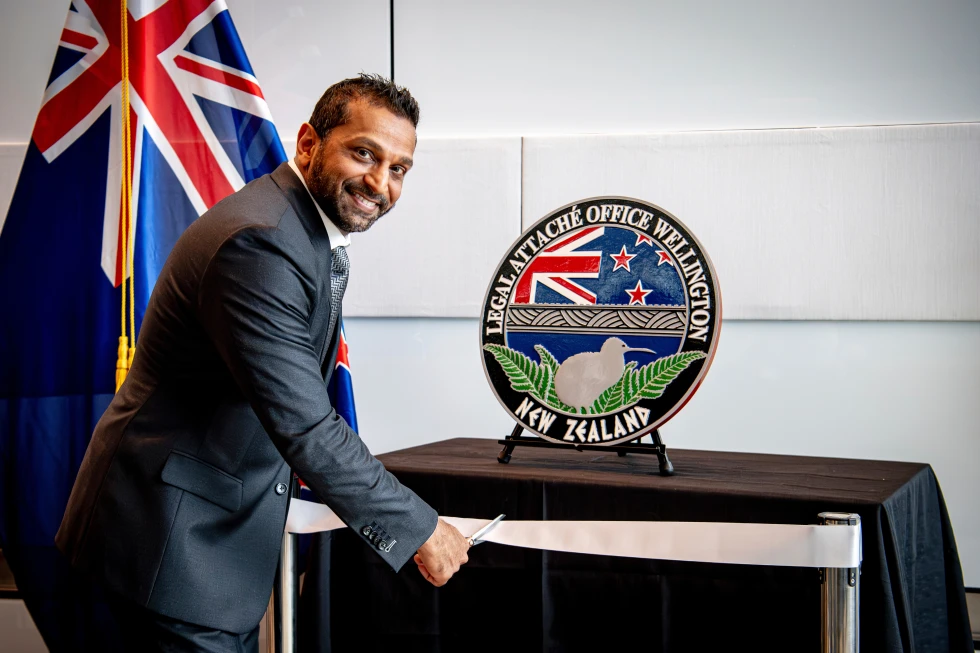
Patel, the highest-ranking Trump administration official to visit New Zealand, traveled to Wellington to inaugurate the FBI’s first standalone office in the country.
“The gifted item was a 3D-printed replica of a firearm, and it was specially designed to be incapable of firing ammunition,” a spokesperson for Patel said in an email Tuesday. “The item was modified in various ways, to include but not limited to omitting chambers, barrels, and firing pin within the replica. These modifications ensured that it was inoperable.”
Experts say guns could be made operable
New Zealand law does not draw a distinction between an inoperable firearm and one that can be made functional with relatively simple modifications. In August, just days after Patel’s visit, police armory team leader Daniel Millar emailed his superiors to explain how easily the Maverick PG22 models could be converted into working guns.
“These processes are very straight forward processes and require minimal skills and common ‘handyperson’ tools,” Millar wrote, adding that these tools were “a battery drill and a drill bit for the holes and a small screw for the firing pin.”
The New Zealand Police Association said in February that the Maverick PG22 is among the most commonly seized 3D-printed firearms in the country. Millar noted that his team had asked to retain one of the revolvers for testing, but the police commissioner rejected the request, and all of the guns were destroyed on Sept. 25.
“The first risk is that it can be made viable and it gets into the hands of the wrong person and it’s used for a crime,” said professor Alexander Gillespie, a firearms regulation specialist at the University of Waikato. “The second risk is it just explodes because it’s not actually safe. There’s a reason these have been made in people’s backyards instead of coming from an armory.”
Online build guides for the Maverick PG22 warn that it “does not feature proper modern safeties and should be used in a controlled environment.”
Who manufactured Patel’s gifts remains unclear. Millar wrote that the examples received by New Zealand officials had been “manufactured to a high standard.”
Five senior officials received the guns
Three of New Zealand’s top security officials said they were given revolvers on July 31. One was Police Commissioner Andrew Coster. The others were Andrew Hampton, director-general of the New Zealand Security Intelligence Service (NZSIS), and Andrew Clark, director-general of the Government Communications Security Bureau (GCSB), the country’s signals-intelligence agency.
Police Minister Mark Mitchell and Defense Minister Judith Collins, who also oversees the intelligence services, each received a revolver in separate meetings with Patel. All five officials voluntarily turned over the weapons.
In New Zealand, it is unusual to see police officers routinely carrying guns. Front-line officers typically patrol unarmed, keeping their firearms secured in lockboxes inside their vehicles.
New Zealand Police declined an AP public records request for photographs of the guns, arguing that “releasing the requested images would be likely to prejudice New Zealand’s relations with the United States of America.”
Although photos and instructions for producing the Maverick PG22 are readily available online, police did not explain why images of gifts from a U.S. official to New Zealand counterparts would endanger diplomatic ties.
New Zealand’s tightened gun laws
New Zealand drastically strengthened its gun laws after a 2019 white supremacist attack on two mosques in Christchurch. An Australian gunman, who had legally collected multiple semiautomatic weapons, killed 51 Muslim worshipers during Friday prayers.
The revolvers Patel gave to New Zealand officials were not among the semiautomatic firearms banned after the Christchurch massacre. Even so, there are numerous other legal hurdles to possessing particular weapons, including the requirement for specific permits to own pistols.
New Zealand does not have a deeply rooted gun-rights culture, and attitudes toward firearms have become more cautious since the mass shooting. In law, gun ownership is defined as a privilege rather than a right.
Firearms remain common in rural areas, where they are used primarily for pest control and hunting. But serious gun violence is rare, and many city residents may go their entire lives without seeing a real firearm up close.