
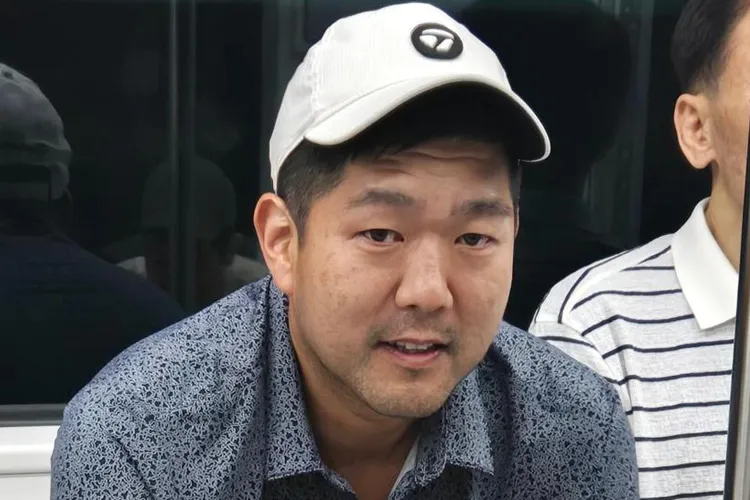

A 40-year-old scientist and permanent U.S. resident has been held in immigration custody for over a week without a clear explanation, according to his attorney, after being detained by officials upon returning from his brother’s wedding earlier this month.
Tae Heung “Will” Kim, a Ph.D. student at Texas A&M University, was reportedly stopped by immigration authorities at San Francisco International Airport on July 21. Officials have yet to publicly state the full reason for his detention, though they’ve indicated it stems from a misdemeanor drug charge from over a decade ago, and claim he now faces deportation as a result.
“If a green card holder is convicted of a drug offense, violating their status, that person is issued a Notice to Appear and CBP coordinates detention space with ICE,” a Customs and Border Protection spokesperson said. “This alien is in ICE custody pending removal proceedings.”
Kim has lived in the United States since he was five years old and has dedicated his academic work to researching Lyme disease prevention, according to the National Korean American Service and Education Consortium.
:max_bytes(150000):strip_icc():focal(749x0:751x2):format(webp)/Tae-Heung-Will-Kim-2-073125-50d56ce939cf412c825a6e9aed123fee.jpg)
“He is being held in inhumane conditions without access to legal counsel,” NAKASEC stated in a release.
Supporters say Kim has not received formal clarification on why he was detained. In 2011, he was charged with misdemeanor marijuana possession and fulfilled the terms of his sentence, including court-ordered community service, NAKASEC said.
“Having taken responsibility and successfully paying his dues, Will should be able to rebuild and return to his life like anyone else,” the group said.
Despite that, Kim has reportedly endured extended confinement under harsh conditions, in violation of CBP’s own guidelines, which advise against detaining individuals for more than 72 hours.
His attorney, Karl Krooth, stated that Kim was forced to sleep in a chair with the lights kept on 24/7. He had access only to water and food from a concession stand.
Eric Lee, a partner at Lee & Godshall-Bennett, LLP, which is representing Kim pro bono, said a CBP supervisor shockingly asserted that Kim, despite being a lawful permanent resident, had no constitutional rights — a claim Lee flatly disputes.
:max_bytes(150000):strip_icc():focal(749x0:751x2):format(webp)/Tae-Heung-Will-Kim-1-073125-7657c229da8447bb979ba5b57e1c9920.jpg)
“When I asked whether the Constitution applied to Will, a green card holder who has lived here for 35 years, the officer said, ‘No,’ ” Lee recalled in a statement.
CBP did not respond to PEOPLE’s inquiries about the reported treatment Kim has received while in custody or the alleged denial of his constitutional protections. Immigration and Customs Enforcement also declined to comment.
Kim’s mother, Yehoon “Sharon” Lee, expressed heartbreak over her son’s treatment.
“We believed that the U.S. was the best place for us to raise our family, and for decades we built our life here,” she said. “My children only know the U.S. as home. Will should not be trapped or treated poorly just because he made a mistake or is not a citizen. He deserves to go back to his normal life.”
Kim’s case is one of several drawing attention since President Donald Trump returned to office and renewed a hardline focus on immigration enforcement.
The president’s campaign pledged to “seal” the southern border and increase removals of undocumented individuals, especially those with criminal records. However, some deportation efforts — including Kim’s — have sparked controversy.
Other recent cases have involved mistaken arrests and families torn apart due to mixed immigration statuses.
In a statement, NAKASEC Co-Director Becky Belcore criticized the administration.
“CBP’s arrest of Will highlights a dangerous escalation of the Trump regime’s attacks on individuals, communities, and constitutional rights,” she said. “For many of our Asian and immigrant communities, we know too well the slippery slope toward authoritarianism when one person or community’s rights can be disregarded.”


