
Salym Liufau was at a family birthday party in 2022 when she bent down to pick up her kids—something she’d done countless times as a mom of four. But this time, something felt off.
“I couldn’t stand back up,” she recalled. “It didn’t hurt, but it just felt wrong.”
At first, she brushed it off. Life was busy. Her family was in the middle of relocating from Las Vegas to Houston, and she chalked it up to stress or fatigue. But in the following weeks, her left foot began to feel weak and unresponsive. Eventually, she lost all movement in it.
After the move, her symptoms worsened.
“I remember thinking, ‘Why can’t I run anymore?’” she said. “I wasn’t an athlete, but I could easily run a couple of miles. Suddenly, I couldn’t even go a quarter mile. I got on the treadmill, and my body just wouldn’t work.”
It was then that she turned to her husband, tears in her eyes, and said, “Something’s wrong with me. Seriously wrong.”
In February 2022, after settling into Texas, Salym went to her primary care doctor. Her bloodwork was normal, and he offered a hopeful guess: maybe it was just a vitamin issue.
:max_bytes(150000):strip_icc():focal(599x0:601x2):format(webp)/Salym-Liufau-8-071525-3dcf900617274d0b91fb77f994f60c59.jpg)
But Salym’s intuition told her it was more. Eventually, she was referred to a neurologist.
After a quick exam, the neurologist acknowledged, “This is beyond me. You need a specialist.”
Her worry only deepened when she learned the earliest specialist appointment wasn’t for another two months.
“I thought, ‘I can’t wait that long. Something’s happening now,’” she said.
So she admitted herself to Houston Methodist Hospital. During a routine reflex test, doctors tapped her knee—nothing. She was hospitalized immediately.
Over the next 10 days, she underwent test after test: MRIs, CT scans, muscle biopsies, and endless rounds of bloodwork.
“There must be a blood bank out there with my name on it,” she joked.
:max_bytes(150000):strip_icc():focal(599x0:601x2):format(webp)/Salym-Liufau-5-071525-07bf67bf82e64f2091484ecaf54fdc81.jpg)
The most painful were the EMGs—nerve tests that involved inserting needles into her muscles and sending electrical pulses.
“They’re awful,” she said. “I’d rather be in an MRI all day than do one more EMG.”
As they waited on results from the Mayo Clinic, doctors started her on steroids, which helped briefly. Still, her condition continued to worsen. At home, she tried to maintain a sense of normalcy for her kids, then 8, 6, and 2-year-old twins.
“I just told them the doctors were trying to help Mom get better,” she said.
Finally, in May, she saw the specialist. More EMGs followed—including on her tongue. On May 23, 2023, she got the diagnosis.
“He looked at me and said, ‘This doesn’t look good,’” she recalled. When the biopsy results came in, he told her: You have ALS.
She was 31.
According to the ALS Association, amyotrophic lateral sclerosis is a progressive neurodegenerative disease that affects nerve cells in the brain and spinal cord. There is no cure.
Her doctor laid out the harsh truth: there were only three FDA-approved medications available. They might slow the disease—but only for a few months. The average life expectancy after diagnosis? Two to five years.
“I’m a quiet crier,” she said. “The tears just started falling. My husband kept it together. He said, ‘It’s going to be okay.’ But my heart broke—not for me, for my kids. They’re so young. And for my husband.”
“It felt like my soul left my body,” she added. “It’s a pain you hope no one else ever has to feel.”
Before ALS entered the picture, life was busy and fulfilling. “It was honestly my dream life,” she said. “I worked, my husband was a firefighter, and the kids were always in school and sports. I did it all—meals, bedtime, school drop-offs—while working. It was a beautiful kind of chaos.”
Now, daily life has changed. Quieter. Slower. More deliberate.
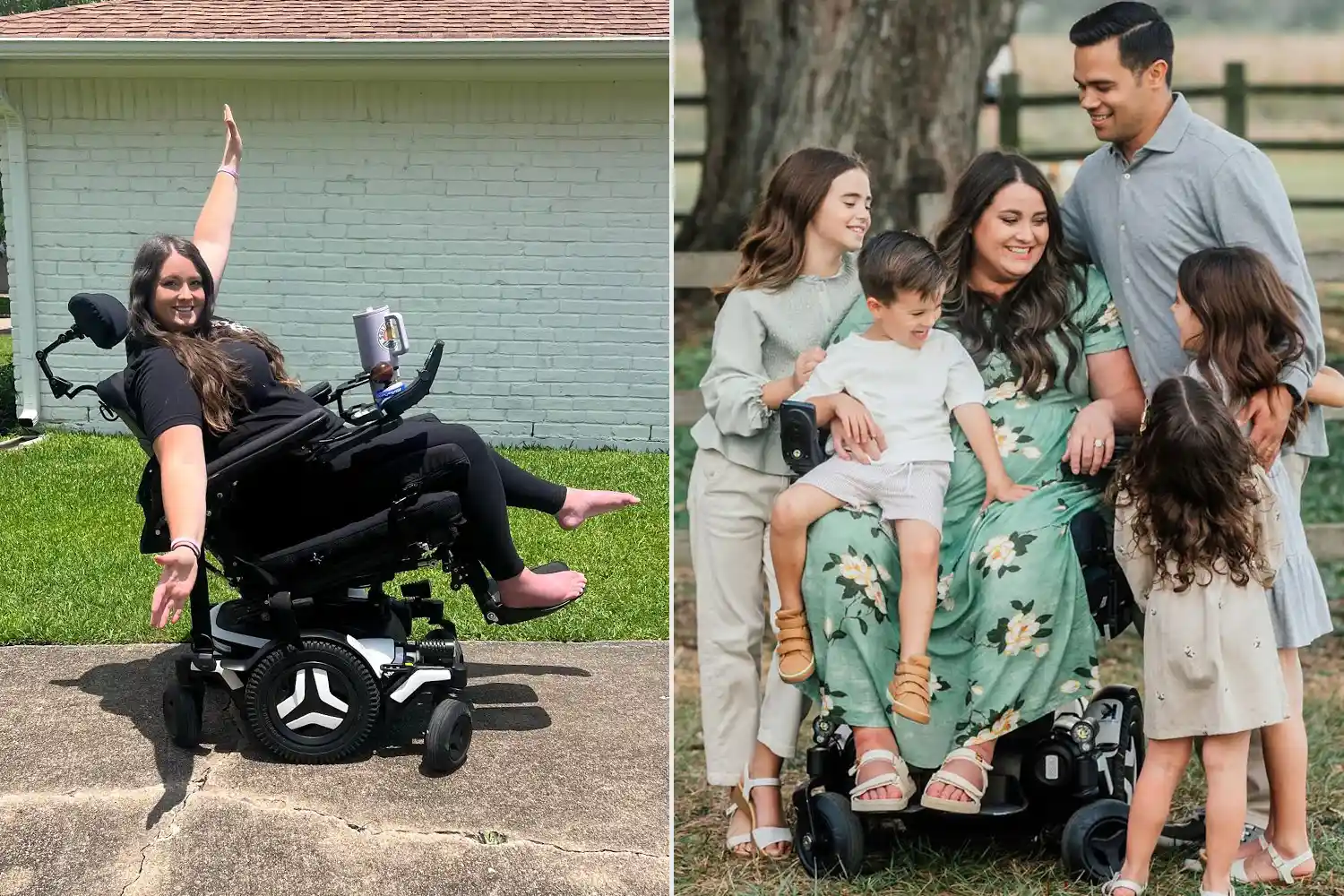
“I can’t walk anymore,” said Salym, now 33. “My legs are almost entirely paralyzed. I can move my toes a bit, but not in any useful way. I use a wheelchair now.”
Despite the physical decline, she focuses on what she can do—and on creating memories with her kids, now 10, 8, and 4.
She documents her journey on TikTok and Instagram (@alswithsalym), where she’s built a strong and supportive following. One especially touching video that’s been seen by over 600,000 people shows her teaching her daughter how to style hair.
“She was so proud,” she said. “She looked at me and said, ‘These are slay!’ I call my followers my spicy chicken nuggets—she knows that. It was pure joy.”
“She’s at the age where she’s into makeup and hair,” Salym added. “And I knew it was time to teach her, because my hands are starting to curl. They still work, but not for long. I wanted to pass this on while I still could.”
That sense of joy and purpose helps keep her grounded.
“I’m just trying to teach them all the little things—how to cook, how to crochet, how to hold a pencil,” she said. “One of my daughters is making her first dishcloth. These are the things I want to leave them.”
“I want to show people they can do hard things,” she added. “Don’t take movement for granted. Life is hard—whatever your story is—but you can find something beautiful in it. Even on the worst days, you can find joy in something small.”
Still, some days are incredibly difficult.
“Not being able to do things for my kids—it breaks me,” she said. “I had to walk my 10-year-old through making a simple dinner. I can’t bathe the twins. Just the basic mom things that I want to do but physically can’t.”
But even in those moments, she finds comfort. The morning of her interview, she couldn’t get out of bed. Her husband had already left for work. That’s when her 8-year-old stepped in to help.
“That’s joy,” she said.
Salym has started writing letters to her children and husband—memories, advice, love in written form. Her family and friends have launched a GoFundMe to help with the growing medical costs and necessary accommodations.
“I used to plan everything in five-year blocks,” she said. “Now I just focus on the month in front of me. Sometimes even just the moment.”
Recently, she had a conversation with her children to explain the reality of what she’s facing.
“I told them, ‘I’m not going to get better. Not today, not tomorrow—but someday I’ll pass away,’” she shared. “They asked, ‘Will you be here for a couple more years?’ and I said, ‘I hope so.’ I told them, ‘We all go to heaven. So no matter what, we’ll still be close.’”
The kids are slowly beginning to understand.
“They’ll ask things like, ‘Will Dad get remarried?’” she said, laughing gently. “And I tell them, ‘Maybe, if he finds the right person.’ And they’re like, ‘No, he can’t!’ They’re still trying to make sense of it all.”
Her 12-year-old niece and extended family have stepped in to help care for the kids. “She’s a little angel,” Salym said of her niece. “It’s been good for the kids to have her around.”
In quiet moments, Salym is also preparing in her own way.
She recently arranged to have her obituary photo taken—but didn’t tell anyone until after.
“My husband didn’t even know until I posted it,” she said. “He said, ‘I didn’t know you did that.’ And I told him, ‘I wanted it to feel like just another day. We needed family photos anyway.’”
Instead of focusing on group shots, she asked the photographer for something specific.
“I said, ‘Can you take my obituary photo?’” she recalled. “I didn’t want it to be from too far along, when my body had changed more. But I didn’t want it to be from before my diagnosis either. I call that ‘preemie’—before I became who I am now.”
It was a hard day. Around the kids, she kept her emotions tucked away.
“My husband said, ‘I thought you’d want one of you standing.’ And I told him, ‘No. That’s not really me anymore. That was me, but not the whole story. I’m both—who I was and who I’m becoming.’”
She wanted a photo that showed that.