
A rare reptile is drawing renewed attention from Florida wildlife officials.
On Monday, Aug. 19, the Florida Fish and Wildlife Conservation Commission (FWC) asked the public to report any sightings of the rainbow snake — a secretive, nonvenomous reptile that has become increasingly scarce in recent decades.
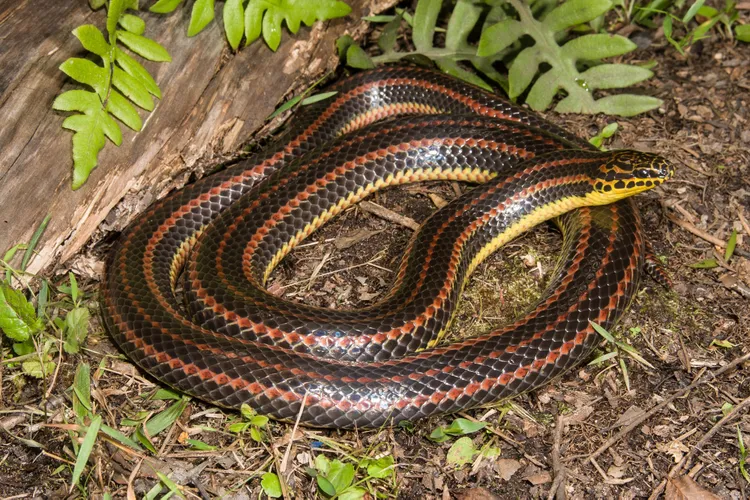
The rainbow snake (Farancia erytrogramma) is known for its striking appearance: glossy black or violet-blue scales that shimmer with iridescence, three bright red stripes running down its back, and yellow chin and lip scales accented with violet spots. Adults typically measure between three and four feet long.
According to USA Today, the last documented sighting of this elusive species in Florida occurred in February 2020.
FWC officials note that rainbow snakes rely heavily on American eels as their main food source. A decline in that prey, coupled with habitat loss, has driven population decreases. In addition, some populations in other states face threats from snake fungal disease, adding to concerns about the species’ long-term survival.
:max_bytes(150000):strip_icc():focal(999x0:1001x2):format(webp)/rainbow-snake2-81925-c4946d5557d64a6ab32c132bc45cb2df.jpg)
“We need help from Floridians and visitors to better understand where rainbow snakes still occur in the state,” said Kevin Enge, a research scientist with FWC’s Fish and Wildlife Research Institute. “Every sighting report gives us valuable data about their current distribution and helps us assess the health of the species in Florida.”
The Florida Museum at the University of Florida describes rainbow snakes as highly aquatic and notoriously secretive. They are rarely spotted, though they may occasionally be seen crossing roads between waterways on rainy nights or gliding slowly along the bottom of spring-fed rivers by swimmers and divers.
Despite their vivid appearance, rainbow snakes are harmless to humans. Some mistakenly believe the species has a stinger at the tip of its tail, but experts say the pointed scale is not dangerous.
These reptiles prefer habitats near rivers, springs, and brackish marshes. Historically, the South Florida subspecies was documented in Fisheating Creek in Glades County, more than 150 miles south of the nearest known population in Lake County. However, no confirmed sightings have been recorded in that area since 1952.
FWC officials are urging the public to help track the species’ current distribution. Sightings can be submitted online, and photographs are encouraged to confirm identifications.