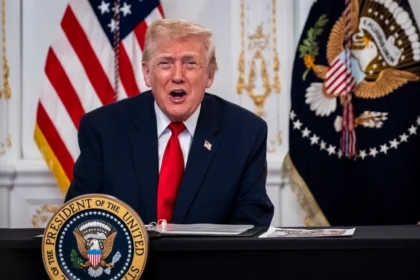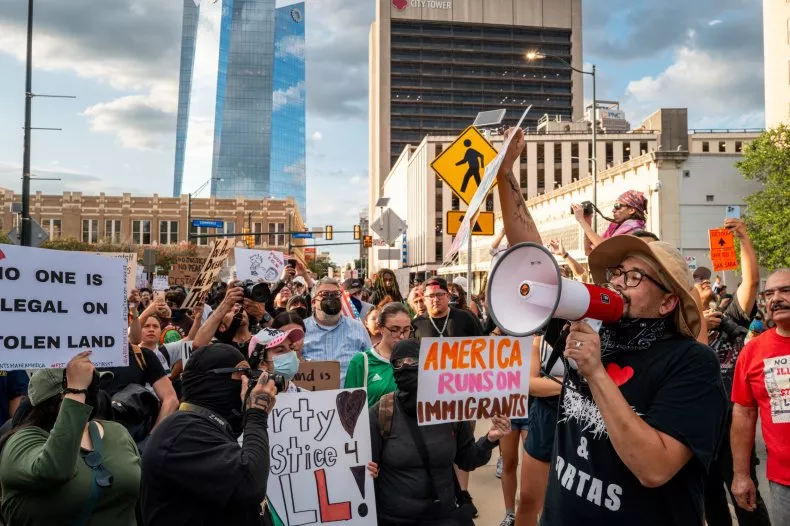

A federal appeals court on Tuesday refused to block the rollout of a national registry for noncitizens, handing the Trump administration a procedural win in a closely watched case that immigrant rights groups have strongly opposed.
In a per curiam order—meaning issued in the name of the court rather than a specific judge—a three-judge panel of the U.S. Court of Appeals for the D.C. Circuit denied an emergency request from advocacy groups to halt the Alien Registration Requirement (ARR) while the case moves forward.
Judges Karen Henderson, Robert Wilkins, and Bradley Garcia—appointed by Presidents Ronald Reagan, Barack Obama, and Joe Biden, respectively—ruled that the plaintiffs had not met the “stringent” threshold for an injunction pending appeal.
The decision ensures the registry will remain in effect nationwide for months as the legal battle continues. For the Trump administration, it marks progress in reviving strict immigration enforcement rooted in decades-old laws. For immigrant rights organizations, it signals a tough fight ahead against a policy they say could deter noncitizens from public life and expose millions to surveillance and potential prosecution. The ruling also highlighted that judges across party lines agreed the plaintiffs failed to meet the legal standard for emergency relief.
The regulation, which took effect April 11 after a lower court ruling, requires all noncitizens aged 14 and older to provide fingerprints and carry an identification card or risk fines or jail time. Children under 14 must be registered by a parent or guardian and re-register upon turning 14.
The Department of Homeland Security (DHS) estimates between 2.2 million and 3.2 million people may be affected, largely those who entered the U.S. without documentation. Canadians staying longer than one month are also included under the rule.
Tuesday’s decision keeps in place an April 10 ruling from U.S. District Judge Trevor McFadden, a Trump appointee, who determined that the plaintiffs—Coalition for Humane Immigrant Rights, United Farm Workers of America, Casa Inc., and Make the Road New York—had not shown the registry would undermine their core missions. McFadden said their arguments amounted to only speculative harm, leaving the court unable to rule on the merits.
The plaintiffs contend that the registry, which the Trump administration argues is consistent with the 1952 Immigration and Nationality Act, is part of a broader “self-deportation” strategy.
Carl Berquist, general counsel for the Coalition for Humane Immigrant Rights, told Courthouse News the registry “melds into the administration’s entire self-deportation plan of rolling out these [ICE] raids, repurposing the CBP One app into this CBP Home app with a self-deportation tool and trying to roll out some kinds of incentives for people to take action.”
He said the measure has had a “severe chilling effect” on noncitizens, raising concerns about “their Fifth Amendment right not to self-incriminate” and “their First Amendment right to assemble and to protest.” While describing the case as “a little bit below the radar” compared with higher-profile immigration disputes, Berquist insisted the harm is “substantial nonetheless.”
The National Immigration Law Center has also warned the policy could lead to racial profiling. In a statement, the group said: “While their stated targets are undocumented immigrants, the very mechanics of enforcing registration expand the target to anyone who looks or sounds foreign to law enforcement.”
Newsweek contacted Carl Berquist and the National Immigration Law Center for comment via email on Thursday outside of regular office hours.
DHS Assistant Secretary for Public Affairs Tricia McLaughlin said: “The Trump administration will enforce all our immigration laws—we will not pick and choose which laws we will enforce.” In a statement to Courthouse News, she added: “We must know who is in our country for the safety and security of our homeland and all Americans.”
According to DHS, several categories of immigrants—including green card holders, individuals with removal orders, Employment Authorization Document holders, those admitted with visas, and border crossing card holders—are already considered registered under existing law.
The D.C. Circuit has set an expedited briefing schedule, with the plaintiffs’ filing due September 16, the government’s response due October 16, and the plaintiffs’ reply due November 6. Oral arguments will be scheduled afterward.
For now, the ARR remains in effect nationwide, with both sides preparing for a fall showdown that could help define the government’s authority to require noncitizen identification and tracking.