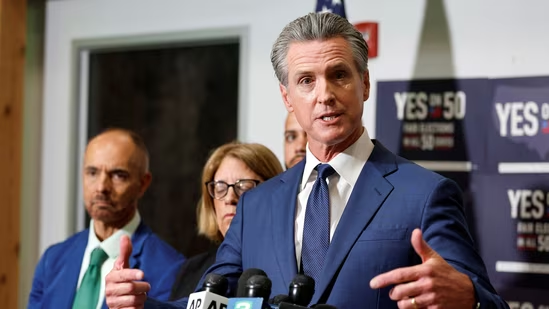

California voters will decide in November whether to approve a new congressional map aimed at helping Democrats gain five additional U.S. House seats, following a similar move by Texas Republicans, who redrew their own map at President Donald Trump’s urging to strengthen their House majority.
California lawmakers largely voted along party lines Thursday to approve legislation calling for the special election. Democratic Gov. Gavin Newsom, a leading advocate for the map, quickly signed it, marking the latest chapter in a high-stakes redistricting clash.
“This is not something six weeks ago that I ever imagined that I’d be doing,” Newsom said at a press conference, promising a campaign that would reach out to Democrats, Republicans, and independent voters. “This is a reaction to an assault on our democracy in Texas.”
Republicans, who have filed a lawsuit and called for a federal investigation into the plan, pledged to challenge the measure at the ballot box as well.
California Assemblyman James Gallagher, the Republican minority leader, criticized Trump for advocating new Republican seats in other states, framing it as a response to Democratic gerrymandering. Gallagher also warned that Newsom’s “fight fire with fire” approach could backfire.
“You move forward fighting fire with fire and what happens?” Gallagher said. “You burn it all down.”
Meanwhile, in Texas, the Republican-controlled state Senate was set to vote on its map Thursday night. Once Republican Gov. Greg Abbott signs it, the map will become official—part of Trump’s strategy to prevent the GOP from losing its House majority in the 2026 midterm elections.
A national fight over House control
Nationally, the partisan balance of existing districts leaves Democrats just three seats shy of a House majority. Historically, the president’s party tends to lose seats in the midterms.
Trump has also encouraged Republican-controlled states like Indiana and Missouri to revise their maps in favor of GOP candidates. Ohio Republicans were already planning similar adjustments.
Redistricting usually happens once a decade after the census, but states face no federal barrier to mid-decade map changes. The U.S. Supreme Court has ruled that partisan gerrymandering is constitutional, so long as race is not used to redraw district lines. Texas Republicans cited this precedent when the state House approved its revisions Wednesday.
“The underlying goal of this plan is straightforward: improve Republican political performance,” said state Rep. Todd Hunter, who authored the Texas map revision bill.
California Democrats pointed to Hunter’s remarks as justification for their own aggressive response. “What do we do, just sit back and do nothing? Or do we fight back?” Democratic state Sen. Lena Gonzalez said. “This is how we fight back and protect our democracy.”
The push for a nonpartisan approach
California Democrats initially supported the state’s nonpartisan redistricting commission, established by the 2008 ballot measure and expanded in 2010 to handle congressional maps. They have long advocated for a national commission to oversee redistricting in all states, though legislation to create such a system has stalled.
Newsom emphasized that California’s approach sets an example. “We’ll be the first state in U.S. history, in the most democratic way, to submit to the people of our state the ability to determine their own maps,” he said before signing the legislation.
Former President Barack Obama, who has supported a nationwide nonpartisan model, also endorsed Newsom’s effort, calling it a necessary counter to the GOP’s moves in Texas. “I think that approach is a smart, measured approach,” Obama said during a recent Democratic fundraiser, noting that California voters will ultimately decide the map.
A temporary map with long-term impact
The proposed California map would last through 2030, after which the state’s commission would draw the next decade’s districts. Democrats are also considering reopening mid-decade map redraws in states like Maryland and New York.
While many Democratic-led states have commission systems or redistricting restrictions, Republican-led states often have fewer constraints, giving GOP lawmakers greater flexibility to redraw maps quickly. In New York, for instance, new maps cannot be drawn until 2028, and voter approval is required.
In Texas, Democrats employed unusual tactics to delay the vote, resulting in a 15-day postponement and round-the-clock police monitoring for returning lawmakers.
California Republicans, while less dramatic, criticized Democrats for pushing the redistricting package through the Statehouse. GOP State Sen. Tony Strickland said the effort undermined California’s “gold-standard” nonpartisan system.
“What you’re striving for is predetermined elections,” Strickland said. “You’re taking the voice away from Californians.”