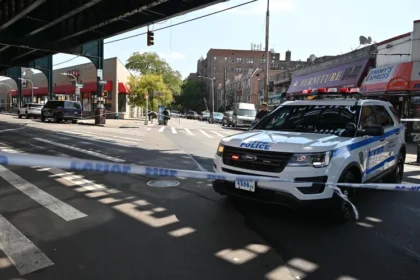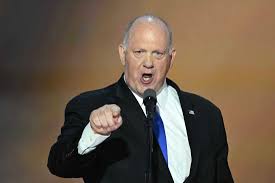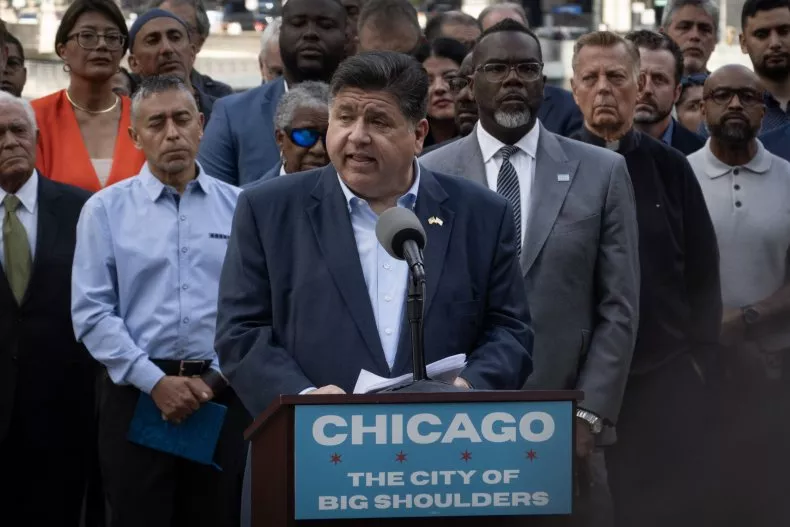

President Donald Trump stepped up his confrontation with Illinois officials on Saturday, posting on Truth Social a warning that federal authorities were “coming” while criticizing Governor JB Pritzker over Chicago’s recent weekend violence.
At the same time, Chicago Mayor Brandon Johnson signed an executive order directing city agencies not to cooperate with federal immigration enforcement, creating a potential clash between local and federal authorities.
Why It Matters
This warning is part of Trump’s ongoing attacks on Chicago’s leadership, even though city crime statistics have improved.
Earlier this week, Trump wrote on Truth Social: “A really DEADLY weekend in Chicago. 6 DEAD, 27 HURT IN CRIME SPREES ALL OVER THE CITY. Panic stricken Governor Pritzker says that crime is under control, when in fact it is just the opposite. He is an incompetent Governor who should call me for HELP. Mayor Johnson is no better. Make Chicago Great Again!”
However, on Monday, Johnson’s office released updated year-to-date crime numbers showing homicides down 32.3 percent and overall violent crime down 21.6 percent.
What To Know
“Six people were killed, and 24 people shot, in Chicago last weekend, and JB Pritzker, the weak and pathetic Governor of Illinois, just said that he doesn’t need help in preventing CRIME. He is CRAZY!!! He better straighten it out, FAST, or we’re coming!” Trump wrote on Truth Social Saturday.
Johnson’s executive order stops Chicago police from taking part in joint operations with federal immigration agents. It also requires federal officers in the city to wear body cameras and clear identification. The Department of Homeland Security (DHS) has asked for support from Naval Station Great Lakes, north of Chicago, though no official deployment decisions have been made.
Trump recently signed an executive order to create “specialized units” in the National Guard to fight urban crime, but the details are still unclear. Johnson’s order specifically tells Trump to “stand down,” warning residents they could see “militarized immigration enforcement” and “National Guard troops” on city streets.
Pritzker condemned the federal plans, saying the administration is trying to “militarize our cities and end elections.” Johnson’s order is part of a larger resistance by Democratic leaders who believe federal intervention undermines local governance and civil liberties.
What People Are Saying
Illinois Governor JB Pritzker said at a press conference this week: “If this was really about fighting crime and making the streets safe, what possible justification could the White House have for planning such an exceptional action without any conversations or consultations with the governor, the mayor, or the police?”
He posted on X: “Donald Trump is exactly the kind of person that our founders warned us about. He cozies up to dictators like Putin because he idolizes them. His actions are dangerous and un-American.”
He added: “Unlike Donald Trump, we keep our promises. We will not stand idly by if he decides to send the National Guard to intimidate Chicagoans. Action will be met with a response.”
In a statement to Newsweek, White House spokeswoman Abigail Jackson said: “If these Democrats focused on fixing crime in their own cities instead of doing publicity stunts to criticize the President, their communities would be much safer. Cracking down on crime should not be a partisan issue, but Democrats suffering from TDS [Trump Derangement Syndrome] are trying to make it one. They should listen to fellow Democrat Mayor Muriel Bowser who recently celebrated the Trump Administration’s success in driving down violent crime in Washington DC.”
Vice President JD Vance said on Thursday in LaCrosse, Wisconsin: “We’re not too far from Chicago. Chicago has had a lot of crime problems. Why is it that you have mayors and governors who are angrier about Donald Trump offering to help them than they are about the fact that their own residents are being carjacked and murdered in the streets? It doesn’t make an ounce of sense.”
Chicago Mayor Brandon Johnson told CNN before signing the executive order: “We may see militarized immigration enforcement. We may also see National Guard troops. We may even see active duty military and armed vehicles in our streets. We have not called for this. Our people have not asked for this, but nevertheless, we find ourselves having to respond to this.”