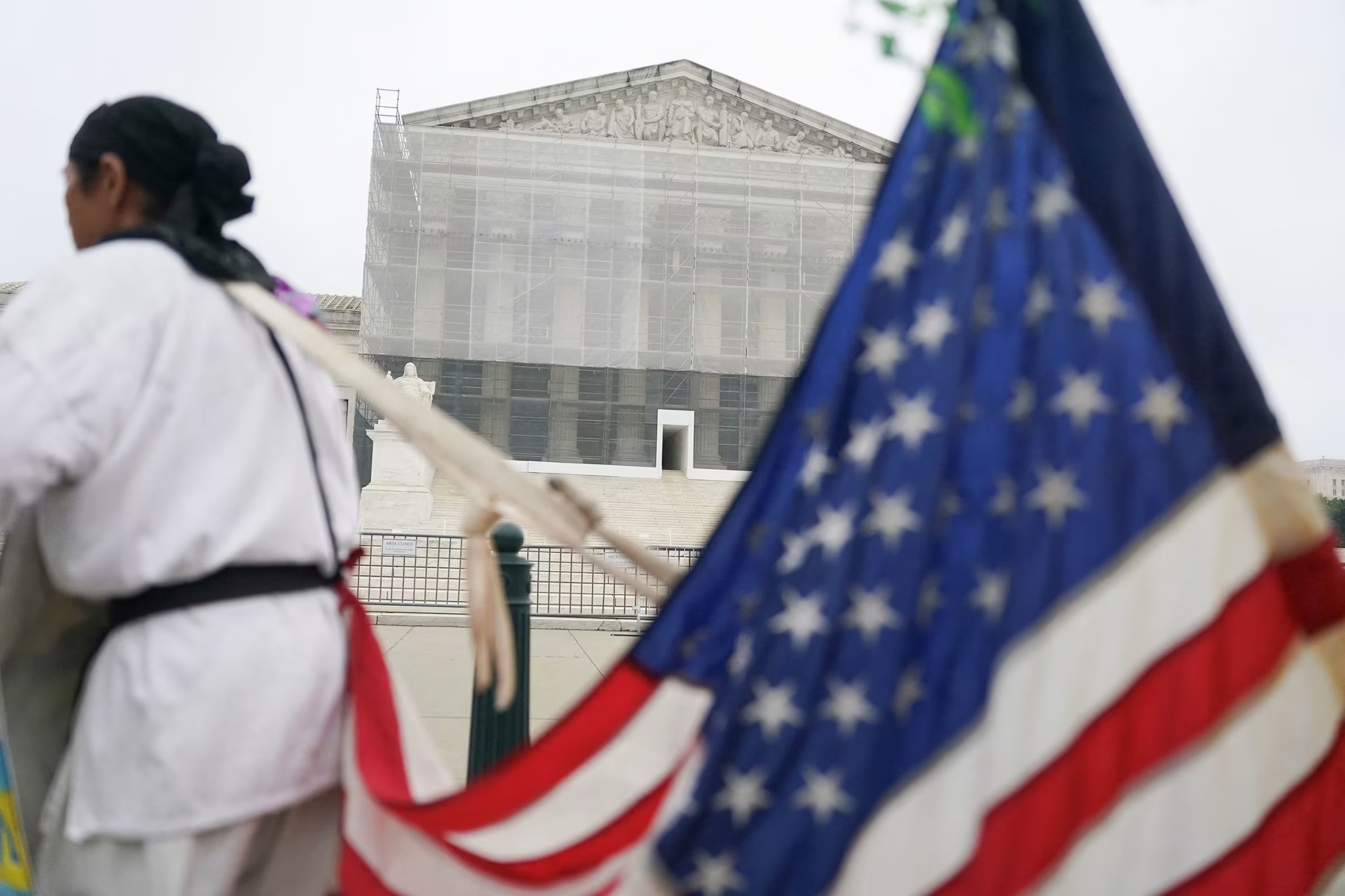

The Trump administration asked the Supreme Court on Friday to review the constitutionality of President Donald Trump’s executive order seeking to end birthright citizenship, marking the second time this year the issue has reached the high court.
Despite over a century of understanding that the 14th Amendment grants citizenship to anyone born in the United States, the administration argued in its appeal that this interpretation is “mistaken” and has produced “destructive consequences.”
“The lower court’s decisions invalidated a policy of prime importance to the president and his administration in a manner that undermines our border security,” wrote Solicitor General D. John Sauer, the administration’s top appellate attorney. “Those decisions confer, without lawful justification, the privilege of American citizenship on hundreds of thousands of unqualified people.”
CNN reviewed a copy of the appeal, which has not yet been docketed at the Supreme Court.
While the Supreme Court issued a significant ruling in June related to birthright citizenship, that case focused primarily on the procedural question of how much authority lower courts have to block a presidential policy. A 6-3 majority limited—but did not entirely eliminate—lower courts’ power to intervene.
That ruling prompted states and individuals challenging Trump’s order to file new cases seeking alternative ways to block the policy, including class-action lawsuits. The Supreme Court implicitly allowed these other challenges to proceed.
Recent rulings have continued to prevent Trump’s policy from taking effect, and the administration is now asking the justices to resolve the issue definitively.
The administration has expressed confidence that the high court will ultimately uphold Trump’s order. However, it remains uncertain whether at least four justices will vote to hear the cases, as required.
The appeals focus on two lower-court decisions that have halted Trump’s policy since the Supreme Court’s procedural ruling this summer. In July, a San Francisco-based federal appeals court upheld a Seattle judge’s nationwide block on the policy in a case brought by several Democratic-led states.
A separate New Hampshire ruling issued earlier that month barred enforcement of Trump’s order against babies affected in a class-action lawsuit filed by the American Civil Liberties Union. The administration filed appeals in both cases on Friday.
“The government has a compelling interest in ensuring that American citizenship—the privilege that allows us to choose our political leaders—is granted only to those who are lawfully entitled to it,” the administration wrote in the appeals.
In recent weeks, the administration also appealed the New Hampshire ruling to a Boston-based federal appeals court, which has not yet reviewed the case.
“This executive order is illegal, full stop, and no amount of maneuvering from the administration is going to change that,” said Cody Wofsy, an ACLU attorney who argued the New Hampshire case. “We will continue to ensure that no baby’s citizenship is ever stripped away by this cruel and senseless order.”
Signed by Trump on January 20, the executive order, titled “PROTECTING THE MEANING AND VALUE OF AMERICAN CITIZENSHIP,” directs the federal government not to “issue documents recognizing United States citizenship” to children born on U.S. soil to parents who are unlawfully present or temporarily in the country.
Three decades after the 14th Amendment was ratified in 1868, the Supreme Court ruled in US v. Wong Kim Ark that people born in the United States—including the son of Chinese immigrants in that case—are entitled to citizenship, with limited exceptions. The administration argued in its appeal that this precedent has been misinterpreted over time.
The Wong Kim Ark decision granted citizenship to those born in the United States who had “permanent domicil and residence,” according to Solicitor General Sauer. “That limit,” Sauer wrote, “was central to the analysis.”
So far, these arguments have not gained traction in lower courts. The 9th Circuit, in a 2-1 ruling in July, found that Trump’s order conflicts with the citizenship clause of the Constitution, the Wong Kim Ark precedent, and decades of executive branch practice.
“The district court correctly concluded that the Executive Order’s proposed interpretation, denying citizenship to many persons born in the United States, is unconstitutional. We fully agree,” wrote appeals court Judge Ronald Gould for the majority.