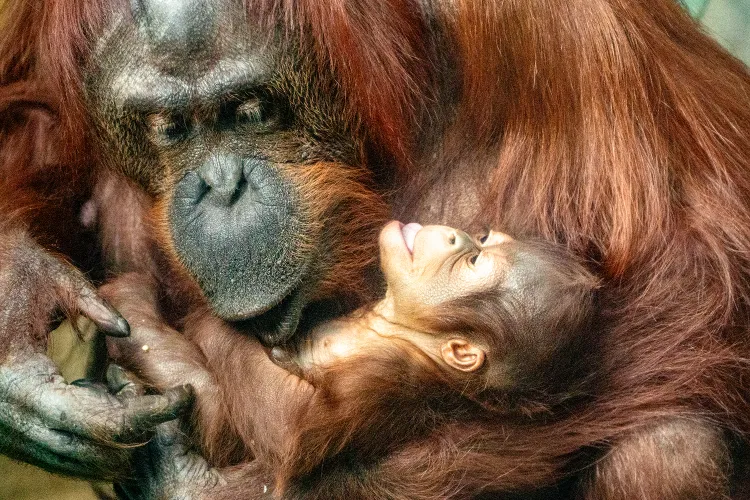

The Los Angeles Zoo has welcomed a new arrival — a baby Bornean orangutan, the first born at the zoo in almost 15 years.
On Thursday, Nov. 6, the zoo announced that 43-year-old Kalim, one of its Bornean orangutans, gave birth to a healthy baby boy on Oct. 10. The mother and her newborn spent their first month behind the scenes before making their debut at the Red Ape Rain Forest habitat.
“This marks the first orangutan birth here since Elka was born nearly 15 years ago,” said Candace Sclimenti, the zoo’s curator of mammals, in a press release. “Watching the orangutan group interact with the infant will be truly special, and we’re excited for our guests to experience the joy of seeing our growing orangutan family.”
Although this is Kalim’s first offspring with 31-year-old Isim, she has previously raised two other infants. Zoo officials have not yet chosen a name for the baby, but a spokesperson told the Los Angeles Times that a naming contest may be held.
:max_bytes(150000):strip_icc():focal(749x0:751x2):format(webp)/la-zoo-baby-orangutan-3-110725-48c0571083024c67a8bfd5f70c70af9a.jpg)
According to the zoo, orangutans have the longest interbirth interval of any non-human primate, typically giving birth every seven to eight years. During that time, mothers teach their young essential survival skills — from finding food to avoiding predators.
“Kalim is an excellent mother with years of wisdom and lessons to share with her new little one,” said Megan Fox, senior animal keeper. “Elka has grown into a wonderful young orangutan because of the incredible job Kalim has done raising her over the last 14 years. Guests will now get to see interactions that haven’t been part of the Red Ape Rain Forest for a very long time. This is a fantastic moment for my team and the entire zoo to share.”
Bornean orangutans are one of three orangutan species and are known as the world’s largest arboreal mammals, spending about 90% of their lives in trees. Their name, translated from Malay, means “person of the forest.”
These great apes are easily recognized by their reddish fur and long, powerful limbs, which allow them to swing and climb through the treetops. Males are about twice the size of females and can have an arm span exceeding seven feet.
According to the International Union for Conservation of Nature (IUCN), Bornean orangutans are considered “critically endangered” due to deforestation, climate change, and habitat loss driven by human activity, including mining and palm oil production.
Visitors to the Los Angeles Zoo can now see Kalim and her newborn bonding together at the Red Ape Rain Forest exhibit — a heartwarming sign of hope for this endangered species.