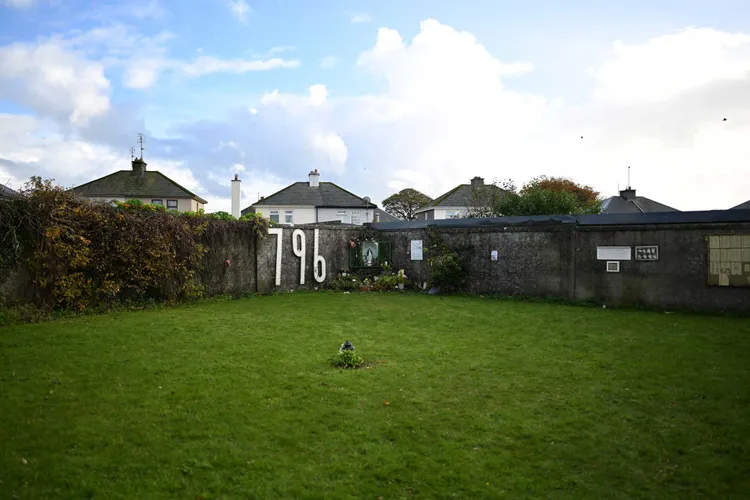

Nearly 800 children are believed to have died at a church-run home for unmarried mothers in Tuam, Ireland — and officials have confirmed that forensic teams are continuing to recover remains from what was once part of a sewage system.
The Office of the Director of Authorised Intervention, Tuam (ODAIT) announced this week that seven sets of infant remains were recently found in an underground vaulted structure on the grounds of the former Mother and Baby Home. Experts are conducting tests to determine how old the remains are and when the children died, with results expected in the coming months, according to the agency.
The Tuam property has served several institutional purposes over time. From 1841 to 1918, it operated as a workhouse where impoverished people lived and labored for food and shelter. It later became a military barracks between 1918 and 1925, and subsequently, from 1925 to 1961, it functioned as the Bon Secours Mother and Baby Home.
:max_bytes(150000):strip_icc():focal(999x0:1001x2):format(webp)/Bon-Secours-Mother-and-Baby-home-110725-3-2c1cc50644ad432daae14d2d54081b51.jpg)
Mother-and-baby homes in Ireland were institutions, often run by Catholic religious orders, that housed unmarried pregnant women who were sent there to give birth. Many infants who died in these homes were never formally recorded or buried in individual graves, according to the Associated Press.
The ODAIT confirmed that excavation work at the Tuam site is ongoing in multiple phases. Alongside the seven sets of infant remains, recovery teams have documented several personal items, including a Bovril jar and a razor.
In another section of the property, seven additional sets of skeletal remains — believed to date back to the workhouse era — have also been recovered. Those remains are being handled in cooperation with the National Museum of Ireland.
:max_bytes(150000):strip_icc():focal(999x0:1001x2):format(webp)/Bon-Secours-Mother-and-Baby-home-110725-1-5f0cc8549e7145d3b830d3ee3f89cada.jpg)
Earlier state-led test excavations revealed what officials described as “significant quantities” of juvenile remains within structures that were once part of the home’s sewage system. Authorities have not yet disclosed a final estimate of how many children might ultimately be recovered.
Local historian Catherine Corless was the first to uncover the extent of the tragedy. Through years of meticulous research into death certificates and church archives, she identified 796 children who died at the Tuam home between 1925 and 1961 — none of whom were listed in burial records. Her findings suggested that many of the children had been buried without markers or memorials, drawing national and international attention to the case.
:max_bytes(150000):strip_icc():focal(749x0:751x2):format(webp)/catherine-corless-tuam-061725-1-0f4f989394ac4cc6a412fcbe9220a1de.jpg)
Corless said that for years her work was dismissed and even criticized by locals who accused her of tarnishing the town’s reputation. But she continued her efforts to expose the truth.
“It’s been a fierce battle. When I started this, nobody wanted to listen. At last we are righting the wrongs,” said Corless, now 71, in an interview with AFP. “I was just begging: Take the babies out of this sewage system and give them the decent Christian burial that they were denied.”